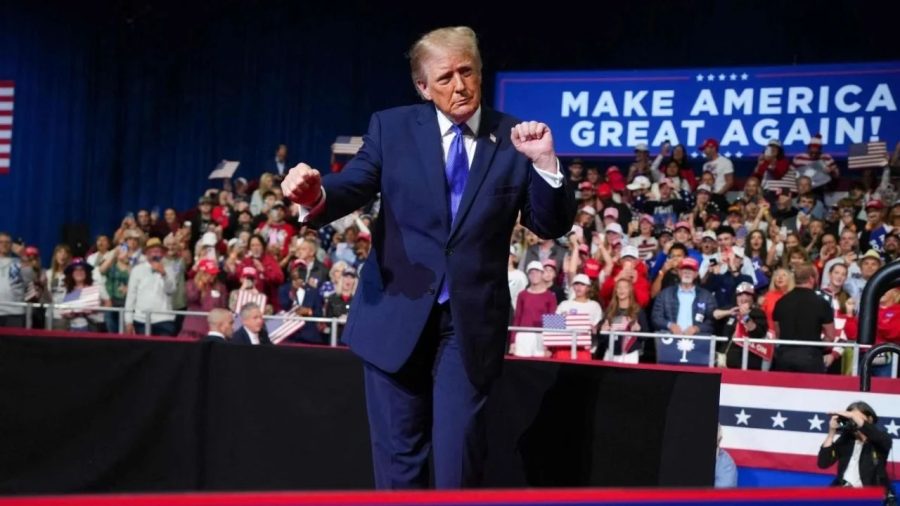



The Democrats’ massive win at midterm elections has upset the power balance in Washington and questions the leadership of the United States on the international stage. By taking control of both chambers of Congress, they have dealt President Donald Trump’s Republican Party a major setback, only two years after his return to the White House. The Democratic Senate caucus has 54 members, two of them independent, to the Republican caucus’s 44, with two races still to be called. A House majority has been won by Democrats as well, who have taken at least 30 seats. That’s a result of voter frustration over energy insecurity, tariffs, immigration and the growth of the technology sector, as well as living costs and the Iran war.
Trump will not lose his executive authority in the election. The new Congress begins January 3, 2027, and the President will continue to have veto power and a significant role in foreign and military policy. Congress can affect budgets, defence spending, legislation, and oversight, but without a two-thirds majority in Congress, Democrats don’t have the power to override a presidential veto. The next two years are thus unlikely to see an immediate turnaround in administration policy, but rather a more critical examination, investigations, and legislative clashes.
Perhaps the Middle East will be affected the most internationally. The conflict with Iran that started with the US and Israeli strikes on Feb. 28 has already disrupted regional security and energy supplies. Market uncertainties have been compounded by tensions over the Strait of Hormuz, through which crude oil and liquefied natural gas (LNG) pass. The rising price of gas has also led to a lack of satisfaction among U.S. voters. Now that the Republican Party has been defeated, Trump might be under more pressure to limit the costs of the war and find a diplomatic solution.
The result could give Trump an incentive to head to the negotiating table with Tehran, a Reuters news report said Nov. 4. A weak President was seen as more inclined to contemplate a negotiated exit than a big military escalation, said Gulf sources cited by the news agency. But there’s no sign of an accord yet. Iran could also see political turmoil in Washington as a chance to consolidate its position, leading to a longer confrontation. The Democratic win could open up space for diplomacy, but not peace.

The outcome is also significant for Israel. Benjamin Netanyahu’s bloc secured 53 seats in the 120-member Knesset, just below a majority, in the last elections on October 27, while the opposition and Arab-led parties combined for 67. No firm conclusions can be drawn about coalition talks. The Gaza war and the Iran conflict have exacerbated Democratic divisions on Israel support within the U.S. The new Congress could take a closer look at arms sales, military aid and human rights. But a basic turnaround in US-Israel relations is not likely.
Energy markets have reacted to hopes of a diplomatic thaw. Brent crude dipped 8.7 percent to $94.62 a barrel on Nov. 4, as investors evaluated the potential for a return to U.S.-Iran talks. The drop is not necessarily an indication that the war is coming to a close, but rather a reflection of expectations. Lower prices could help alleviate foreign exchange pressures and lower prices for fuels, electricity, and transport and industrial costs for Bangladesh, an important energy importer. Lower-cost LNG will also help. However, continued volatility could put Bangladesh under import-cost pressure and balance-of-payments risk again.




Ukraine could get a political window of opportunity. Trump’s strategy has limited direct American military and financial aid, and many Democrats are proponents of ongoing support for Kyiv in its battle against Russia. Democrats will be able to introduce relief bills and demand that they be passed. But military aid is by no means guaranteed to rise rapidly and requires Republican backing to override a presidential veto. Don’t expect Ukraine to be able to obtain Patriot air-defence interceptors to defend its cities and energy infrastructure quickly. The election provides Kyiv leverage in Washington – not guarantees of a different result on the battlefield.
Trump’s trade agenda will be under more scrutiny in the Hill. His tariffs and push for renegotiating trade deals could face more resistance from Democrats. However, the President still has the legal power to put on some tariffs, and the shift in congressional control does not mean that the policy will automatically come to a halt. China could be in a stronger position to bargain as Trump is under domestic pressure. However, Democratic fears of Chinese technological advances – and the semiconductor industry and supply chains – are still significant. Even if competition between the United States and China shifts in its nature and style, it will likely persist.
Another industry to monitor is the technology industry, especially artificial intelligence (AI). Data centres have been the subject of public concern due to their electricity and water consumption, environmental impact, and utility costs. Reuters reported on November 4 that candidates advocating for restrictions on data-centre growth were securing important victories, an analysis that tied the opposition to data-centre expansion to Democratic victories. The new Congress could be more stringent in monitoring technology companies and holding AI infrastructure to account. Some Asian stocks related to chips and AI were rattled by the election as investors ponder the possibility of stricter oversight curbing data-center construction in the United States and thereby limiting hardware demand.
The ramifications for Bangladesh go beyond trade and diplomacy. The United States is a leading export destination, a significant partner in investment, trade policy, labour rights and Rohingya. An in-depth check on Trump’s tariffs might provide relief to the Bangladeshi exporters, especially the ready-made garment sector. Meanwhile, the Democratic focus on human rights, labour standards and democratic accountability could again pressure Dhaka. Congress will also play a role in continuing to provide support to Rohingya refugees and in exerting pressure on Myanmar.

The Democratic win is not so much a change of policy in the world as a change of power. Starting in 2027, Trump could be subject to more rigorous congressional oversight, budget constraints, and opposition. However, his executive powers will still be important, and there will not be any drastic change in foreign policy. The broader point is that US domestic politics and international affairs are becoming more tightly connected: war drives up household costs, trade policy drives changes in jobs and prices, and technological change has become an election topic. Whether the Blue Wave can transform national politics as it did for President Barack Obama and how Trump will react to the voters’ mandate will determine how much the wave will affect global politics.
The views expressed in this article are solely those of the author
The writer is an Associate Professor in the Department of Public Administration at the University of Rajshahi, Bangladesh. Email: [email protected]