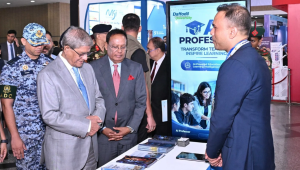



An initiative has been taken to launch third language education centres across 50 universities in the country to enhance students’ communication skills, Professor Mamun Ahmed, chairman of Bangladesh University Grants Commission (UGC), has announced.
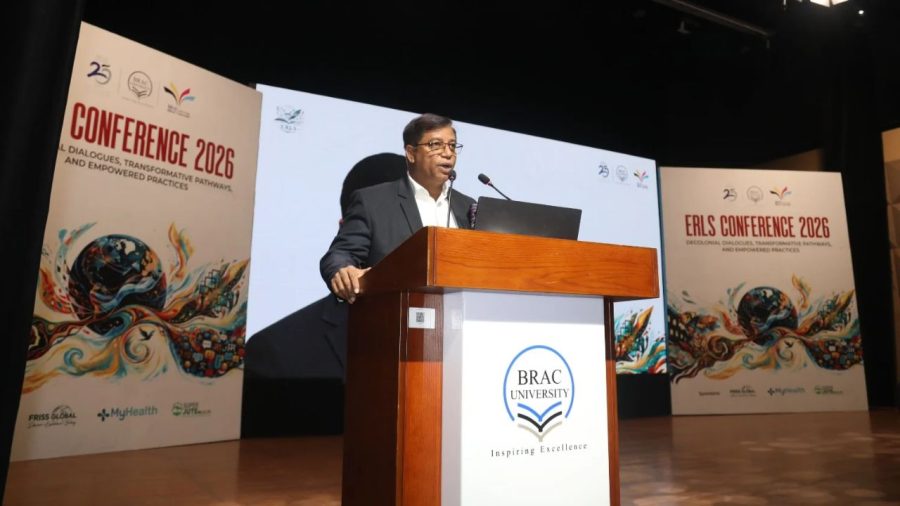
Speaking as chief guest at the inauguration of a two-day international conference on Friday, he said UGC took this initiative in alignment with the government’s priority to expand foreign language learning opportunities to make students more skilled in international education, employment, research, and communication.
The second international conference, titled “Epistemic Reconfigurations in Language Studies (ERLS) 2026,” was organised by the BRAC Institute of Languages (BIL) at BRAC University auditorium under the theme “Decolonial Dialogues, Transformative Pathways and Empowered Practices.”
Professor Mamun said acquiring proficiency in foreign languages in today’s world is not merely an additional academic qualification, but a vital medium for higher education, employment, cultural exchange, research cooperation, and developing international relations.
He added that foreign language education must be treated as a crucial part of the national skill development strategy to build a skilled, confident, and globally competitive young generation.
The UGC chairman observed that the relationship between the mother tongue and the history and national identity of Bangladesh is inseparable.

He stressed that while upholding Bangla, the mother tongue, as the foundation of national identity and culture, opportunities for students to learn foreign languages must be expanded.
He added that there is no need to choose between the mother tongue and a foreign language, but rather to create opportunities to attain linguistic skills for international communication while maintaining respect for the mother tongue and cultural self-identity.
Professor Mamun further mentioned that the government is giving special importance to expanding foreign language education, with initiatives underway to increase learning opportunities in languages including Chinese, Japanese, Korean, Arabic, German, French, Italian, and Spanish.




He described the establishment of third language education centres in 50 universities as a significant step to broaden opportunities for higher education, global communication, and jobs.
He added that training in Japanese, Korean, Chinese, English, and Arabic is also being provided through various institutions considering demand in overseas job markets.
The UGC chairman pointed out that language education is not confined to gaining communication skills alone, but influences human thought, pursuit of knowledge, culture, and identity.
He explained that a university’s responsibility is not merely to impart information and knowledge, but to foster independent thinking, analytical skills, research capability, and real-world problem-solving capacity.
Language learning creates opportunities for students to become acquainted with new knowledge, culture, and diverse perspectives.
Addressing the role of the BRAC Institute of Languages, Professor Mamun Ahmed said BIL could develop as a centre of excellence in Bangladesh for multilingual education, teacher training, curriculum innovation, language research, and international cooperation.
He highlighted that the institute can play a vital role in crafting effective models for third language education, developing skilled language teachers, and building partnerships with universities, embassies, and international bodies.
He also emphasised that foreign language education must align with the country’s cultural identity and educational priorities.

Professor Mamun expressed his vision for an education system where Bangla serves as the strong foundation of national identity, English functions as the medium for acquiring global knowledge, and other foreign languages open up new avenues for higher education, employment, research, and international engagement.
He expressed optimism that effective guidelines would emerge from the conference to make language education more inclusive, transformative, and empowering.
Syeda Sarwat Abed, founder and advisor of BRAC Institute of Languages, spoke at the inaugural ceremony, while Lulzim Pllana, ambassador of the Republic of Kosovo to Bangladesh, addressed the gathering as guest of honour.
The event was presided over by Professor Arshad Mahmud Chowdhury, pro-vice-chancellor of BRAC University. Professor Shaila Sultana, director of BRAC Institute of Languages and convener of the conference, delivered the closing speech.
The conference focused on several key issues, including colonial impacts on language education, reconsidering knowledge production and linguistic practices, multilingualism, teacher autonomy, innovation in research methodologies, and the exchange of knowledge and experience among countries of the Global South.
It placed special emphasis on developing inclusive, equitable, and locally grounded teaching methods beyond conventional dominant concepts in language education.