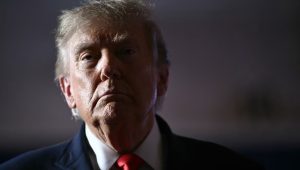
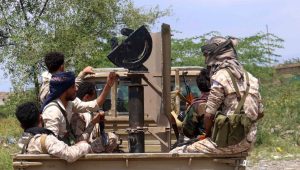
US President Donald Trump arrived in the Philippines on Tuesday to open a three-day Asia trip, seeking trade deals and relief from setbacks at home as protesters took to the streets of the capital, reports AP.
It is his first trip abroad since his Republican party lost both chambers of Congress in the midterm elections, a defeat widely blamed on the US war with Iran. He has also contended with a nationwide air-traffic ground stop and the resignation of Nvidia chief Jensen Huang, who admitted an affair with an alleged Chinese government agent. Beijing says it was not involved.
Between 1,500 and 2,000 demonstrators faced riot police in central Manila, waving red flags and banners reading “Trump out now” and “Reject Pax Silica”. Protest leader Teddy Casiño urged President Ferdinand Marcos Jr’s government to stop being a “puppet of Donald Trump”, and demonstrators planned to burn an effigy of the US leader.

Pax Silica is a US initiative to build a mine-to-chip supply chain and counter China’s dominance in semiconductors and rare earths. It has divided opinion in the Philippines, and months of protests have focused on its flagship 1,620-hectare AI manufacturing hub north of Manila, which threatens to displace Indigenous families. US Ambassador Lee Lipton said last week that a long-rumoured deal signing for the site would not take place during the visit.
Trump’s streamlined agenda starts with a meeting of the Quad, a grouping broadly aimed at counterbalancing China, with India’s Narendra Modi, Japan’s Sanae Takaichi and Australia’s Anthony Albanese, the first such gathering since he returned to power. Japan’s foreign ministry said the East and South China Sea would be discussed, but Ryan Hass of the Brookings Institution told AFP the short slot meant it was unlikely to go beyond pleasantries. Its timing mattered, he said, as it was “a way of inoculating Trump against criticism of caving to authoritarians when he meets with Xi (Jinping) and (Vladimir) Putin in Shenzhen”.



He is then due to sign a trade deal with Thailand, take part in a “special summit” with the 11-member Association of Southeast Asian Nations (ASEAN) and attend a gala dinner as guest of honour. Under a framework announced in October, Bangkok would drop tariffs on most US goods and spend more than $18 billion on American aircraft, farm goods and liquefied natural gas.
Trump’s tariffs have loomed over three days of ASEAN talks. Chinese Premier Li Qiang denounced a “countercurrent of unilateralism and protectionism” on Monday, while Brazil’s Luiz Inacio Lula da Silva and Canada’s Mark Carney spoke of weaning themselves off dependence on the US market. A new US rule requiring special licences for advanced chip shipments to Singapore, Malaysia, Thailand and Indonesia, which Washington says carry a “higher-than-normal risk of diversion”, could rankle too. Singapore said it was exploring “trusted access” for its firms.
On Wednesday, Marcos will give Trump a red-carpet welcome at the presidential palace, where the two are expected to affirm their treaty alliance. Trump is also expected to announce deals in aviation, defence, energy and technology, and officials are arranging a possible reunion with Marcos’s mother, Imelda, 97, if her doctors agree.

Trump then heads to Shenzhen for the Asia-Pacific Economic Cooperation summit, where he is due to hold the first three-way nuclear talks with Xi and Putin. Beijing says they will be of “groundbreaking significance”, and the Kremlin’s Yuri Ushakov said a one-on-one Trump-Putin meeting was being arranged. Trump said North Korea’s Kim Jong Un “may come” but “that’s up to President Xi”.
Taiwan is expected to be overshadowed when Trump and Xi meet there for a third time, with a $14 billion US arms package stalled and Beijing intensifying pressure, including coast guard patrols off the island’s east coast since June.