




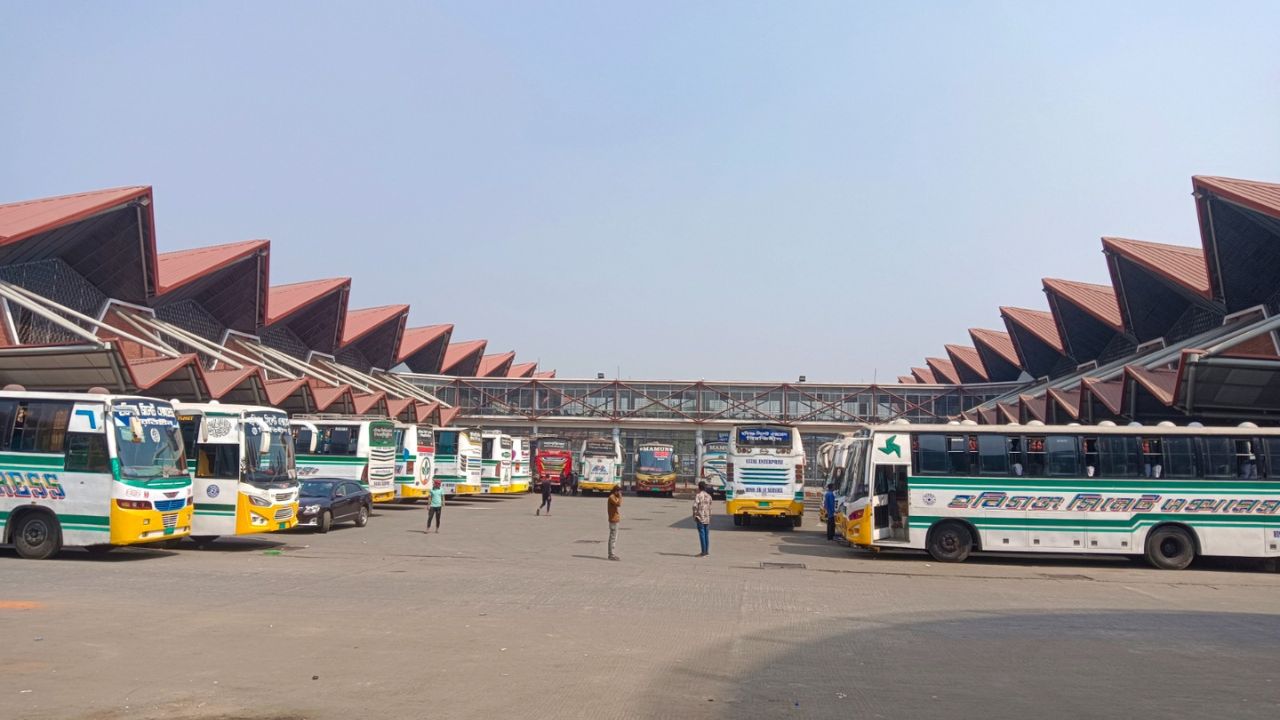
A Tk117 crore central bus terminal built to showcase Sylhet’s architectural heritage now stands largely deserted, with rusting chairs, broken fittings and vast empty halls giving it the feel of an abandoned complex.
Modelled on Assam-pattern architecture and inspired by landmarks such as Keane Bridge and Ali Amjad’s Clock, the Sylhet Central Bus Terminal was once promoted as one of the country’s most modern transport hubs.
The sprawling complex includes separate arrival and departure terminals, a five-storey circular administrative tower, a modern control room, police and tourism information centres, restaurants, a food court, VIP lounge, breastfeeding and smoking zones, separate toilets for men, women and persons with disabilities, and prayer facilities.
A 970-seat passenger hall, 30 ticket counters and a 300-foot-long departure bay with capacity for 48 buses at a time were designed to ease congestion and modernise city transport.
Yet despite the facilities, much of the building remains unused.
On the ground floor of the two-storey main structure, only a handful of drivers and passengers are seen, while the upper floor is largely empty.
Chairs are rusting, lights and fans are falling apart and expensive glass walls are plastered with transport workers’ election leaflets and banners.
The five-storey administrative tower appears almost untouched since construction, except for a VIP lounge on the second floor now used informally by transport workers as a meeting room.
The most frequently used facilities in the complex are reportedly three public toilets.
The project began in February 2019 under the Municipal Governance and Services Project, implemented by Sylhet City Corporation.
Built on nearly eight acres of land, the total cost was set at Tk117 crore, including Tk56 crore allocated for a dumping ground and Tk61 crore for infrastructure development.
The terminal was launched on a trial basis on 15 February 2023 and formally inaugurated on 15 November that year by former mayor Ariful Haque Chowdhury.
Soon after, allegations of construction flaws surfaced, prompting criticism and the formation of an investigation committee.
Since then, there has been little visible oversight or formal follow-up, and the terminal has not seen full operational expansion.
Management responsibility later shifted to leaseholders.
City Corporation sources said the terminal was leased in August 2024 for Tk56 lakh for one year, with limited maintenance obligations placed on the lessee, while major repairs remained the corporation’s responsibility.
Revenue department officials said that from 1 July last year, toll collection from vehicles and counters was leased for Tk1 crore and 43 lakh for one year to Md Mizanul Islam, who is currently overseeing operations.
He could not be reached for comment.
Sylhet Bus Minibus Workers Union President Moynul Islam said there had been no effective supervision by the City Corporation since the terminal’s launch and that leaseholders were not fulfilling their responsibilities.
“As a result, many facilities are being damaged,” he said.
Meanwhile, due to mismanagement at the new terminal, large buses continue to park along city roads as before, occupying half the carriageway and contributing to traffic congestion.
Sylhet City Corporation Acting Chief Engineer Md Ali Akbar acknowledged the lack of maintenance.
“It is true that maintenance is not happening properly. For the past two years we have been running under an interim administrative arrangement. Once elected representatives return, we will sit and decide the responsibilities of the lessee and the corporation. The terminal’s aesthetic value will be restored,” he said.


