


Md. Nurul Haque
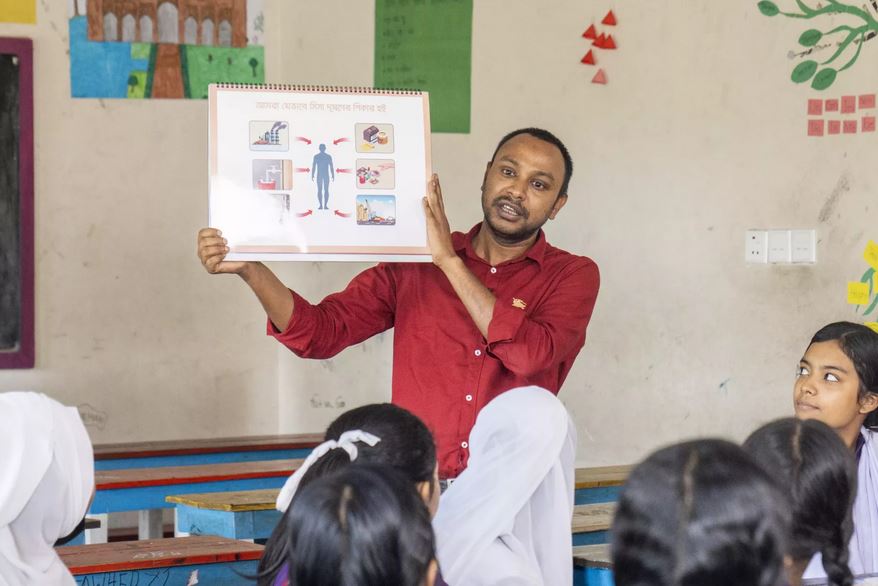
A piece of chalk may seem like mere dust, but in truth, it inscribes the destiny of a nation. On this Teachers’ Day, while bouquets, slogans, and ceremonial applause will abound, one must dare to ask: do we genuinely honor the very hands that shape our children into citizens? Or have we, as a society, confined the teacher to token garlands while stripping away the dignity of their profession? The classrooms of today are the factories of tomorrow’s history. To neglect teachers, therefore, is not a mistake; it is a slow, deliberate suicide of a nation.
Teachers’ Day is observed in various forms across the world. UNESCO declared October 5 as World Teachers’ Day in 1994 to commemorate the 1966 ILO/UNESCO Recommendation on the Status of Teachers. Bangladesh has confined Teachers’ Day to mere symbolism, more festivity than reform, more applause than action. We clap for our teachers on stage, but we fail to raise their salaries from the ground.
Teaching is not a profession; it is a promise. A true teacher does not merely deposit information into minds like coins into a slot machine; they spark transformation. They turn alphabets into ethics, equations into equality, and poems into possibilities. To teach is not to “cover the syllabus” but to uncover the soul of a student. A teacher, in essence, is the midwife of civilization, helping each new generation to be born wiser than the last.

And yet, in Bangladesh, the reality is brutally different. Many schoolteachers earn less than a mid-level clerk in a government office. University lecturers entrusted with research, innovation, and nation-building, are often forced into private tutoring or loans just to sustain their families. The word guru, once uttered with reverence, has been replaced by a perfunctory “sir,” delivered with half-respect and half-pragmatism. The classroom, once a stage of intellectual grandeur, has been reduced to a fallback job.
Why? Because in the ledger of state priorities, teachers’ salaries are written in pencil, while politicians’ allowances are carved in stone. Salary discrimination, delayed promotions, lack of healthcare, and the absence of retirement security have turned teaching into a profession of last resort.
It is no surprise, then, that the brightest minds no longer choose teaching. Instead, they flock to banking, bureaucracy, IT, corporate management, or foreign shores. The irony is tragic: those who should be nurturing the next generation are themselves nurturing survival strategies abroad. When an entry-level banker earns more than a university lecturer with a PhD, the state is sending a dangerous message: that money matters more than mentorship, and that markets prize balance sheets more than blackboards.




Contrast this with the world’s educational leaders. In Finland, teachers are drawn from the top 10% of graduates and rewarded with both prestige and pay. In South Korea, a teacher’s salary and status rival that of corporate executives. In Singapore, teaching is as competitive as law or medicine, with salaries and incentives designed to retain the very best. Even in neighboring India, government teachers earn more secure and respectable wages than many Bangladeshi professors.
According to the OECD (Organisation for Economic Co-operation and Development), teachers in developed countries earn, on average, 20–30% more than the national income benchmark. In Bangladesh, teachers earn 30–50% less. This gap is not only economic—it is ethical. A society that underpays its teachers is, in truth, overpaying its own ignorance.
The demands of the present era are unambiguous. Bangladesh is no longer a sleepy agrarian village; it is a digitalizing, industrializing society. The nation requires skilled teachers in science, technology, engineering, and the humanities to produce a workforce ready for global competition. But how will second-class citizens produce first-class graduates?
The government must respond, not with rhetoric but with reform. Restructuring salary should be taken into consideration where teachers’ salaries should be equal and aligned with civil service parity. Research grants should be provided which include research funds, sabbatical leave, and international collaborations in order to climb global rankings. Basic and standard healthcare and housing should be provided for the safety of teachers. Promotions should be given based on merit, teaching excellence, and research rather than political allegiance. Their standards should be reframed as nation-builders rather than mere wage-earners.
A nation’s wealth is not its skyscrapers but its classrooms. If teachers remain poor, students will inherit poverty of thought. If teachers are stripped of dignity, society will lose its direction. Bangladesh must decide: will it honor teachers as the architects of the nation, or continue to treat them as ceremonial tokens for a single day of applause?
Teachers’ Day must no longer be a ritual of flowers and forgotten gratitude. It must become a catalyst for reform. Instead of handing bouquets, the government should sow the seeds of lasting change—better salaries, secure facilities, restored dignity.
For when teachers thrive, nations rise. And a country that neglects its teachers may build roads and bridges, but it will never build a legacy of history.
The writer is an Assistant Professor of English at IUBAT