Speakers at an open discussion organised by the Amar Bangladesh Party (AB Party) have called for an all-party dialogue to forge national consensus on resolving the Rohingya crisis, alongside demanding a special session of the Jatiya Sangsad in light of the International Court of Justice (ICJ) ruling.
Addressing the discussion titled “International Court of Justice Verdict and Future of Rohingya Crisis” at Salam Hall of the National Press Club in Dhaka on Thursday, political leaders and experts warned that the Rohingya issue has transcended a purely humanitarian concern and is now fundamentally linked to Bangladesh’s state security, sovereignty, and national interests.
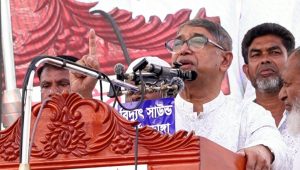
Presiding over the meeting, AB Party Chairperson Mojibur Rahman Manju highlighted that the ongoing crisis has severely imperilled public life, the environment, and security in Cox’s Bazar. He noted that the ICJ’s landmark ruling on 19 November regarding the Rohingya genocide established Myanmar’s liability, creating a firm moral basis for justice and repatriation that Bangladesh must strategically leverage.
Criticising government priorities, Manju accused the administration of focusing on showy, loan-dependent publicity campaigns rather than fulfilling basic human needs and managing critical national challenges.

He voiced deep concern over alleged joint conspiracies by India and the Awami League against Bangladesh, pointing out the lack of visible diplomatic action or strong protest from the government regarding a Kolkata minister’s statement threatening to occupy Bangladesh by 16 December.
Discussing camp conditions, Manju warned of a massive humanitarian catastrophe where prolonged displacement drives crime and drug trafficking, identifying Teknaf as a major drug pipeline affecting national security and calling for decisive measures from the Home Ministry.




Former Adviser to the Interim Government, Brigadier General (Retd) Sakhawat Hussain, termed the ICJ’s genocide ruling a moral victory for Bangladesh, but cautioned that hosting a large foreign population indefinitely poses severe diplomatic and security risks.
He urged Bangladesh to bolster its strategic standing, engage all key regional actors—including the Arakan Army—and abandon unrealistic expectations of Indian support. Hossain demanded an immediate government-led all-party dialogue alongside coordinated talks with international stakeholders, stressing that resolving the crisis is a national priority beyond party lines.


Former minister of State for Foreign Affairs Abul Hasan Chowdhury said that establishing the genocide in international court is a vital breakthrough that must be built upon. He advocated calling a special parliamentary session, urging a more active United Nations role, and reaching a tripartite understanding among Bangladesh, Myanmar, and China. He also called on the OIC, ASEAN, influential Muslim nations, and international frameworks such as the Makkah Pact to step forward.

Major General (Retd) Fazle Elahi Akbar, chairman of the Foundation for Strategic and Development Studies, stressed China’s pivotal role in achieving an effective solution. He urged the government to act strategically based on the ICJ verdict, clarify Bangladesh’s stance in regional and global geopolitics, and called for political and social pressure to spur official action.
AB Party General Secretary Asaduzzaman Fuad observed that statelessness has subjected once-prosperous Rohingyas to prison-like conditions, causing severe psychological trauma and triggering camp-based crime. He reiterated that the situation directly impacts Bangladesh’s sovereignty and security rather than being a standalone refugee problem.
Former Ambassador and diplomat Sakib Ali called for active diplomacy to ensure China and Russia do not directly side with Myanmar. Emphasising that economic vulnerability invites external pressure, he stressed the necessity of strengthening Bangladesh’s economic and strategic capabilities.