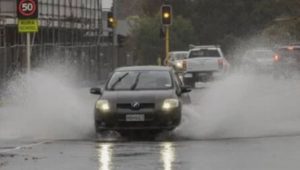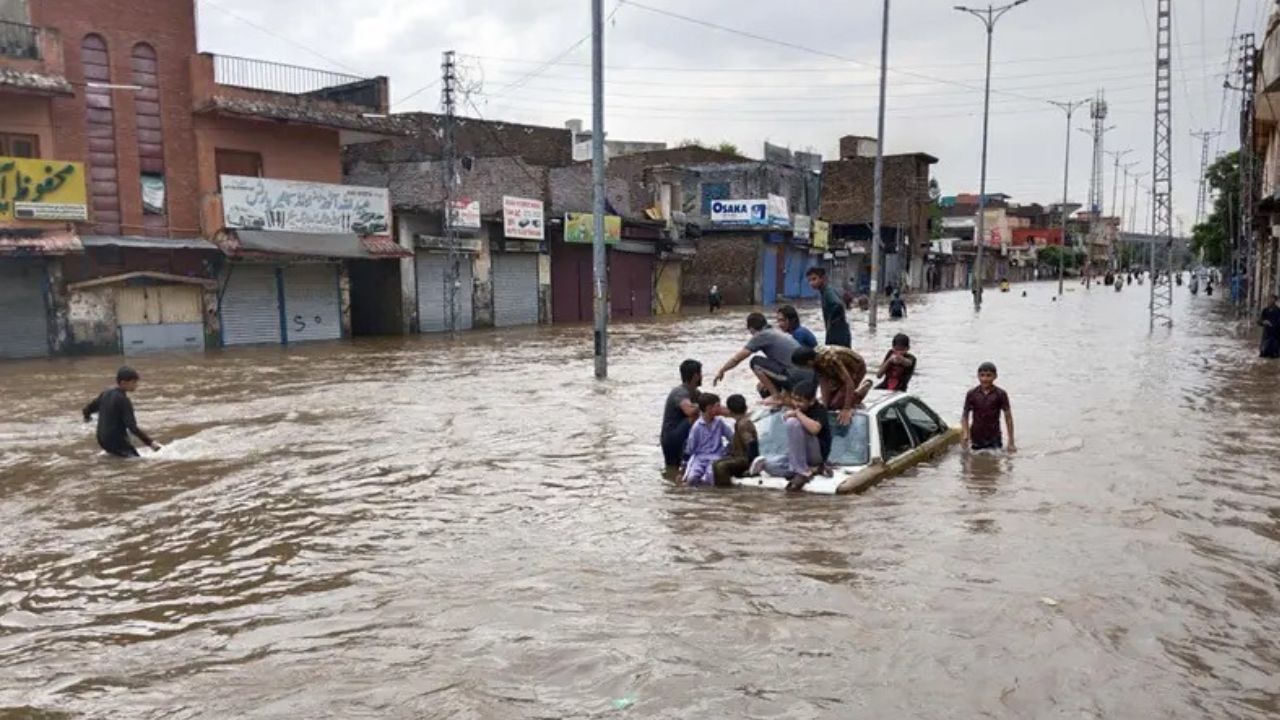



Heavy rain described as the worst in three years struck Islamabad and Rawalpindi on Tuesday, killing three people, critically injuring another, and flooding roads, homes and hospitals as authorities opened dam spillways and evacuated residents.
The Meteorological Department recorded up to 201mm of rain in parts of Rawalpindi, with more forecast until Wednesday evening, says DAWN news.
In Islamabad’s G-14 sector, 20-year-old Faizan Ashraf died and 65-year-old Raz Mohammad was left critical after the roof of the makeshift house they shared near the golden market collapsed, trapping both under debris before rescuers freed them.
Separately, 17-year-old Yahswa Azhar drowned after being swept into a nullah near Esa Nagri in sector I-9/1.
A nullah in E-11 overflowed after roughly 150mm of rainfall, submerging nearby roads and building basements, while a protective wall in D-12 and the outer walls of two government schools, in G-6 and Lakhwal, also collapsed without injury. Water in Rawal Dam climbed to 1,751.90 feet, prompting officials to open its spillways.
Islamabad’s deputy commissioner said low-lying areas were being closely monitored, explaining that the E-11 nullah had been overwhelmed by record rainfall while a nullah in Ghauri Town had been blocked by dumped concrete slabs.

He blamed negligence by the local society administration for the resulting flooding of homes and streets, and said the Capital Development Authority would act against those responsible. Traffic was disrupted on several major roads.
In Rawalpindi, education department employee Sohail Asghar, 50, died of an electric shock after moving his family to the third floor of his Arya Mohallah home to escape rising floodwater. A police investigating officer said Asghar had gone back downstairs to retrieve his pet dog and was electrocuted while trying to switch on a UPS unit.




The Leh Nullah rose to 29.5 feet at Kattarian Bridge and 20 feet at Gowalmandi Bridge, prompting sirens to warn residents nearby to move to safety.
The army, district administration, Water and Sanitation Agency, Rescue 1122, Civil Defence and health departments were placed on alert. Deputy Commissioner retired Captain Nadeem Nasir told Dawn the army had not been deployed but was on standby, and that the morning’s rain had forced him to declare a public holiday.
The downpour eased after about three hours, with Leh Nullah’s level falling to 10 feet at Kattarian and seven feet at Gowalmandi by afternoon, while Rawal Dam’s spillways, opened after the dam filled early in the day, were later closed.
A Met official said Tuesday’s rain was the heaviest of the current monsoon season and the highest in three years, attributing it to moist currents moving into the country’s upper regions alongside a westerly trough over the north.
The department warned of rain, wind and thundershowers in Upper Khyber Pakhtunkhwa, the Potohar region, Islamabad, Gilgit-Baltistan, Kashmir and nearby hilly areas, and cautioned that further rain could trigger landslides in Dir, Swat, Kohistan, Battagram, Buner, Abbottabad, Mansehra, Haripur, Murree, the Galliyat, Gilgit-Baltistan and Kashmir, as well as urban flooding in Mardan, Swabi, Peshawar, Islamabad, Rawalpindi, Gujranwala and Gujrat.
Numerous Rawalpindi neighbourhoods, including Dhoke Juma, Arya Mohallah, Satellite Town, Raja Bazaar and Sadiqabad, were left under two to three feet of water, while the Raja Bazaar model bazaar and the Rawalpindi tehsil office were also inundated.
Flooding reached Benazir Bhutto Hospital’s officer ward and the basement of Holy Family Hospital, where gynaecology and paediatrics equipment had to be moved upstairs.
Residents of Street 10/3 in Faisal Colony, an area not typically prone to flooding, said water flowed through their street “like a huge canal” for more than six hours after the rain stopped, and have urged authorities to investigate why drainage failed.
Several vehicles were damaged at Leh Nullah bridges, power and internet were disrupted across much of Rawalpindi, and major roads including Murree Road and the Islamabad Expressway were closed to traffic.
Rescue 1122 evacuated 60 people, including 30 from Rahimabad bridge, eight from Kuri Road, eight from Dhoke Kala Khan and six women from Darulaman.