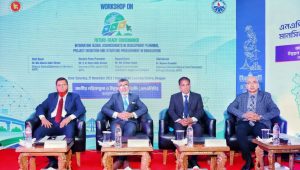
Bangladesh’s youth employment challenge stems primarily from weak institutions linking policy to livelihoods rather than a mere lack of skills or economic opportunity, according to a study by the Power and Participation Research Centre (PPRC) presented on Saturday, 21 November 2026, at the CIRDAP Auditorium in Dhaka during a national dissemination event titled “Youth Economic Opportunity and Realities in Post-Uprising Bangladesh” organised by PPRC with support from The Asia Foundation. Co-presented by PPRC Executive Chairman Dr Hossain Zillur Rahman and Senior Research Associate Namira Shameem—with the event bringing together young people and entrepreneurs from the study regions alongside researchers, development practitioners, development partner representatives, civil society, academia, business, local government and media to examine youth aspirations, opportunities and challenges after the July–August 2024 uprising—the study highlights what Dr Rahman called Bangladesh’s “missing middle” between macro-level policies and the efforts of households, young people and entrepreneurs.
Conducted as a non-nationally representative rapid regional diagnostic between August and September 2026, the study combined separate consultations with young people and employers in Rajshahi, Jashore and Chattogram, a brief questionnaire completed by 100 young people and 59 employers and entrepreneurs, and field engagements in Naogaon, Pirganj, Jashore High-Tech Park, coastal Noakhali and indigenous communities in Bandarban. It found regional bottlenecks blocking potential across locations: weak storage, testing and finance for Rajshahi horticulture and mango processing, logistics and marketing; institutions lagging behind Jashore’s digital, light-engineering, flower and women-led enterprises (including businesses around local food and culture such as pithas) alongside an underused High-Tech Park; value loss in Noakhali from processing products such as soybean elsewhere, poorly designed seasonal finance and credit barriers for women; a broken education-to-employment transition in Chattogram where employers cite skills shortages while youths struggle to get entry-level experience; and constrained market, infrastructure and service access in Bandarban despite local youth and community innovations such as residential schooling, practical trades and youth-led STEM learning for indigenous children. Both young people and employers point to practical capability shortages and finance ill-suited to small and youth-led enterprises, while disagreeing over whether graduates should already be work-ready or employers should provide first-time experience—a transition PPRC argues training institutions, employers, financial institutions and government agencies must share rather than leave to young people alone.
In his closing synthesis, Dr Rahman outlined seven priorities: centring reform on the meso-economy; reimagining local governments and educational institutions as regional transformation catalysts; shifting from training and certificates to practical capability, mentoring, self-learning and resilience; examining and curbing high entrepreneurial dropout rates; holding public assets accountable for productive use and results; broadening economic diversification to cover regional products and the creative economy; and embedding inclusion, dignity and voice in economic policy for women, indigenous communities and marginalised groups, while arguing that the July uprising’s economic aspirations involved fairness, dignity, access and economic justice beyond job numbers. Opening the event, The Asia Foundation Bangladesh Country Representative Kazi Faisal Bin Seraj highlighted productive and meaningful employment for prosperity as well as youth participation, ownership and stability; a written message from Finance Minister Amir Khasru Mahmud Chowdhury—absent due to state duties—urged practical measures to remove youth barriers as part of Bangladesh’s economic agenda; BRAC Institute of Governance and Development (BIGD) Executive Director Dr Imran Matin called for tackling frontline institutional bottlenecks, strengthening local government, competence-focused training, better youth entrepreneurship risk management drawing on microfinance lessons, and stronger mentorship and apprenticeship learning; and World Bank Division Director for Bangladesh and Bhutan Jean Pesme said the growth model is no longer inclusive enough and cited ruptures between growth and jobs requiring renewed focus on skills, firms, finance and private investment. Speakers also called for industry-led learning, apprenticeships, job tracking, market-based curricula, youth databases, employment centres, internship platforms, accessible finance, regional processing, enterprise support, AI-readiness, youth policy participation, mental-health support and stronger links between budgets, policies and measurable outcomes, as said in a press release with contact listed for PPRC Communication Manager Joyanta K Paul.