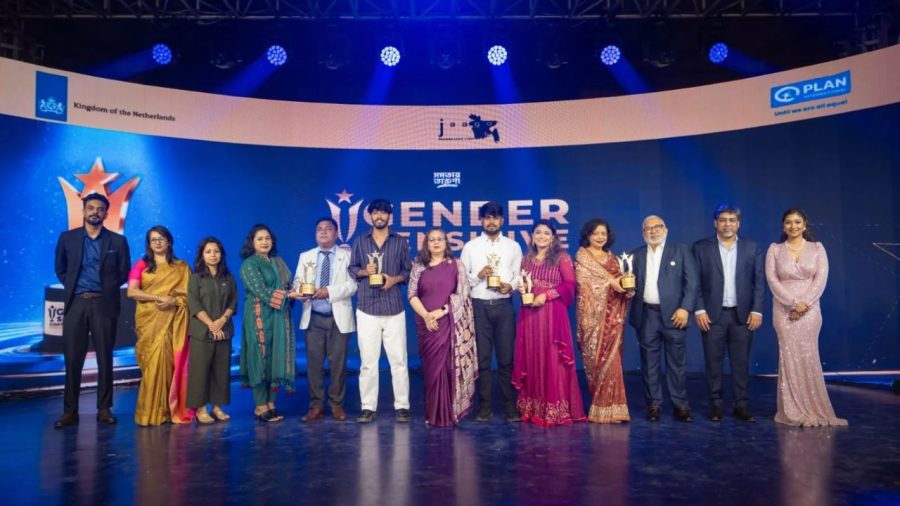



Five social media content creators and influencers received the Gender Sensitive Content Award 2026 at an event at Aloki in Tejgaon, Dhaka on Thursday night, 19 November 2026, for content addressing gender stereotypes and promoting equality, as noted in a press release dated 20 November 2026. Organised by JAAGO Foundation Trust under the Shomotay Tarunno: Youth for Equality Project—implemented in partnership with Plan International Bangladesh with support from the Embassy of the Kingdom of the Netherlands in Bangladesh—the ceremony featured National Institute of Mass Communication (NIMC) Additional Director General Rownok Jahan as chief guest, Ambassador of the Kingdom of the Netherlands to Bangladesh Joris van Bommel as special guest, and JAAGO Foundation Trust Founder and Executive Director Korvi Rakshand delivering closing remarks.
Maisha Mahjabeen Priooty won the National Level Influencer award and Md Mehedi Hasan Nur received the Inspiring Content Creator award, while Hasibul Islam Bappy and Apusi Chowdhury took the Emerging Content Creator awards in the male and female categories and Targiv Sanan Roham received the Jury’s Mention. Organisers said entries were judged by external judges on content quality and relevance to gender equality—focusing on storytelling, ethical communication, inclusivity and challenging harmful norms rather than follower count alone—with Emerging Content Creator awards restricted to creators trained under the project, which has trained 154 young content creators from eight divisions in gender equality, ethical storytelling and responsible online behaviour.
Rownok Jahan said in a press release that digital platforms carry gender stereotypes and offensive, hateful comments that block women’s progress and hold society back, adding that the event marks the start of a movement for a discrimination-free, equal and gender-sensitive society alongside NIMC’s collaboration with JAAGO Foundation Trust. Joris van Bommel said gender-sensitive content creation involves asking whose voices are missing and using an honest story, responsibility and goodwill rather than the biggest platform to spark real change. Korvi Rakshand said the project has spent three years across eight divisions and 64 districts training young people, youth-led organisations and journalists, adding that trained participants will continue speaking differently even after the project ends.