M. A. Matin
Today, politics in Bangladesh is largely defined by the struggle for power. Daily debates revolve around who will form the next government and who will remain in opposition. Yet, hidden behind these power struggles is a question of far greater consequence for the nation’s future: the reform of the political economy.
Political economy is not merely about economic growth; it is about how state resources are utilized, who benefits from them, and how power structures shape the distribution of wealth. Politics and economics are thus inseparably linked. Unfortunately, our political parties remain focused on power-sharing arrangements rather than on meaningful structural reform of the state economy.
Why Political Economy Reform is Urgent
- To uproot corruption – Corruption in Bangladesh is not simply an administrative failure; it is deeply embedded in the political economy. Partisan patronage and favouritisms have created entrenched economic groups that perpetuate corruption.
- For equitable resource distribution – A functioning economy ensures that resources are fairly distributed across urban and rural areas, the rich and the poor, men and women. The current system, however, is exacerbating inequality.
- To build transparent institutions – Without reform, state institutions cannot be genuinely accountable or serve the public interest.
Recent Economic and Social Indicators
There are some indicators which show significant spikes at alarming rates. There is an increase in the poverty rate from 18.7% (2022) to a whopping 97.3% (2025) and a rise from 5.6% (2022) to 9.35% (2025) in extreme poverty. Also, nearly half of households are categorised as vulnerable to poverty. When it comes to income inequality, there was an increase in the Gini co-efficiency from 0.48 in 2016 to 0.50 in 2022.
When talking about wealth inequality, data shows that the income inequality is high and imbalanced and the wealth is concentrated among the richest. Systematic disadvantages are found under the Urban-Rural Gap indicator which shows that inequalities are more pronounced in urban areas and rural communities face systematic disadvantages.

Bangladesh scored 23/100 and was ranked 151st worldwide in 2024 under the banner of corruption index, according to Transparency International.
All of these show that there is a household burden with the rise in food insecurity, healthcare costs, indebtedness, and decline in living standards.
What These Numbers Reveal
- Poverty and inequality are rising rapidly, a direct result of skewed state policies and inequitable resource distribution.
- Extreme poverty is growing alongside a swelling “vulnerable non-poor” population—households one shock away from destitution.
- Even as aggregate income increases, benefits overwhelmingly flow to the wealthy and middle classes, bypassing low-income groups.
- Bangladesh’s poor corruption ranking reflects the lack of transparency and accountability in public institutions.
Foreign Trade Relations: A Critical Perspective




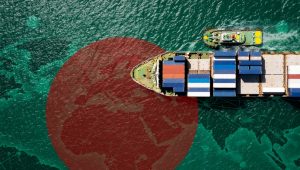
Bangladesh’s political economy is deeply linked to global trade. Export dependence, trade deficits, and reliance on international markets directly impact economic security, workers’ livelihoods, and political stability.
Recent Data (2023–2025)
In the Fiscal Year 2023-2024, Bangladesh exported $44.47 Billion worth of goods and $6.64 Billion worth of services. Out of the total exports, around 85% are from the RMG Sector Share.
When we look at the diversification, it is the RMG sector that dominates with close calls from the pharmaceuticals, agro-processing, and IT sectors.
Challenges and Analysis
- Over-reliance on RMG exports makes the economy vulnerable to global demand fluctuations.
- Trade deficits and foreign currency pressure arise due to higher imports compared to exports, affecting currency reserves.
- Employment and opportunity inequality: Benefits concentrate with big business; workers remain disadvantaged.
- Low value addition and limited technology transfer restrict entry into higher-value products.
- Trade policies and agreements: International tariffs, labor laws, and trade agreements directly influence export competitiveness.
Recommended Reforms
- Diversify exports: IT, pharmaceuticals, agro-processing, and green industries.
- Ensure workers’ rights and fair wages.
- Strengthen regional cooperation and equitable foreign trade agreements.
- Promote technology transfer and higher value-added exports.
The Need for National Consensus
Political economy reform cannot succeed on government goodwill alone. All political parties must recognize that constant power struggles weaken state structures and harm citizens. A national dialogue is urgently needed—one that prioritizes long-term public interest over narrow party agendas.
Politics Must Serve the Public Interest
The main focus of politics should be to provide equitable education, affordable healthcare, opportunities to the youth for employment, effective anti-corruption measures, resilience of environment and climate, fair distribution of resources, and a balanced and fair foreign trade policies.
Ignoring these issues in favour of factional conflicts is nothing short of national self-destruction.
Conclusion
History shows that change in Bangladesh comes only when the people rise. The 2024 mass uprising reaffirmed this truth. Yet without structural reform of the political economy, even large movements risk failure.
The time has come to move beyond power struggles and rebuild the nation’s political economy. Public awareness, institutional reform, equitable foreign trade relations, and national consensus are indispensable. To transform Bangladesh into a true people’s republic, political economy reform must drive the future.
The writer is a political analyst.