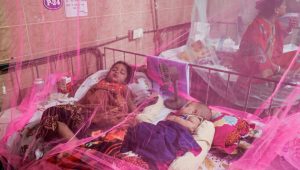
Experts have emphasised that strong political commitment is essential for reforming Bangladesh’s healthcare system.
Ahead of the upcoming national elections, health experts and civil society leaders have called for urgent reforms in Bangladesh’s health sector, emphasising patient-centred care, universal health coverage, and the need to reduce systemic inefficiencies that undermine public health.
They made these remarks during a discussion meeting held at Dhaka Reporters’ Unity in Segunbagicha, organised jointly by UNICEF, PPRC, the UHC Forum, and the Bangladesh Health Reporters’ Forum.
Hossein Zillur Rahman, chairman of the private research organisation Power and Participation Research Centre (PPRC) and convener of the Universal Health Coverage (UHC) Forum, highlighted the importance of making health services more patient friendly.
“The model or structure may vary, but what ultimately matters is an effective, practical system that benefits the patient,” he said.
Hossain Zillur Rahman, chairman of Power and Participation Research Centre (PPRC), said, “It is very important for healthcare to be patient friendly. Whatever the model or structure, ultimately effective practical systems are important, and they must be made convenient for patients.”
He noted, “The new government coming in 2026 must have in their discussions not just treatment but also prevention, healthy living and overall wellness, particularly in light of rising non-communicable diseases.”

He pointed to the deep structural weaknesses in the country’s health system.
“We take pride in an average life expectancy of 73, but people spend the last 15 years of their lives running after treatment. Ineffective primary care, urban hospitals under strain, and the lack of preventive health programmes reduce quality of life,” he said, citing an example from Noakhali where patients face confusion and delays due to the absence of coordinated referral systems.
Rahman also criticised the proliferation of unused infrastructure, insufficient motivation, and weak management, stressing that accountability extends beyond the government to civil society and health organisations.
Aminul Hasan, presenting the keynote presentation, highlighted Thailand’s success in achieving universal health coverage as a model for Bangladesh.
“Thailand’s 2002 UHC program reduced out-of-pocket expenditure from 50 percent to below 10 percent through strong political commitment, leading to a service coverage index of 83, among Asia’s best. In comparison, Bangladesh’s index stands at 54,” he said.



Hasan emphasised that improving population coverage, service provision, and financial protection is critical. He warned that Bangladesh’s high out-of-pocket expenditure of 73 percent pushes millions into poverty annually, undermining health equity and economic productivity.
Hasan outlined four priority areas for reform: Governance and legislation, health financing, service delivery, quality, equity, and accountability. He called for the establishment of an independent health commission, primary healthcare legislation, regulation of private providers, expanded budgetary allocations, social health insurance, and the creation of a national health financing authority.
Strengthening primary care, implementing referral systems, integrating family planning, expanding non-communicable disease (NCD) screening, and introducing national standards for care quality were also emphasised.
He underlined that these reforms require trained human resources, rural posting incentives, digital health systems, and data-driven decision-making.
Professor Mohsin Zillur Karim, BNP’s national executive committee secretary for family welfare, shared concerns from a clinical perspective.
“Medical education quality is a major concern. Many new doctors graduate without adequate skills, leading to serious misdiagnoses,” he said.
Citing a recent case from Noakhali, he described how a patient was misdiagnosed with asthma and admitted to an ICU for seven days, only to discover her condition was heart failure.
Karim stressed the need to train competent and ethical physicians and criticised the commercialisation of healthcare.
“Our goal is a patient-friendly health system accessible to all, where the same standard of care is available whether in Dhaka or a rural hospital,” he said.
AKM Waliullah, vice president of the National Doctors Forum (NDF), stressed the role of political leadership in driving health sector transformation.
“Our health indicators are unacceptable – Bangladesh’s service coverage index is 50, compared to Myanmar’s 64. Countries like Indonesia, Malaysia, and Sri Lanka are ahead. This situation must change immediately,” he said.
Waliullah urged legal reforms, good governance, anti-corruption measures, and proper coordination between public and private sectors, along with support for NGOs. He also proposed establishing specialised district-level hospitals with ICU, CCU, and dialysis facilities to reduce pressure on Dhaka hospitals and ensure timely care.
Professor MA Faiz emphasised the need for coordinated, high-quality primary healthcare applicable across rural and urban areas.
“Health is not effective if human resources are inadequate or poorly trained. Medical education must produce doctors capable of meeting modern standards,” he said. He also highlighted the influence of political determinants on health system outcomes.
Syed Md Akram Hossain, reflecting on his experience with the Health Sector Reform Commission, criticised the lack of implementation despite years of planning.
“The Health Ministry focuses on routine work and promotions rather than genuine reform. Decisions are often made based on personal relations rather than public need. Essential initiatives like the Essential Drug List and Universal Healthcare legislation remain unimplemented,” he said.
Hossain urged that health be placed among the top priorities in political party manifestos to ensure long-term reforms.
The experts collectively emphasised that Bangladesh’s health system faces multiple challenges: Fragmented governance, weak accountability, insufficient funding, human resource shortages, commercialisation, and inadequate preventive health measures.
They stressed that immediate political commitment, targeted reforms, and effective implementation are essential to achieve universal health coverage, reduce health inequities, and improve national economic productivity.