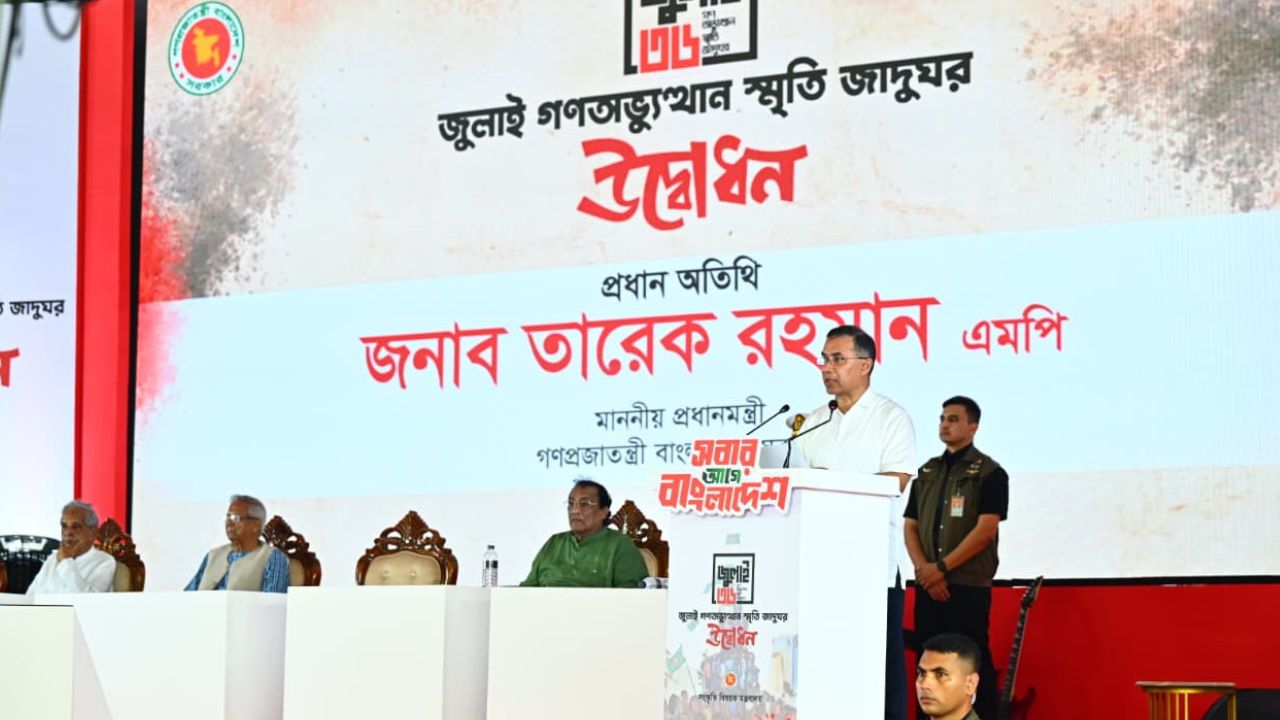



Prime Minister Tarique Rahman has said those responsible for the killings during the anti-fascist movement will be brought to justice through transparent, impartial and credible trials conducted in accordance with the due process of law.
“The government believes justice for every crime is essential to ensure the rule of law,” he said while addressing a discussion titled “July-36″ after inaugurating the July Mass Uprising Memorial Museum at Ganabhaban in the capital’s Sher-e-Bangla Nagar Wednesday morning.
He said the government has decided to name institutions after those killed or became victims of enforced disappearance and other violence over the past 17 years and during the July 2024 movement.
Speaking about the July museum, the prime minister said the country’s democratic people expect the museum not to become a place for promoting the exclusive political narrative of any individual, group or political party.
He stressed that the mass uprising did not belong to any individual, group or political party. The true heroes of the uprising are the democratic people of Bangladesh.
Tarique said the 1971 Liberation War was fought to achieve the country’s independence, while the 2024 mass uprising was waged to safeguard the independence of the state and the freedom of its people.

“Just as the people have never forgotten the freedom fighters of 1971, they will never forget those who laid down their lives in 2024 to protect the country and the freedom of its people,” he said.
Warning against attempts to create instability in the country, the Prime Minister urged all concerned to avoid creating unnecessary controversies.
“I urge everyone to reflect on whether, by creating unnecessary issues and such situations in a fascism-free Bangladesh, they are unknowingly paving the way for the resurgence of ousted and fugitive autocratic forces,” he said.


Recalling authoritarian rule of more than one and a half decades, Tarique said the country had paid a heavy price in its struggle for democracy.
“Today marks another milestone in Bangladesh’s democratic history. During more than one and a half decades of the anti-fascist movement, thousands of people became victims of enforced disappearance and abduction,” he said.
“Millions suffered repression, persecution, attacks and false cases, forcing them to remain away from their homes for years,” he said, adding, “During the July-August Mass Uprising alone, thousands of students, people from all walks of life, women and children embraced martyrdom.”
He also said, “The fascist forces even opened fire from helicopters during the July-August Mass Uprising and killed pro-democracy people.”
The prime minister stated that such cruelty and brutality by the fallen, defeated and ousted fascist forces are rare in the civilised world, adding, “During the fascist regime, enforced disappearances, killings and abductions were made into a matter of routine.”
Referring to the role of the historic July Mass Uprising Memorial Museum, the premier said it would preserve the courageous legacy of the nation’s predecessors for future generations. “This museum will also reveal the true face of the ousted fascist forces to the new generation,” he added.
Tarique declared that this museum is a historic initiative to permanently retain in the country’s memory the struggles, sacrifices, suffering, courage and democratic aspirations of the people.
“I hope it will not remain only a memorial to the tragic events of 2024. It will also show the relationship between the July Mass Uprising and Bangladesh’s broader democratic journey,” he said.
“Not only the history of the July Mass Uprising, but also the history of every democratic movement and struggle in Bangladesh should be kept here,” he added.
Stating that the ousted fascist forces had never been able to accept democratic rule, Tarique said their predecessors had buried democracy by amending the Constitution in 1975.
“Later, Shaheed President Ziaur Rahman, the declarer of Bangladesh’s independence, restored multi‑party democracy after taking on the responsibility of running the state,” he said, adding, “Future generations will certainly gain if these chapters of history are also included at the museum.”
The prime minister emphasised the importance of preserving history with accuracy, saying, “Incomplete, exaggerated or motivated narratives do not strengthen history. Rather, they weaken its credibility and create grounds for future divisions.”
“Therefore, factual accuracy should be ensured in every matter. At the same time, presenting the museum’s exhibits in English and other languages alongside Bangla will allow people from different linguistic backgrounds to learn about Bangladesh’s democratic struggles,” he said.