The National Citizen Party (NCP) is preparing a major overhaul of its central leadership, with plans to abolish three senior posts and exclude two leaders from its proposed Political Council after they resigned from the council over the party’s decision to join the Jamaat-e-Islami-led 11-party alliance ahead of the national election.
The restructuring will abolish the posts of chief organiser, chief coordinator and spokesperson, redistribute responsibilities among council members and introduce new cells and affiliated organisations to expand the party’s organisational reach.
Samantha Sharmin, a senior joint convener, and Nahida Sarwar Niva, a senior joint member secretary, will not be accommodated in the proposed council, although both will remain general members of the party, according to NCP sources.
Several NCP leaders, speaking on condition of anonymity, told TIMES of Bangladesh that the revised leadership structure and allocation of posts had been finalised in principle. Formal approval from Convener Nahid Islam and Member Secretary Akhter Hossen is pending.
A joint chief coordinator of the party said the NCP intended to change its structure “top to bottom”. The leader added that the party had recognised the need for organisational change ahead of the 13th national election in February this year and was continuing the process after the polls.
The overhaul is intended to streamline decision-making and strengthen grassroots coordination ahead of local government elections and the party’s first national council, scheduled for February next year.
Two senior leaders left out
Samantha Sharmin and Nahida Sarwar Niva resigned from the party council before the national election in protest against the NCP’s participation in the Jamaat-led 11-party alliance, according to party sources.

Both remain party members but have been largely inactive in organisational activities since the election, despite briefly attending several party meetings earlier this year.
A senior NCP leader said neither would be included in the new Political Council or the party’s top leadership. Both would continue as general members.
New leadership hierarchy
Under the proposed arrangement, Nahid Islam will remain convener and Akhter Hossen member secretary.
Nasiruddin Patwary, currently the chief coordinator, and Hasnat Abdullah, chief organiser for the southern region, are set to become senior joint conveners. Sarjis Alam and Asif Mahmud Shojib Bhuyain will serve as senior joint member secretaries.
The remaining 10 Political Council members will become joint conveners. They are Abdullah Al Amin, Ariful Islam Adeeb, Atiq Mujahid, Abdul Hannan Masud, Ali Ahsan Junaid, Sarwar Tushar, Akram Hossain, Saleh Uddin Sifat, Mahmuda Alam Mitu and Nusrat Tabassum.




The proposed leadership roster consists of 16 members, with the party considering adding another member following internal consultations.
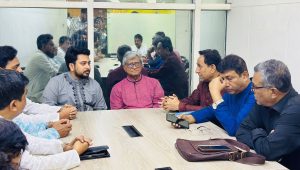
The Political Council has met twice in the past fortnight to discuss the changes and agreed on the broad framework, according to party sources.
The revised leadership lists were initially expected on Tuesday, October 13 as declared earlier, but the announcement is now likely on Wednesday or Thursday, after Nahid returns from visits to Shariatpur and Madaripur.
Portfolios and grassroots structure
With the abolition of the three senior posts, Political Council members will take charge of specialised subcommittees and cells covering political liaison, organisational affairs, finance, media and policymaking.
Nasiruddin Patwary is expected to head the Political Liaison Subcommittee, coordinating with other political parties. He will also supervise Jatiya Jubo Shakti, an affiliated organisation of the NCP.
Sarwar Tushar is expected to oversee media, public relations, branding and cultural activities, while Abdullah Al Amin will lead policymaking and related subcommittees on finance and trade.
The party plans to distribute around 30 specialised portfolios covering international relations, office administration, finance, human rights and law. Each cell is expected to have an editor and an associate editor.
The NCP also plans to appoint another 10 to 11 joint conveners and seven to eight joint member secretaries to broaden its central committee.
A 23-member Organisational Subcommittee, led by Sarjis Alam, has been formed to oversee grassroots activities and improve coordination between the centre and field-level units. Ariful Islam Adeeb and Ali Ahsan Junaid will serve as its deputy heads.
The proposed structure includes 10 divisional organising secretaries and 10 associate organising secretaries to coordinate activities at divisional and district levels.
New platforms for minority communities
The NCP plans to establish an Ethnicity Affairs Cell and a National Hindu-Buddhist-Christian Alliance to broaden political participation among ethnic and religious minority communities.
The proposed Ethnicity Affairs Cell would include representatives of small ethnic and non-Bengali communities from the Chattogram Hill Tracts and the plains. It is intended to provide a platform for these communities to participate directly in politics and raise issues concerning their languages, cultures and rights.
The National Hindu-Buddhist-Christian Alliance would focus on communal harmony and political participation among religious minorities.
Party sources said it would operate as an independent affiliated organisation rather than a direct NCP wing, with autonomy over its policies and organisational affairs.
Preparations are also under way to establish Jatiya Sechchasebak Shakti, a separate platform for social service and volunteer activities.
Nari Shakti leadership reshuffle
The NCP is also considering changes to the leadership of Jatiya Nari Shakti, one of its main women-based affiliated organisations.
Five leaders are being considered for its three top positions: convener, member secretary and organising secretary. They are Mahmuda Alam Mitu, Monira Sharmeen, Nusrat Tabassum, Humaira Noor and Manjila Jhuma.
A senior party leader said lawmakers Mahmuda Mitu and Nusrat Tabassum were recommended for positions in the organisation’s top leadership and the proposals remain under consideration.
The revised leadership structure and affiliated organisation appointments are awaiting formal approval from Nahid Islam and Akhter Hossen.