




Without repaying nearly Tk5,700 crore owed to 23 banks in Bangladesh, the owners of Navana Group have moved vast sums of money into at least five countries, including Singapore, Canada and the United Arab Emirates.
They opened foreign bank accounts to stockpile funds, invested in an international hedge fund, moved to issue foreign bonds and acquired the citizenship of another country through investment—all without authorisation, reveals a TIMES of Bangladesh investigation.
The offshore financial empire was built over more than a decade beyond the knowledge of regulators. It came to light in 2020 when the Anti-Corruption Commission (ACC) opened an investigation into allegations of money laundering and loan default.
Surprisingly, the probe was shut down within months, and Navana Group was rewarded fresh loans, thanks to the then Awami League government and its finance ministry, documents show.
Founded in 1964, Navana Group is one of the country’s largest conglomerates, with businesses spanning automobiles, construction, real estate, energy, batteries, electronics and food, among other sectors. Once known as the sole distributor of Toyota and Hino brands in Bangladesh, the group is now mired in a debt crisis brought on by capital flight.
A vast trove of documents obtained by TIMES, supported by international corporate records and information gathered from regulatory bodies, found that the group’s owners built an offshore financial network over at least 15 years, from 2007 to 2022. The investigation identified evidence that at least Tk8.26 crore was siphoned abroad during that period. The actual amount could be many times higher, as this investigation was unable to uncover the full money trail.
During the same period, the group’s bank loans began turning irregular, indicating a link to money laundering.
Several current and former senior officials of the group allege that the owners smuggled a large share of these bank loans out of the country.
An analysis of the documents reveals a consistent pattern of moving assets abroad. It began with a bank account in Singapore holding fixed deposits and an investment in an international hedge fund. Money then moved through Dubai to Hong Kong, followed by transfers to Canada and, finally, the purchase of foreign citizenship through investment.
Officials of the Bangladesh Financial Intelligence Unit (BFIU) confirmed to TIMES that each of these documents constitutes evidence of an illegal offshore financial network run by Navana’s owners.
The investigation found that Navana Group chairman, Shafiul Islam Kamal, had, since before 2007, held a joint private banking account at Singapore’s United Overseas Bank (UOB) with his elder son and the group’s senior vice chairman, Saiful Islam Shumon.
A 2007 bank statement for that account shows fixed deposits and financial assets worth SGD 405,186 (Tk3.86 crore), along with an investment in the international hedge fund Permal FX Financials and Futures Limited.
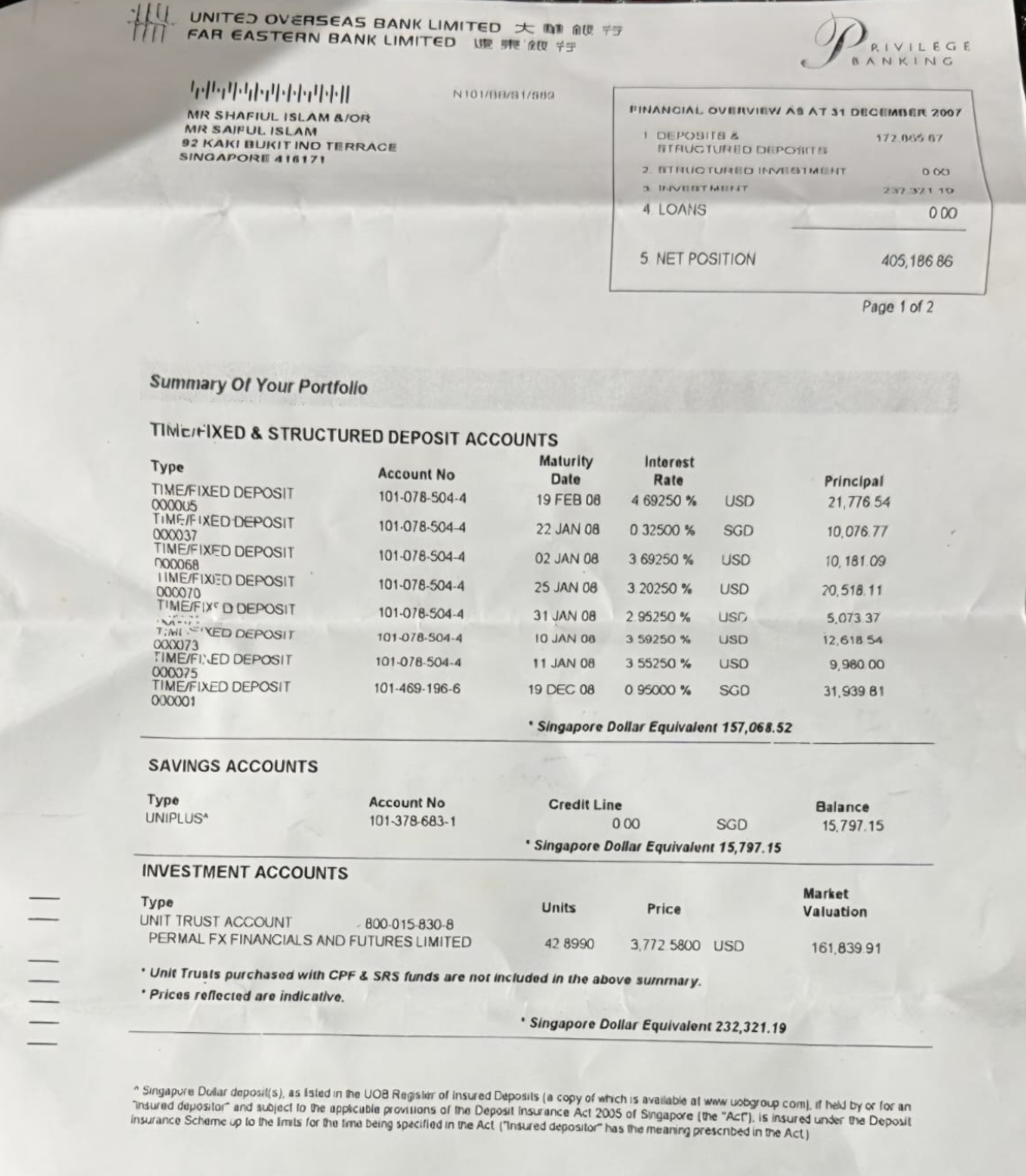
The statement lists a commercial address in Singapore. TIMES could not independently verify whether the account and investment remain active today or have grown further, though BFIU officials said they would examine the matter as part of their investigation.
A 2014 document became one of the most important sources for this investigation. It shows that USD 93,489 was paid as legal costs for a proposed international bond issued by Navana CNG Limited that year.
The invoice, from the international law firm Hogan Lovells Lee & Lee, instructed that the payment be sent to an account held by Lau Man Keung at Hang Seng Bank in Hong Kong.
Two telegraphic transfer vouchers from GCC Exchange in Dubai show the same amount being sent to the same bank account, under the same reference number and to the same beneficiary, in a clear attempt to launder money.

However, the relevant department of Bangladesh Bank said no such foreign transaction was ever approved. According to the regulator, any authorised transaction must be routed through a bank based in Bangladesh. How the money actually reached Dubai from Bangladesh remains unknown. The BFIU will look into the matter.
Among the several hundred pages of documents are a beneficial ownership declaration from The Bank of New York Mellon in Singapore, the Hogan Lovells Lee & Lee invoice, and a copy of an advisory agreement with Emerging Capital Limited for a listing on a foreign stock exchange.
Yet the Bangladesh Securities and Exchange Commission (BSEC) said it holds no information about the LPG bond issue or the related private placement. Navana also disclosed no price-sensitive information on the matter to the Dhaka Stock Exchange. Similarly, no Navana entity was found to be listed on the Frankfurt Stock Exchange or the National Stock Exchange of Australia.
Millions for Caribbean passports
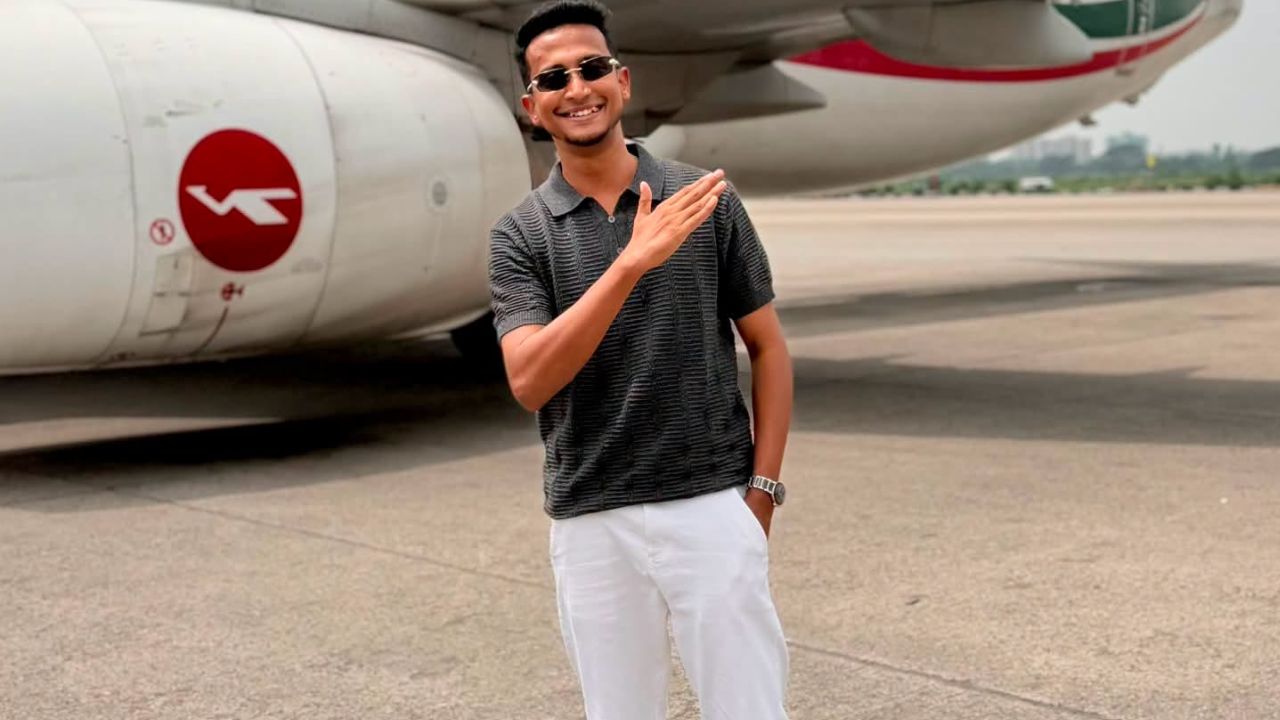
Continuing this pattern, documents reveal that Navana Group’s owners had also acquired foreign citizenship. Passport copies (verified) obtained by this news outlet show that Saiful Islam Shumon took an Antigua and Barbuda passport in 2020, followed by his younger brother and Navana Group vice chairman Sajedul Islam Shuvro in 2022.

Citizenship of the Caribbean nation, widely regarded as a tax haven, comes at a steep price. When the brothers acquired their passports in 2020 and 2022, the cheapest route under Antigua and Barbuda’s citizenship-by-investment programme required a non-refundable contribution of around USD 135,000, or nearly Tk1.66 crore. That means the two brothers spent at least Tk3.32 crore between them for passports.
The central bank confirmed that no approval was sought for this investment either.
Canada connection
Saiful Islam Shumon has long been based in Canada and set up several businesses there with laundered money, prompting the ACC to open an investigation against him in February 2020.
He allegedly set up several businesses there with laundered money, but details could not be found in this connection as the probe halted within months of launching it.
TIMES spoke with two officials of the anti-graft body who are familiar with that investigation. Speaking on condition of anonymity, they said the probe was shut down through political influence.
A separate document shows that Shumon was engaged with the Awami League. He was a member of the Central Relief and Social Welfare Sub-committee of the party that was ousted in a mass uprising in 2024.
The same year the probe was halted, the state moved to extend fresh loans to Navana Group. A document shows that at a finance ministry meeting in August 2020, a policy decision was taken to provide the group Tk1,200 crore in working capital support and to have state banks take over its loans from various non-bank financial institutions. Under this decision, Navana received Tk500 crore in new loans in three instalments under the supervision of Bangladesh Bank.
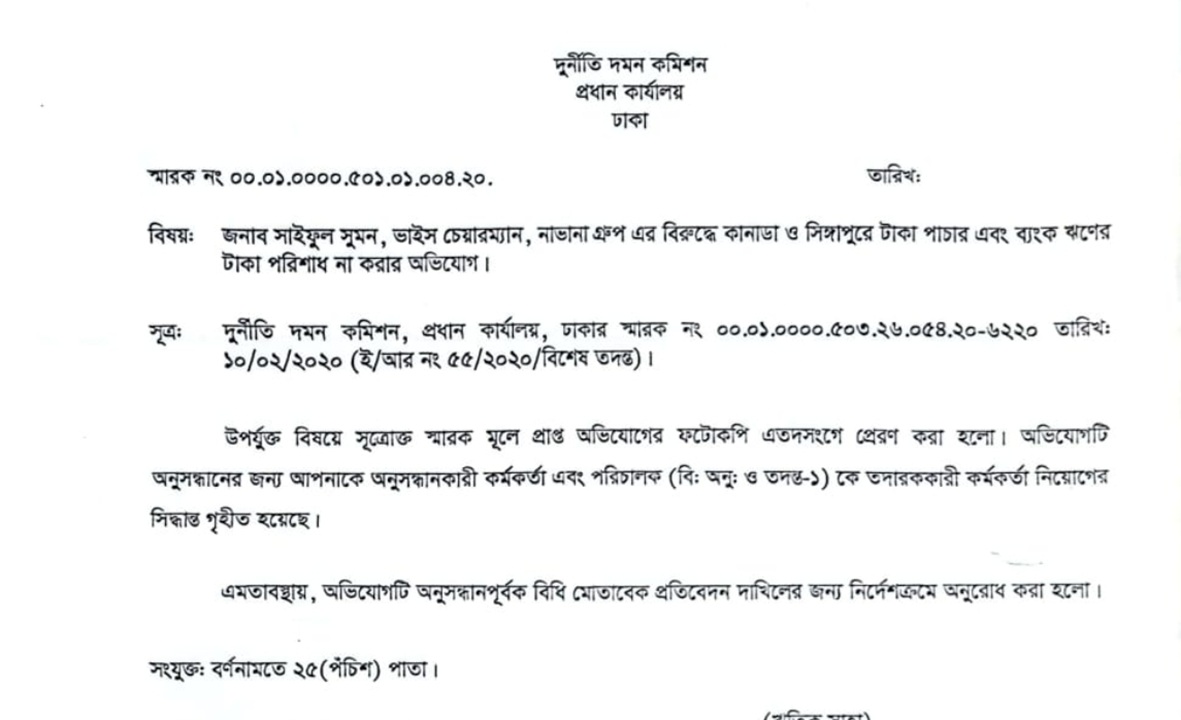
An official present at the meeting, speaking on condition of anonymity, said that political considerations played a role in the loan decision. The discussion, the official said, opened with the words: “Shafiul Islam Kamal was Bangabandhu’s man. He should get cooperation.”
According to Bangladesh Bank data, Navana Group has taken Tk5,658 crore in funded loans from 23 banks. It also carries substantial loans from several non-bank financial institutions. Including non-funded liabilities, its total banking exposure stands at nearly Tk8,000 crore. On the central bank’s list, the group ranks as the country’s 13th largest borrower.
Court records show that, with most of its loans in default, 18 banks and financial institutions filed 78 loan recovery cases against the group’s various entities and owners between 2023 and 2026 alone. More than a hundred other financial cases are pending against the group.
Reviewing the documents, Bangladesh Bank spokesperson Arief Hossain Khan said: “These clearly show that the issue of money laundering is linked to Navana Group’s directors, because they took no approval from Bangladesh Bank to transfer money abroad or set up businesses there.”
The central bank executive director added that the BFIU investigation would bring the full picture to light.
TIMES on Wednesday sent detailed questions via email and WhatsApp to Navana Group’s senior vice chairman Saiful Islam Shumon, vice chairman Sajedul Islam Shuvro and several other senior executives, asking them to comment on the findings of this investigation. None responded until the filing of this report on Saturday night. TIMES also tried to reach them by phone, but they blocked the number.


