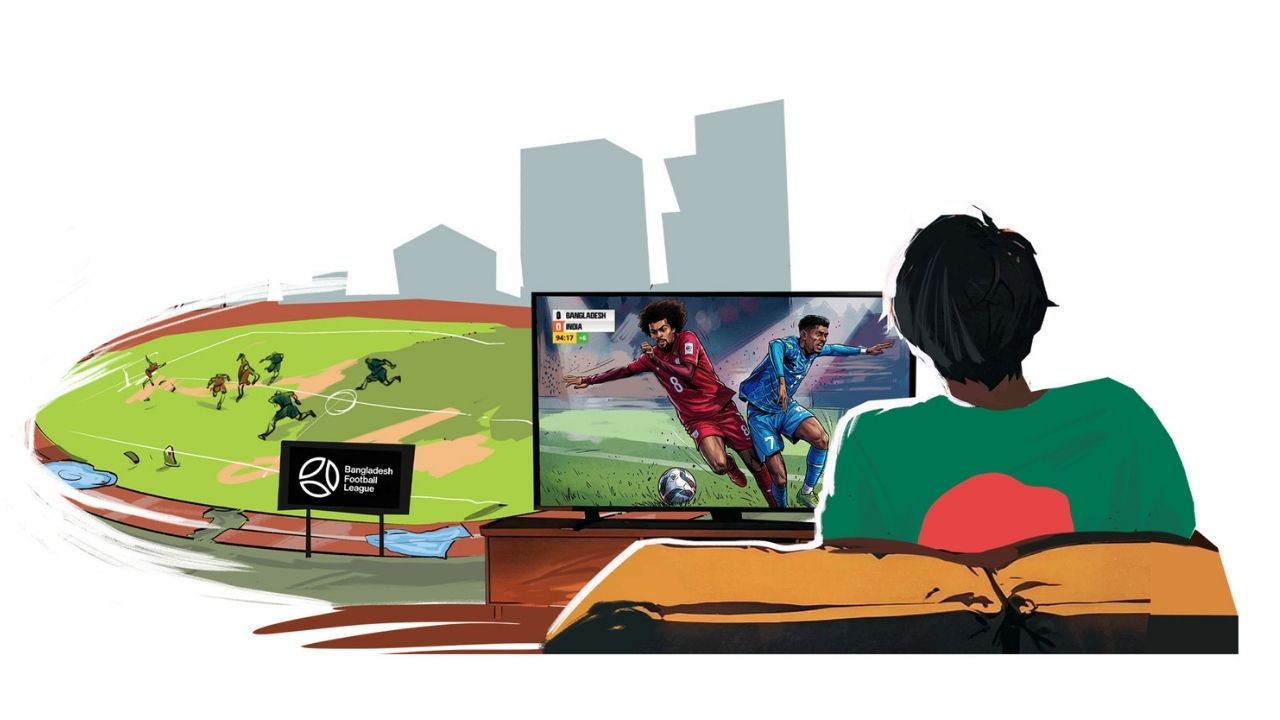



It was half past four in the morning when Barcelona put seven past Newcastle. Rafan (pseudonym) was still awake in Dhaka, phone propped against a water bottle, replaying Raphinha’s second goal for the third time. He messaged his cousin in London, then scrolled through highlights until his eyes stung. This is how most weeks end for him: a scoreline from Spain or England lighting up group chats long after his street has gone quiet.
He does not miss a Bangladesh national team match either. He was among the thousands who refreshed the ticketing website the moment it opened for the last home fixture, and Hamza Choudhury’s name sits on the back of his favourite shirt. Somewhere between the Barcelona highlights and trying to fall asleep, though, Rafan found himself asking why none of that excitement carries over to Bangladesh’s local football, which he could just as easily watch.
He is not alone. Fans who snap up national team tickets within minutes—drawn by Hamza Choudhury, Shamit Shome and a wave of diaspora signings—largely stay away once the club season begins. Turning that enthusiasm into something lasting, supporters agree, requires a fan-friendly domestic league.
Bangladesh’s football authority has struggled to provide one. Late schedules, unpaid contracts, shifting venues and FIFA bans have become familiar features of the local game, and uncertainty is once again hanging over one of the country’s major competitions as another season approaches.
Bangladesh Football Federation (BFF) president Tabith Awal recently promised a fixed calendar: the Challenge Cup on 21 August, the Federation Cup on 25 August, and the Bangladesh League on 28 August. But with the Challenge Cup already cancelled after FIFA banned several top clubs over unpaid dues, none of those dates now looks certain.
Mamunul Islam, former Bangladesh captain and a veteran of the local game, lays most of the blame on the league committee itself.

“Other than the chairman, is anyone on that committee actually capable of running a league? Club members should not even sit on it. If the BFF decides everything, what is the point of having a league committee?” he told TIMES of Bangladesh.
He compared committee members to guests. “They attend meetings, have tea and snacks, and leave. If they continue to behave like guests, the league will keep running like this,” he added.
Syed Rumman Bin Wali Sabbir, a football legend from the sport’s golden era and current director of Mohammedan Sporting Club, believes local football can reclaim its former glory if the storied rivalry between Abahani and Mohammedan—two of Dhaka’s oldest, most decorated clubs—is reignited at a proper venue, ideally the National Stadium.
“The league’s hype will grow if Mohammedan and Abahani get their home venue back. If Abahani and Mohammedan are given Dhaka National Stadium as their home venue, we will see at least two big matches between Abahani and Mohammedan every season. They will also face popular clubs like Bashundhara Kings and Fortis there, so we will have a lot of big matches at the stadium. It will always be packed with fans.”
Mamunul agrees that clubs must give supporters an experience worth remembering.




“Fans need clubs to support. Mohammedan, Abahani, Bashundhara and Fortis all have a following. But you must build the environment first, the stadium, the gallery, before that generation comes back,” he said.
“In La Liga or the Premier League, fixtures are locked in advance, so people get excited before a ball is kicked. Clubs here need to give proper updates from their own pages,” he added.
Sabbir believes the league also needs more players capable of generating the kind of excitement Hamza Choudhury brings to the national side.
“We need 11 players like Hamza across our clubs if we want football to improve. When fans see impactful players playing, they will come to the ground to see them.”
The problem is not simply where matches are staged. Bangladesh’s league also struggles to build any real sense of local ownership around its clubs, rarely converting the strong grassroots appetite for football into lasting club support.
Sayeed Ibnee Nasir, assistant organising secretary of the fan group ‘Bangladesh Football Ultras’, believes an overly Dhaka-centric league limits how far that publicity can travel.
“If football remains Dhaka-centric, its publicity will remain limited. Why are people in Spain so passionate about Barcelona and Real Madrid, or in Manchester about United and City? Because those clubs represent their areas. Fans can feel that the club is their own team,” he said.
He also argues that clubs need settled home grounds rather than shuttling between cities each season.
“A team should have one ground for several years. If they play in Cumilla one year and Gazipur the next, it becomes difficult to build a base and develop local loyalty. BFF should organise league matches outside Dhaka on a regular basis. We see big crowds even at local football matches outside the capital. If national league games come there regularly, people will come.”
Baten Chakma, a popular Bangladeshi football content creator, takes that argument further, suggesting the league could build regional identities through a broader competition structure.
“Even if we do not take the league down to the district level, we at least could bring teams in from the divisions. If those teams play home matches in their own regions, there should be no shortage of support. If the league format allowed teams from every division, people would have greater interest.”
Fahad Karim, BFF vice-president, sees things rather differently, arguing that promotion is primarily the clubs’ responsibility, as it is elsewhere in world football.
“Individual clubs promote their own league to their own fans, not the federation. The game belongs to the clubs, not the federation.”
He confirmed that to promote and bring local football closer to the fans, the BFF runs a separate Federation Cup Facebook page with weekly updates, and will again broadcast selected fixtures on OTT, YouTube and television this season, alongside a fortnightly podcast once the fixture list is finalised.
Until that calendar exists in writing, the thirteen clubs of Bangladesh’s top flight remain stuck in the same holding pattern that has trailed the league for years. And fans like Rafan will keep their phones propped up for Barcelona’s next match, still waiting for their own league to give them a reason to do the same.