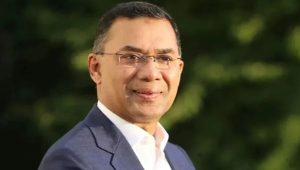
The government is giving serious consideration to introducing a monorail system alongside metro rail to modernise public transport and alleviate severe traffic congestion in the capital city.
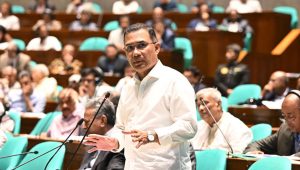
Concurrently, artificial intelligence (AI) enabled traffic signal systems at 50 major points across Dhaka will become fully operational within the next two months, Prime Minister Tarique Rahman informed the Parliament.
Tarique disclosed these details on Wednesday during a question-and-answer session, responding to a supplementary question from Md Abul Kalam, member of parliament for the Cumilla-9 constituency.
Financial losses, initial AI success
During the session, member of parliament Md Abul Kalam highlighted that traffic congestion causes financial losses of over Tk37,000 crore annually in the country, primarily due to the wastage of millions of working hours and extra fuel consumption.

He noted that since the present government assumed office, the introduction of AI traffic systems from Shahid Jahangir Gate to Sadarghat in the capital and on the Dhaka-Chittagong Highway has automatically detected law violations while noticeably reducing accidents and traffic jams.
In this context, Kalam asked whether the prime minister would issue instructions to bring all major roads in Dhaka and key national highways under the AI traffic system.
Replying to the query, Tarique explained that issuing new instructions was unnecessary as directives had already been issued to the relevant department three months ago.



Work is currently underway to install traffic signal lights equipped with AI cameras at 50 important points across Dhaka city.
Operational timeline for AI signals
The prime minister mentioned that city residents can already see the newly installed signal lights at various points. Although they are not yet fully operational, the government expects these AI signals to become active within the next two months.
Once functional, these signals are expected to bring a major positive transformation to Dhaka’s traffic management and significantly reduce congestion.
Citing examples from other densely populated global capitals, Tarique noted that a two-to-four-hour period of traffic congestion during morning office and school hours and afternoon closing times is standard, which is naturally seen in Bangladesh as well.
However, he emphasised that the government is working relentlessly to minimise public suffering as much as possible.

Narrow-route monorail for dense neighbourhoods
Turning to long-term modern plans for traffic alleviation, the prime minister noted that metro rail is already operating on several routes, with initiatives underway to quickly complete the remaining routes.
Alongside this, the government is considering the introduction of a monorail with high importance to make travel easier and more comfortable for the public.
Detailing the specific feature of the monorail, Tarique pointed out that it can operate through relatively small and narrow spaces. Consequently, monorail routes can be extended into the internal roads of densely populated areas such as Mohammadpur, Dhanmondi, or Sabujbagh.
He added that implementing this project would add extraordinary convenience to the daily commute of ordinary citizens.