




Bangladesh risks undermining a projected $760 billion economy by 2030 unless logistics costs, bottlenecks and coordination failures are fixed, experts warned at a focus group discussion on Tuesday.
Even though a 1 per cent cut in logistics costs could lift exports by about 7 per cent, the risk of missing the opportunity persists, they said at the event titled Framing the logistics sector landscape: challenges, opportunities and the way forward, organised by the American Chamber of Commerce in Bangladesh (AmCham).
Stakeholders from readymade garments, freight forwarding, inland container depots, shipping lines, airlines, courier services and development partners flagged how inefficiencies, high charges and weak institutional coordination continue to weigh on the sector as the country moves towards graduation from least developed country status.
AmCham Bangladesh President Syed Ershad Ahmed said logistics underpins supply chains, economic activity and everyday life but remains poorly understood domestically despite its central role in trade and investment.
Despite gradual evolution, Bangladesh’s logistics sector continues to lag behind regional competitors, even as global logistics is being reshaped by artificial intelligence and automation, decarbonisation and fuel transitions, geopolitics, regionalisation and supply-chain resilience, he said.

Policy Exchange Bangladesh Chairman M Masrur Reaz said logistics competitiveness directly shapes trade costs, delivery times and efficiency, stressing that port capacity expansion and modern logistics infrastructure will be critical to sustaining long-term growth.
He warned that heavy reliance on the Dhaka–Chattogram corridor, which carries about 70 per cent of national trade, poses a structural risk to supply-chain resilience, particularly when disruptions occur.
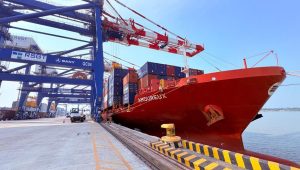
Referring to recent labour unrest at Chattogram port, he said logistics shocks can quickly spill over into the wider economy, exposing the cost of delays and weak contingency planning.




He also pointed to major implementation gaps in the National Logistics Policy, citing government monopolies in rail and air cargo, weak inter-ministerial coordination and the absence of a central logistics authority.
Greater private and foreign investment, particularly in cold-chain and rail logistics, alongside automation and expert-led infrastructure planning, is essential to closing capacity gaps, he said.
Projects such as the Matarbari Deep Sea Port, the Bay Container Terminal and the third terminal of Hazrat Shahjalal International Airport were identified by speakers as opportunities to build long-term logistics capacity.
CF Global Managing Director Mahbubul Anam said air logistics remains a major pressure point, noting that logistics costs at Dhaka airport are estimated to be 20 to 25 per cent higher than road transport, eroding competitiveness for time-sensitive shipments.
As e-commerce-driven demand for express logistics grows, he said cost rationalisation, capacity expansion, efficient courier services and stronger public–private coordination have become critical.
He also highlighted the absence of direct cargo flights to the United States, saying that while clearance facilities exist for the European Union, US cargo clearance for Dhaka remains pending.
World Bank Senior Transport Specialist for South Asia Nusrat Nahid Babi said logistics reform momentum that began in 2022 must be reaffirmed by the new government through clear priorities and high-level consensus.
She outlined the need to move from policy intent to execution, supported by ratification and operationalisation of the National Logistics Policy, stronger multimodal connectivity, skills development, supply-chain digitalisation and sustained investment.
Citi Country Officer Bangladesh at Citibank NA Md Moinul Huq said customs reform is urgent, calling for operationalisation of the Customs Act 2023 through clearly defined electronic document submission and payment systems.
Bangladesh’s continued heavy reliance on letters of credit limits flexibility in trade settlement, he said, urging more adaptable import and export mechanisms to enhance competitiveness.
Concerns were also raised over continued dependence on readymade garment exports, limited development of new logistics infrastructure and weak implementation of electronic documentation despite enabling policies.
Speakers said wider adoption of multimodal transport, including stronger rail connectivity between major industrial hubs and Chattogram port, expansion of cold-chain and agribusiness logistics, industry–academia collaboration on skills development, and deployment of AI-enabled cargo visibility systems will be critical to improving efficiency, resilience and competitiveness.