Forget the aisles of high-street supermarkets; the “buy-one-get-one-free” craze has officially arrived at the Gabtoli sacrificial animal haat.
As the final countdown to Eid-ul-Adha begins, enterprising traders are moving beyond traditional haggling, introducing creative promotional offers to entice buyers amidst a market increasingly crowded by digital content creators.
From the furthest reaches of the country, a steady stream of farmers and seasoned traders continues to arrive at the city’s designated hubs, bringing with them livestock reared with intensive care.
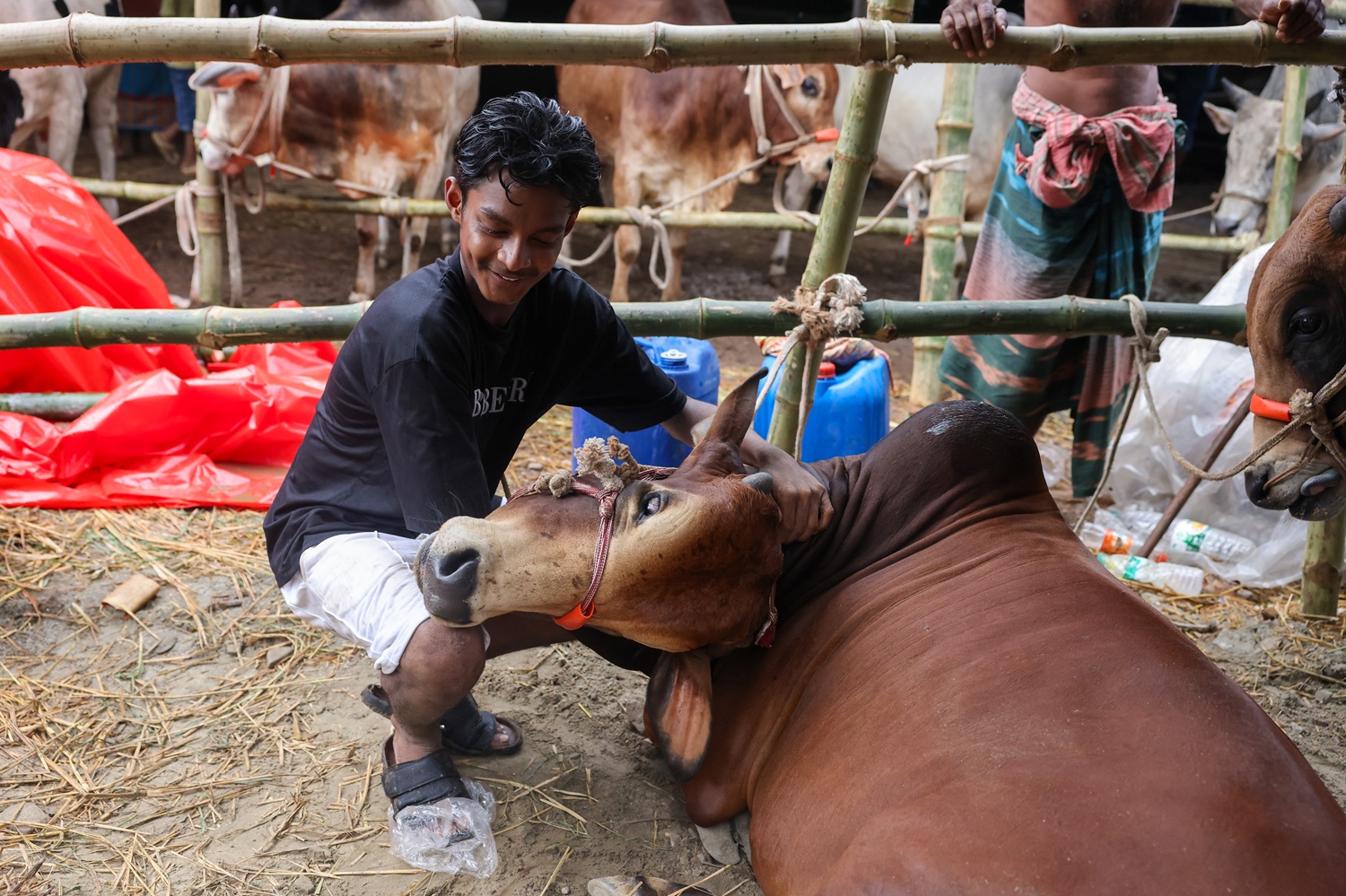
On Friday, the Hazaribagh and Gabtoli markets were transformed into vibrant spectacles where massive crowds coalesced around imposing cows and buffaloes, though it is the unique package deals that are currently stealing the spotlight.
While the presence of genuine buyers has only just started to solidify, traders remain buoyant, anticipating that the true crescendo of sales will peak from Saturday and persist until the very morning of Eid.
Sacrificial steals: The ‘free’ offers
In a bold attempt to distinguish themselves within the competitive atmosphere of Gabtoli, some traders have introduced promotional displays reminiscent of retail stores, offering high-value livestock in pairs.
These package deals are being marketed at prices ranging from Tk12 lakh to Tk25 lakh. Among the most talked-about is Mojibor Rahman, who arrived from the Laakichor area of Keraniganj with a colossal 1,000kg buffalo and a smaller cow. He is currently asking Tk25 lakh for the duo.

When curious spectators questioned whether such a steep price was attainable, Mojibor clarified that the white cow would be given entirely for free to the purchaser of the buffalo. Experienced onlookers at the haat estimated that the “free” cow alone would fetch approximately Tk1.2 lakh in the current market climate.
Regarding his ambitious asking price, Mojibor remained pragmatic, stating that he has quoted a figure and will wait for buyers to offer theirs. “If there is even a small margin of profit at the end of the day, I will sell,” he added.
A similar strategy has been adopted by Aslam Sheikh, who travelled from Sujanagar in Pabna with a Shahiwal cow named “Tiger.”
Aslam is asking Tk12 lakh for the cow, with the added incentive of a large goat for free. He claimed to have reared both animals at home for the past four years. Fellow traders estimated that the goat offered as a “gift” would be worth at least Tk30,000 in the open market.
Despite the creative marketing, Aslam expressed disappointment over the lack of serious offers so far. “I have been at the market for two days, and the highest bid has only reached Tk6 lakh,” he said.



He calculated that a sale price of over Tk8 lakh would be necessary just to recover the financial costs and the intensive labour invested over three years of rearing.
The TikToker nuisance
While the promotional offers draw crowds, traders must also contend with a distinctly modern complication: the “TikToker.”
Police personnel stationed at Gabtoli observed that while the initial period was marked by a lack of serious purchasers, the market has been inundated by digital content creators. These individuals frequently crowd around the larger animals to film snippets for viral social media content, often ignoring the concerns of the sellers.
One such aggrieved seller is Sahabul, a farmer from Godagari in Rajshahi, who brought a colossal 1,300kg black-and-white buffalo priced at Tk30 lakh.


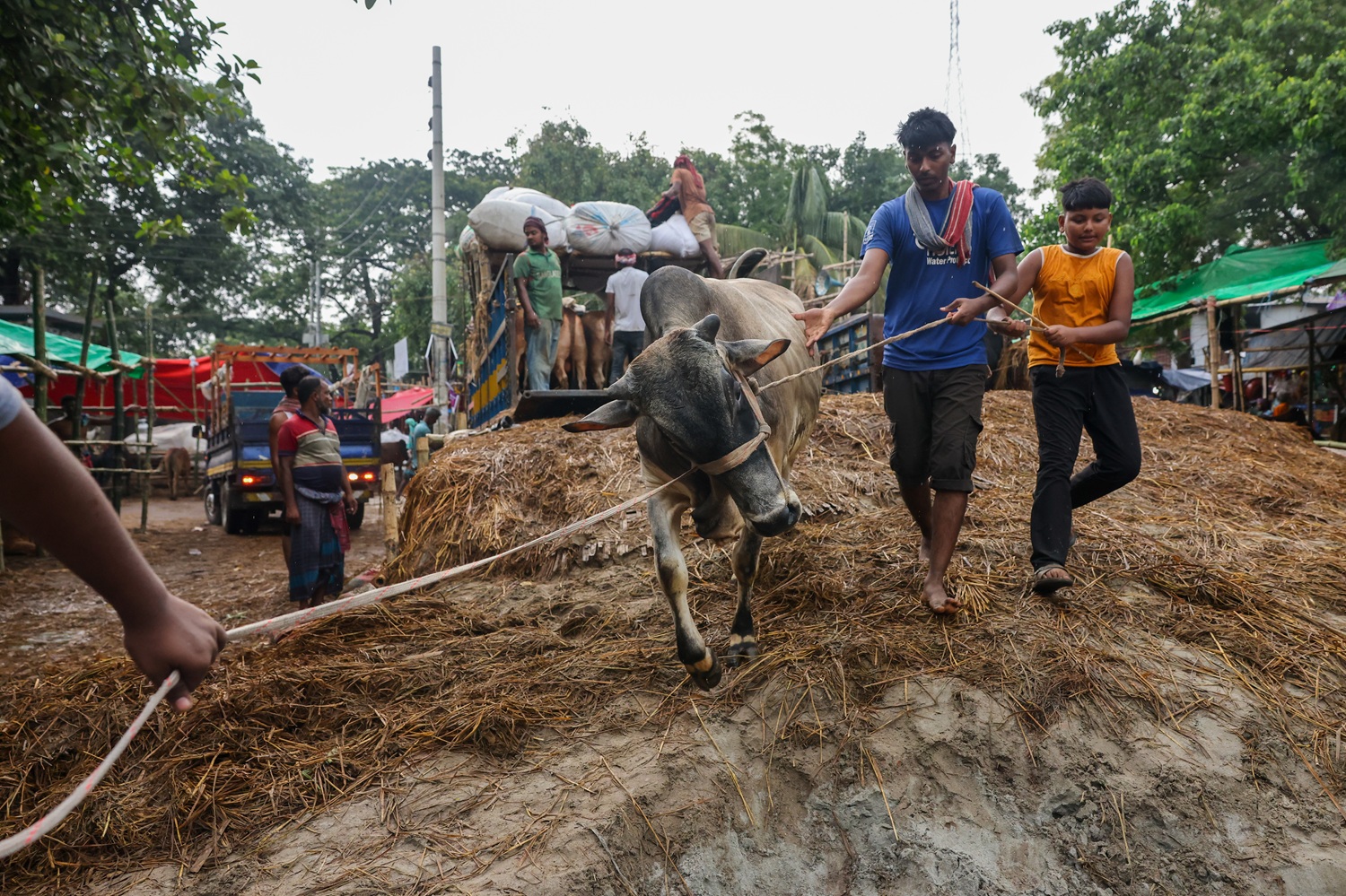
Although his animal has no formal name, Sahabul complained that TikTokers have been aggressively promoting it as “Trump” to garner views, following a previous viral sensation in Narayanganj involving a buffalo with a similar hairstyle to the US president.
“Even when I protest, they dismiss me, saying that whatever name they give is final,” Sahabul remarked with frustration. He also brought another massive black buffalo which TikTokers have provocatively labelled “Danob” (Monster) or “Azrail” (the Angel of Death) due to its thick, twisted horns.
Stars of the haat
Though this year’s market lacks cows marketed under “high-born” pedigrees, traders are compensating with colourful nomenclature to captivate the public. Among the star attractions at Gabtoli are “Raja Babu,” “Kalo Mia,” and “Don.”
Saheb Ali, hailing from Pangsha in Rajbari, is exhibiting a massive 1,400kg Friesian cow named “Raja Babu,” adorned with festive flower garlands and priced at Tk15 lakh.
When visitors enquire about the cow’s history, Saheb Ali confidently directs them to the internet, claiming all the details can be found by searching for “Rajbari’s Raja Babu” on Google.
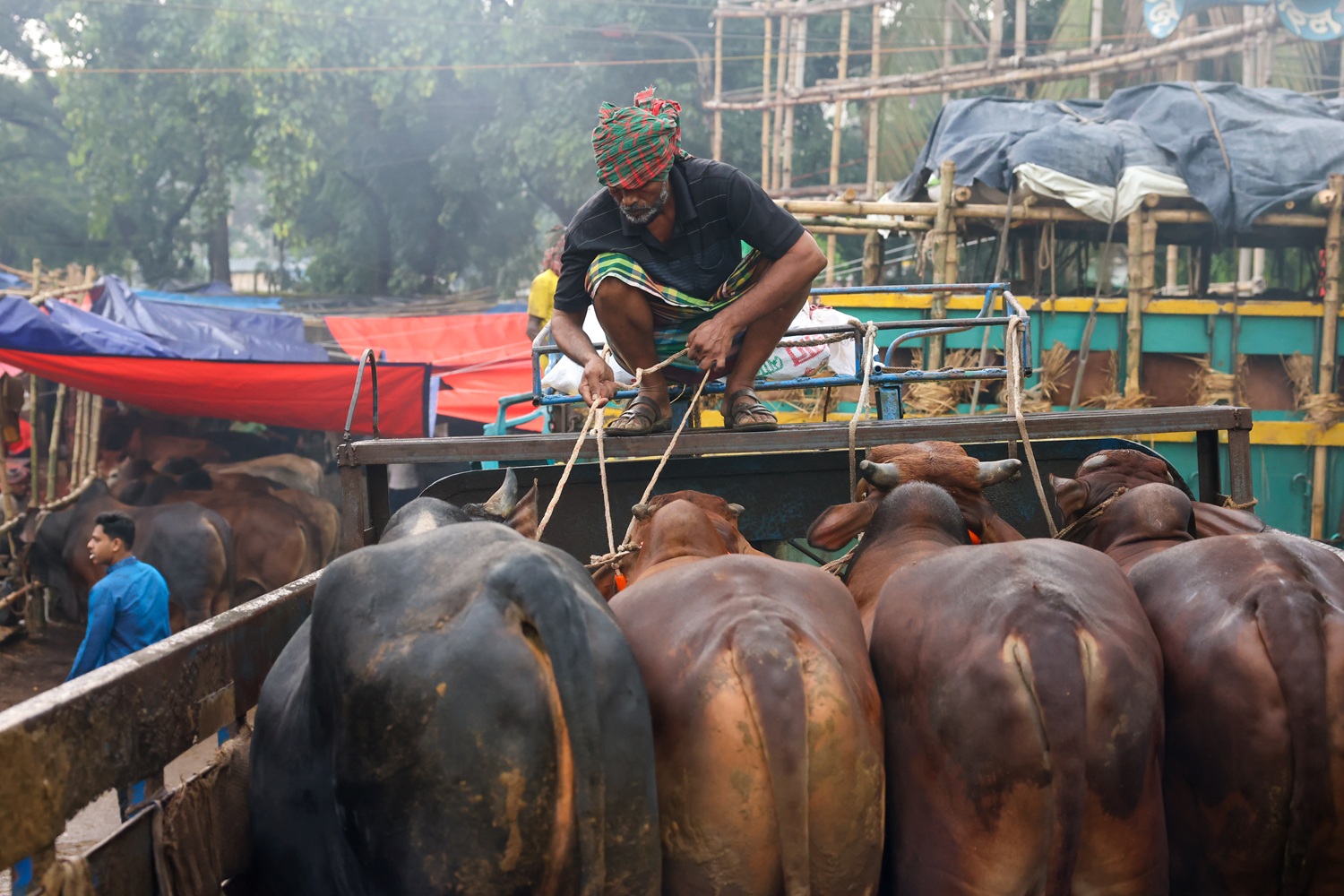
For some, the sale is a deeply emotional family milestone. Jahangir Alam, from Pirganj in Rangpur, arrived with his wife and son to sell their red Shahiwal cow, priced at Tk10 lakh.
He explained that the entire family had spent four and a half years personally caring for the animal at home and, bound by affection, they intend to sleep alongside the cow until a sale is finalised.
Meanwhile, Abdul Wahab from Alamdanga in Chuadanga is showcasing “Kalo Mia,” a 1,500kg beast with an asking price of Tk14.5 lakh. A veteran of the market, Wahab remains unperturbed by the slow start, observing that large cows in Dhaka typically sell at the very last moment.
Market projections and reality
Market leaseholders maintain high expectations for the season’s total turnover.
Robiul Islam, an official at Gabtoli, predicts that total sales will reach approximately 100,000 animals, including cows, buffaloes, goats, and sheep. He noted that while many visitors are currently haggling over the “celebrity” animals, the actual sale of smaller cows has already commenced.
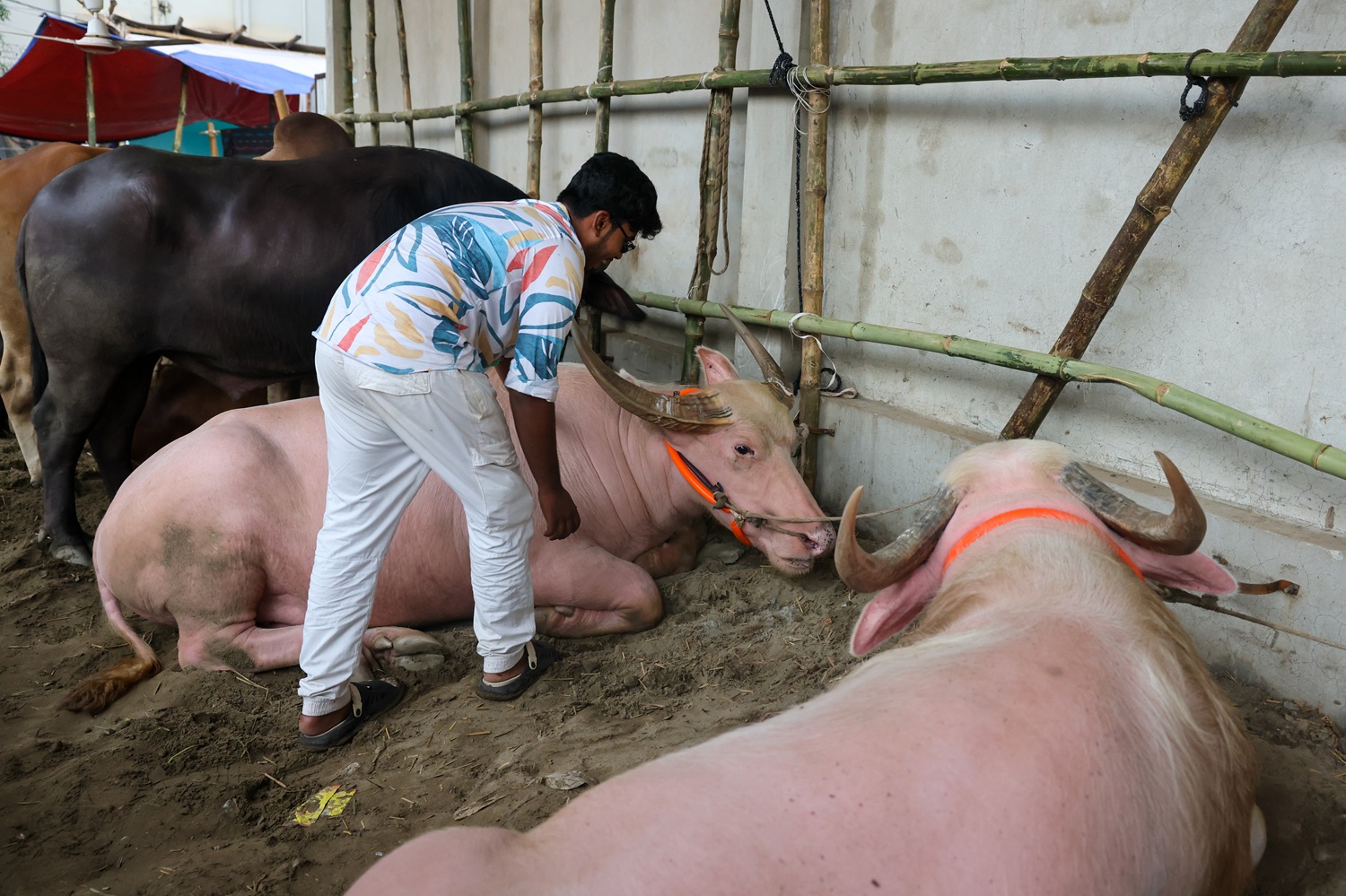
At the Hazaribagh market, leaseholder Humayun Kabir reported that over 5,500 animals have already arrived, with the facility capable of accommodating up to 10,000 livestock.
Despite the headlines generated by massive buffaloes and “buy-one-get-one” deals, the backbone of the trade remains smaller livestock, currently selling for between Tk40,000 and Tk90,000.
Medium-sized local breeds priced between Tk1.5 lakh and Tk2 lakh remain the most sought-after by the city’s residents.