Iran-backed Houthi rebels launched an artillery strike on a residential area in Taiz, Yemen’s third-largest city, on Tuesday, killing two teenage girls and injuring six other civilians.
The attack has renewed international concern over the plight of civilians trapped in the strategically important city, a historical and cultural centre and a gateway to southern Yemen, reports AP.
The Houthis have largely encircled Taiz, cutting off major supply routes and placing residents at “grave risk”, according to United Nations Human Rights Chief Volker Türk. The prolonged blockade has restricted access to food and other essential supplies, while soaring prices have made life increasingly difficult for residents.
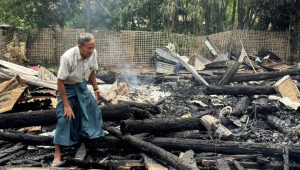
The strike caused extensive damage to the densely populated residential area. Local resident Zainab Ali returned from an errand to find her home flattened.
“We are a family of orphans, and we do not know what to do,” she said.
Türk called for an immediate end to the suffering, urging authorities to ensure the delivery of humanitarian assistance and the safe passage of civilians.

“Humanitarian aid must be immediately allowed to enter the city and its passage must be facilitated. Civilians wishing to leave must be allowed to do so freely and safely,” he said.
He also urged Houthi fighters and Saudi-backed government forces to refrain from using explosive weapons in areas where civilians and infrastructure could be harmed.
Houthi offensive intensifies
Houthi forces resumed their advance towards Taiz last month after taking control of the Red Sea port city of Mokha, a strategic location for maritime shipping. The rebels have continued their months-long bombardment of Yemeni government troops using missiles and artillery.
Late on Tuesday, Yemeni government forces claimed to have repelled Houthi attacks in several sectors of Taiz, saying dozens of rebel fighters had been killed. The claim could not be independently verified, and the Houthis did not comment. The group rarely releases casualty figures.




The attack on Taiz followed a major Houthi assault on the al-Alam military camp on Monday, which killed 73 recruits and wounded more than 200 others as they lined up for training.
A senior Yemeni government official confirmed that it was the deadliest single strike since fighting escalated over the summer.
Videos verified and analysed by the Associated Press (AP) showed numerous motionless bodies lying on the camp’s sandy terrain. Shabwa Governor Awad Ibn al-Wazir told AP that the recruits, aged between 18 and 20, were being trained to provide security in their home province rather than for combat operations.
Ceasefire collapse fuels wider conflict
Yemen’s security situation has deteriorated significantly since July, when government forces and a Saudi-led coalition carried out airstrikes on Houthi-held Sanaa International Airport, shattering a ceasefire agreed in 2022 that had largely halted major hostilities.
Yemen has increasingly become another front in the wider Iran war, which began in February. In response to Saudi Arabia’s continued support for Yemen’s internationally recognised government, the Houthis have intensified cross-border drone and missile attacks against the kingdom.
Yemen descended into civil war in 2014 after Houthi forces captured Sanaa and northern regions, forcing the government into exile. A Saudi-led coalition intervened the following year.
Over the past decade, the conflict has claimed more than 150,000 lives and triggered one of the world’s worst humanitarian disasters.
Britain expands defence support for Saudi Arabia
Saudi Arabia reported intercepting a ballistic missile over its territory on Tuesday. However, despite possessing superior US-supplied weapons, its forces have struggled to counter persistent Houthi drone and missile attacks.
Speaking at the Global Security Forum in Doha, Qatar, Tom Barrack, the US envoy to Syria and Iraq, acknowledged that Saudi Arabia was in a “very difficult position”.
He reiterated that President Donald Trump supported the kingdom logistically but would not commit American troops to ground combat.
“America getting involved in a ground kinetic battle somewhere else seems fruitless,” he said.
Meanwhile, UK Defence Secretary Wes Streeting announced that Britain would expand its military assistance to Saudi Arabia. The support will include defensive Royal Air Force (RAF) air patrols to intercept incoming missiles and drones over Saudi airspace, building on existing in-air refuelling assistance.
Streeting stressed that British aircraft would not carry out strikes against Houthi ground targets inside Yemen.
A regional official, speaking on condition of anonymity, also revealed that the Egyptian government planned to deploy air defence systems and military aircraft to help protect Saudi Arabia.
The deployment, which requires parliamentary approval, would focus exclusively on air defence and would not involve Egyptian ground troops in Yemen.