




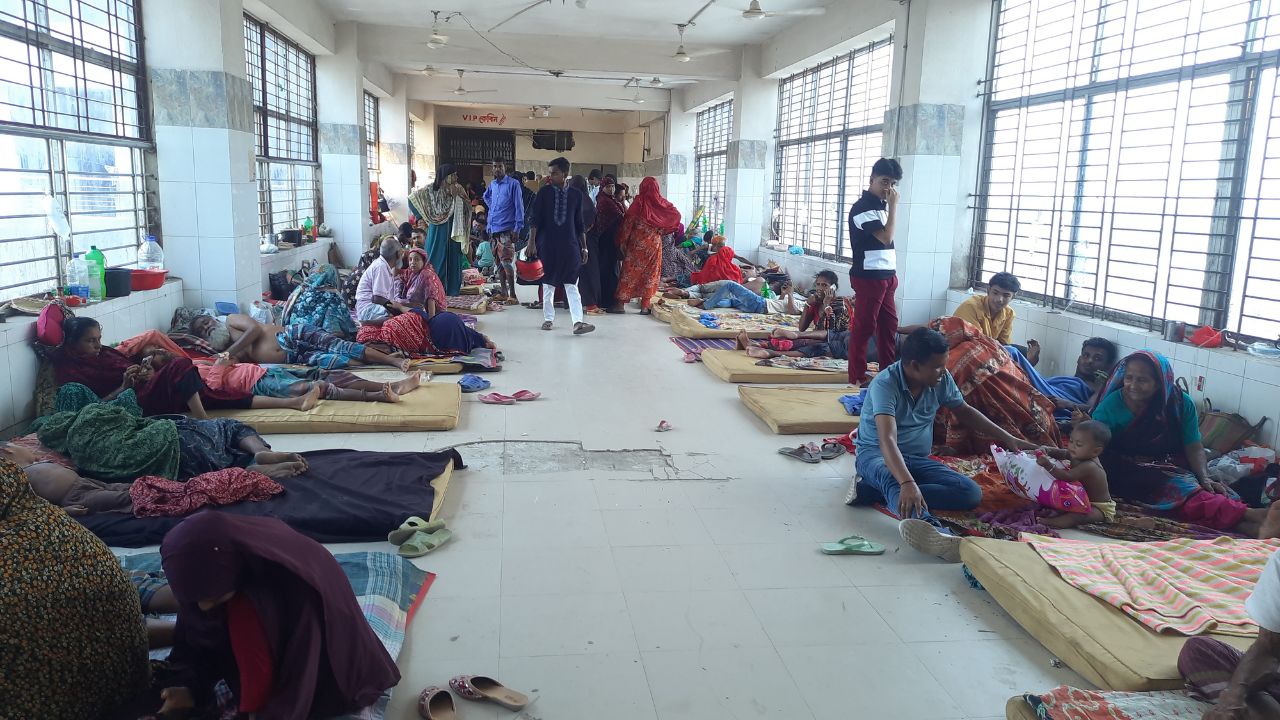
A patient accompanying a relative at Magura 250-bed District Sadar Hospital’s female ward ended up being admitted herself, as growing reports of service disruption and overcrowding continue to highlight the strain on the facility.
The two sisters from Atharokhada village are currently undergoing treatment on adjacent beds. According to hospital sources, the younger sister fell ill while attending to her elder sibling and was subsequently hospitalised.
Both are now receiving saline therapy from a shared stand, an image that locals say reflects the wider condition of the district’s largest public healthcare facility.
Despite having a modern seven-storey building and expanded infrastructure on paper, the hospital is struggling with management shortcomings, shortage of doctors and nurses, poor sanitation, alleged broker activity and frequent irregularities.
Patients are often referred to Faridpur or Dhaka for even moderately complex conditions, leaving hundreds of people from four surrounding upazilas facing daily hardship.
College teacher Latif Jamil from College Para said he brought his elder brother to the hospital the previous day, only to be advised immediate referral to Dhaka Medical College Hospital after preliminary examinations suggested a stroke. He said the decision came so quickly that the family had no time to stabilise the patient locally.
“At Magura Sadar Hospital, any complicated case is immediately referred to Dhaka or Faridpur. Many patients reportedly die on the way due to lack of treatment here. We want urgent improvement in this situation,” he said.
Residents also complain of deteriorating hygiene conditions. Saidur Rahman of Police Line Para said he has been staying in the hospital for four days with his wife. “The environment is so poor that attendants themselves become ill. Cockroaches and bedbugs are everywhere, toilets do not drain properly, basins are broken and regular cleaning is absent,” he said.
Small trader Mominur Rahman from Nanduali said he was forced to lie on the floor due to a lack of beds, while most medicines had to be purchased externally.
A doctor, speaking anonymously, acknowledged that the hospital’s 250-bed capacity is far below actual patient demand, forcing many to remain on floors. He also cited severe shortages of medical staff, saying a single doctor often has to handle an overwhelming number of patients.
Hospital Superintendent Dr Mohsin Uddin Fakir admitted the imbalance between staff and patient load, adding that personnel are trying their best under constrained conditions. He said steps would be taken to address existing challenges.
Healthcare is a fundamental right, but the situation at Magura Sadar Hospital continues to raise serious questions about service delivery. Without urgent reforms in staffing, medicine supply, sanitation, lift maintenance and governance, residents say the pressure on patients is likely to worsen further.


