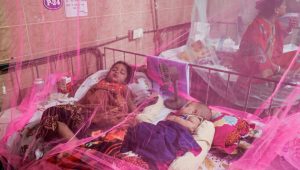
After the July 2024 Mass Uprising, people hoped for health sector reform, but 18 months on, progress is minimal and inefficiencies persist.
The government remains partially optimistic, seeing 2025 achievements as a stepping stone for wider 2026 reforms, while experts pin their hopes on the next administration to drive meaningful change.
The Health Sector Reform Commission, formed by the interim government to build a people-oriented and effective healthcare system, submitted its report to Chief Adviser Muhammad Yunus on 5 May.
Led by National Professor AK Azad Khan, it was hailed as one of the country’s most significant reform proposals.
The Ministry of Health categorised the recommendations into short, medium, and long-term phases, pledging to fast-track 33 “immediately implementable” measures in 2025. These included legal reforms, transparent appointments, a digital complaint system, simplified hospital licensing, e-GP, a central ambulance network, and a national e-prescription system.
In early 2025, a Bangladesh Bureau of Statistics (BBS) survey titled Health Sector Reform 2025, conducted among 8,256 households, revealed overwhelming public backing for structural change.
The findings show that 91.3% support recognising primary healthcare as a constitutional right, 92.6 per cent favour introducing health cards to improve access and tracking, and 97.0 per cent endorse free primary healthcare.
However, visible progress on healthcare reform remains absent.
Despite the commission’s tireless work – submitting reports, publishing articles, and sending letters – no ministry officials have formally engaged or provided feedback, Health Sector Reform Commission Member Professor Md Muhammad Zakir Hossain told TIMES of Bangladesh.
He expressed frustration over the government’s inaction. “The sad part is, Ministry has not officially had a meeting with us. No one felt the need to provide feedback or explanations,” he said, underscoring the disregard for the commission’s efforts.

The disconnect between experts and bureaucrats appears total, with the ministry’s perceived apathy stifling transformative proposals, including the formation of an independent health commission to ensure accountability.
While minor changes, like reduced heart ring prices, have occurred, key measures – such as lowering dialysis and cancer treatment costs and cutting raw material taxes for pharmaceuticals – remain unimplemented.
“Only a very small number of recommendations have been acted upon,” Professor Zakir added.
This sentiment is echoed by Professor Rashid-e-Mahbub, senior physician and former president of the Bangladesh Medical Association.
He said that although the Health Sector Reform Commission submitted a report aimed at improving the country’s struggling healthcare system, no visible changes have occurred in practice.
He added, “Without proper evaluation of the report and concrete steps for its implementation, the intended benefits of the reforms are not being realised.”



Dr Mohammad Mushtuq Husain, adviser to IEDCR, said that beyond data collection and lists of the injured from the July protests, little visible work has been done.
“Some minor and less significant initiatives were attempted, but even those could not be implemented,” he said.
He blamed the lack of an independent health commission, a separate public health secretariat, and reform of the BCS health structure for the stalled reforms.
“Without an independent health commission, a separate public health secretariat, and reform of the BCS health structure, this change will not start,” he asserted.
On the stalled report, he added, “The last hope now lies with the future elected government. If political parties prioritize health then real change can be expected.”
Professor Zakir shared this guarded optimism, hoping that a future administration will recognize the tireless work put into the recommendations.
“A future government will follow the report and give proper attention to health sector reforms,” he hoped.
Senior physician and former president of the Bangladesh Medical Association, Professor Rashid-e-Mahbub expressed profound disappointment, stating that the commission’s potential has been squandered by a lack of political will.
“Reform will not happen unless there are clear goals, political will, and prioritization of public demand,” Professor Mahbub said.
Not only the general public, but also public health experts and veteran medical professionals are frustrated with the state of the health sector. The much-needed changes that people hoped to see after the mass July Uprising in this critical sector have yet to be realized.
Professor Mahbub said the health sector has grown more complicated over the past year.
“While attempting new measures, the old systems have not been properly managed. Priority is given to the wealthy and medical community, not the people,” he said.
He noted that ordinary citizens need basic services—doctors, essential medicines and tests, safe water, pollution-free food, vaccinations, and maternal and child care—but poor planning keeps meaningful reform out of reach.
“Still, if even limited resources are used honestly, progress is possible,” he added.
The health sector crisis in Bangladesh is not just a matter of intent but also of execution. Even though the Health Sector Reform Commission recommended allocating 5 percent of GDP to healthcare, government health authorities have repeatedly failed to spend their existing budgets effectively.
Over the past five years, allocations for the Health Services Division and the Health Education and Family Welfare Division have consistently fallen short of recommended levels, and a significant portion of even these funds remains unspent.
In 2024–25, for example, only 21.74 per cent of the Health Services Division’s allocation and 15.36 per cent of the Health Education and Family Welfare Division’s allocation were utilized.
According to updated data from the Implementation, Monitoring, and Evaluation Division (IMED), in the first five months of the current fiscal year, both divisions have spent just a fraction of their ADP allocations – 3.92 per cent and 1.81 per cent, respectively.
KM Nafiz Ifteakhar Tulon, associate professor at the Institute of Health Economics, University of Dhaka, highlighted a paradox in the health budget. While the commission recommended more funds to hire staff and provide free medicine, the system struggles to use existing allocations effectively.
“How and where will this money be spent?” Ifteakhar questioned, citing inefficiencies, complex procurement, and restrictive audits. He noted that field-level hospitals cannot plan based on real needs, leaving critical services neglected in favour of top-down directives.
“Large health allocations should be disbursed in phases through long-term planning,” he suggested, calling for a 20-year roadmap with sustainable funding from new taxes or reallocated expenditures.
When asked Secretary of the Health Services Division Md Saidur Rahman said the government has made implementing the Health Sector Reform Commission’s recommendations a high priority.
“Overall, the progress of the proposals can be described as positive and dynamic,” he added.
Draft laws for the Health Protection Act, Health Information Protection Act, and Primary Health Care Ordinance are underway, while institutional reforms – including the Bangladesh Health Commission, digital health systems, National Health ID, e-prescriptions, and mandatory e-GP – have begun implementation.
Efforts also focus on service quality, such as strengthening primary care, building a national ambulance network, and improving medicine management.
Rahman said 2025 health sector changes mark the start of structural reform. Key steps include abolishing medical admission quotas, forming the Accreditation Council, launching digital health initiatives, and enhancing transparency and accountability.
He noted that while these reforms establish a foundation, many are still in early stages and require more time for full impact. Government satisfaction is partial but optimistic, seeing 2025 achievements as a base for broader reforms in 2026.