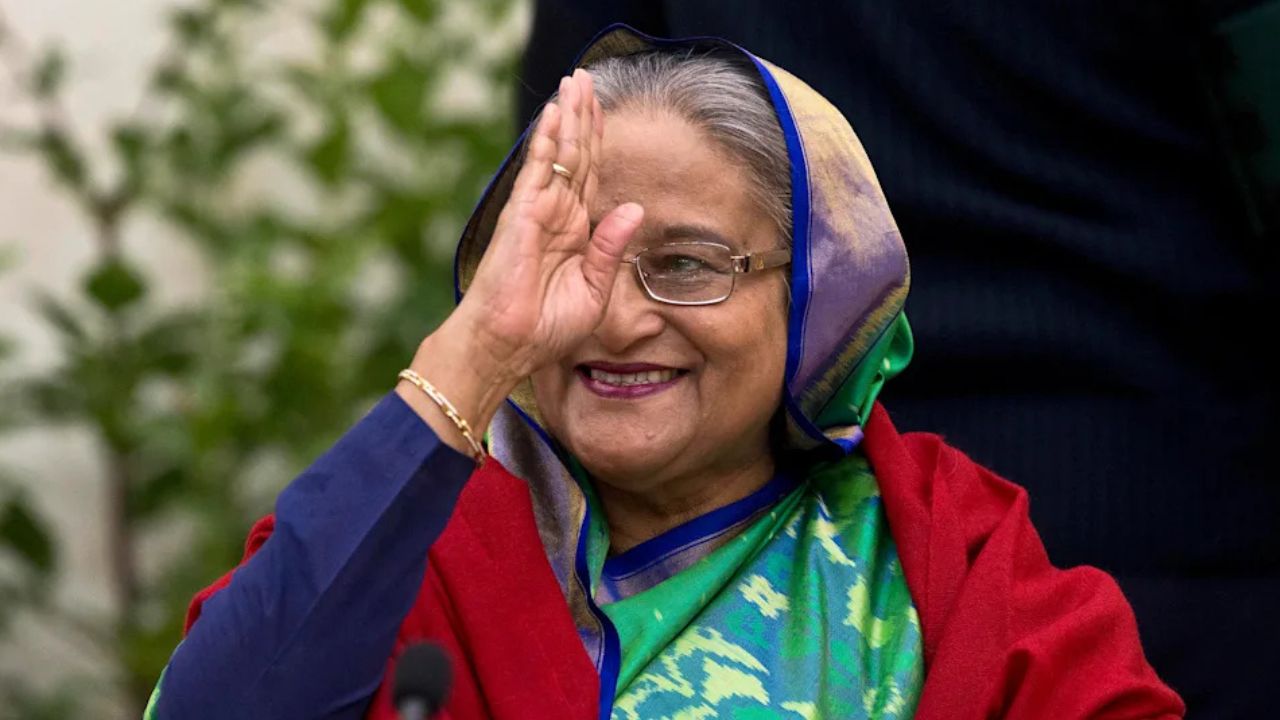
India’s Ministry of External Affairs has clarified that the voluntary plan of former Bangladesh prime minister Sheikh Hasina to return home and Dhaka’s formal request for her extradition are two distinct matters.
Randhir Jaiswal, spokesperson for the Ministry of External Affairs of India, clarified the position in response to questions from journalists during a press briefing in New Delhi on Wednesday evening.
Addressing the media, Jaiswal explained that there are two separate issues at play. One involves Bangladesh’s request for Hasina’s extradition, which is currently being examined under India’s established legal procedures.
The other concerns a citizen wishing to return to her country voluntarily with the required travel documents, a situation he noted is entirely separate from an extradition request.
Hasina fled to India on 5 August 2024 after stepping down from power amid a student-led mass uprising and has been staying under Indian shelter since then.
On 17 November 2025, International Crimes Tribunal-1 sentenced her to death in a case concerning crimes against humanity committed during the July mass uprising.

The government of Bangladesh has repeatedly urged India to return her, submitting formal extradition requests under the bilateral extradition treaty between the two nations.
Planned return and extradition demands
The issue gained fresh momentum following a report by news agency Reuters, which cited Hasina’s spokesperson saying that the ousted prime minister plans to return to Bangladesh from Delhi on 16 December.
The report added that she has requested the arrangement of a flight by the national flag carrier, Biman Bangladesh Airlines, to facilitate her return.




Responding to the news, the Bangladesh government emphasised that as a death-row convict, Hasina must return under the terms of the existing extradition treaty.
Zahed Ur Rahman, adviser to the prime minister, said discussions would be held with Indian authorities regarding the matter.
Meanwhile, when journalists drew attention to statements from Hasina’s aides demanding a flight to bring her back, as well as counter-claims by some in the Bangladesh government that she would be brought back in handcuffs, Jaiswal replied that this remains an issue between the former prime minister of Bangladesh and the current government of that country, adding that India has no role in it.
Concerns over reports of attacks on minorities
During the briefing, questions were also raised regarding reported attacks on minority Hindus in areas such as Narail and Pabna in Bangladesh. Journalists pointed out that Narail is the ancestral in-law’s home of Pranab Mukherjee, former president of India, and asked how New Delhi views the violence.


Jaiswal described the reports of attacks on minority Hindus as concerning, adding that the government of Bangladesh ought to conduct thorough investigations into all such incidents and bring the perpetrators to justice.
Following the reports regarding Narail, the district police issued a press release declaring that information circulating on Facebook about vandalism, arson, and looting of Hindu homes in Bendarchar village was completely false and fabricated.
The police clarified that there is no Hindu settlement in Bendarchar and confirmed that no attacks had taken place on Hindu families or their commercial establishments.

Border visits, Ganges treaty, and Indonesian interception
The press briefing also touched upon visits by leaders of the Awami League – whose political activities are banned in Bangladesh – to the Benapole-Petrapole border area while taking shelter in India.
The leaders reportedly told media outlets that they intended to inspect other land ports as well to assess the feasibility of Hasina returning via land routes. When asked whether the Indian government was facilitating these movements, Jaiswal avoided giving a direct answer.
On the topic of renewing the Ganges Water Sharing Treaty, Jaiswal offered no new updates.
He reiterated past comments, explaining that decisions regarding the sharing of waters for all common rivers, including the Ganges flowing through both nations, are determined through the structured framework of the Joint Rivers Commission.
Finally, Jaiswal was asked about reports indicating that the Indonesian Navy had intercepted a Bangladesh-bound vessel carrying substantial quantities of explosives and equipment used for weapons manufacturing.
He confirmed that a report on the incident had come to the government’s notice, noting that India continuously monitors all developments in neighbouring countries and takes appropriate steps whenever required.