






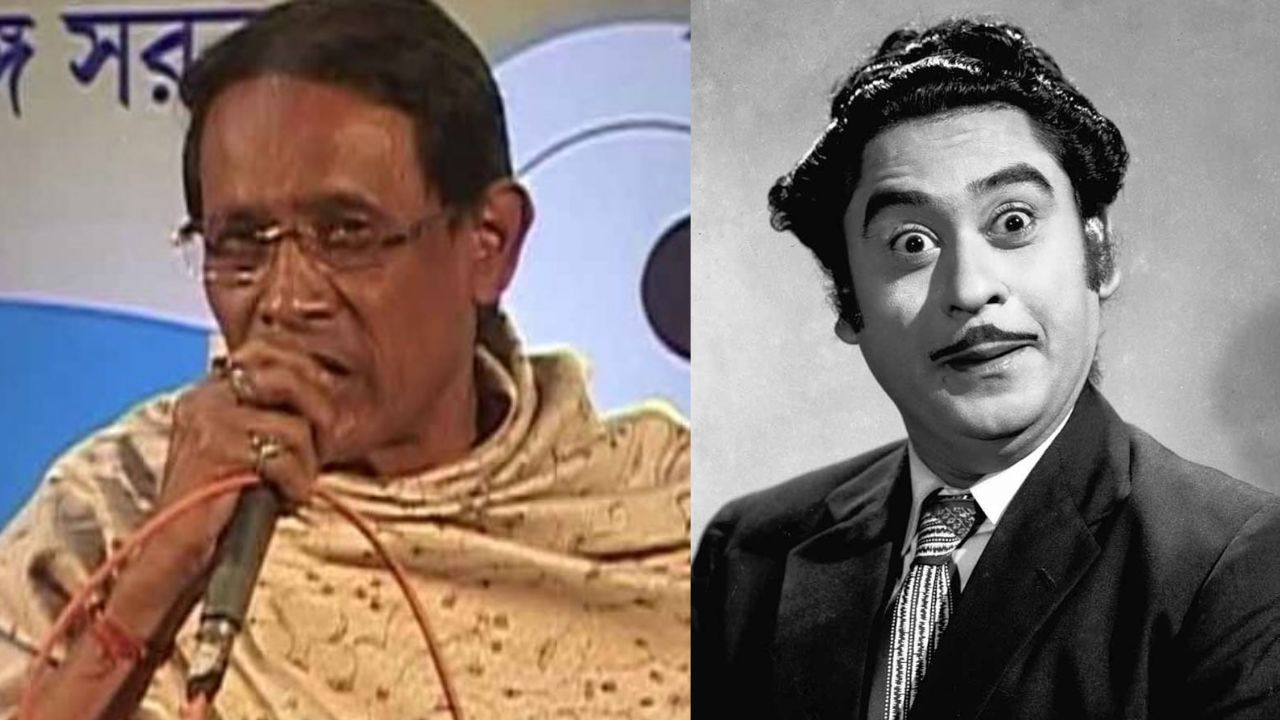
The Indian subcontinent celebrated the birth anniversary of Kishore Kumar yesterday, honouring one of the greatest singers, actors, composers and filmmakers in South Asian cinema.
Born on 4 August 1929, in Khandwa, Madhya Pradesh, Kishore Kumar remains an enduring icon whose magical voice, unmatched versatility and signature yodelling style transformed Indian music.
His contribution to both Hindi and Bengali songs continues to inspire generations, even decades after his death on 13 October 1987, at the age of 58.
Among those who continue to draw inspiration from him is renowned Bengali singer Gautam Ghosh, popularly known as a “Kishore Kanthi” (a singer who performs in Kishore Kumar’s style).
Speaking to an Indian media outlet on the legendary singer’s birth anniversary, Ghosh shared how Kishore Kumar shaped both his life and career.
“If anyone comes after my parents in my life, it is Kishore Kumar,” Ghosh said.
“He is my god and my provider. Had he never sung, I would never have become a singer. Perhaps I would have ended up as a government clerk. Even today, I live because of Kishore Kumar.”
Ghosh said he fell in love with Kishore Kumar’s music as a child and gradually began to understand the depth of his artistry.
“I became Gautam Ghosh simply by singing his songs,” he recalled. “Everything in my musical journey began with him.”
He started by performing Kishore Kumar’s songs at neighbourhood events before turning professional in 1974.
His first payment for singing was only three or four rupees, but it helped support his family.
“I had elderly parents and five sisters to look after,” he said. “I managed to run my entire family by singing Kishore Kumar’s songs. As time passed, my earnings increased through stage shows and musical performances.”
Despite performing Kishore Kumar’s songs for years, Ghosh longed to meet his idol.
In 1984, he travelled to Mumbai—not to build a career, but simply to see Kishore Kumar in person.
“I would go wherever he was recording,” Ghosh said. “I watched how he sang, walked, spoke and expressed himself. I tried to learn everything from him.”
His dream finally came true in 1985 when recording engineer Abhinandan Thakur introduced him to the legendary singer at Mehboob Studio.
“I sang four lines of Mere Naina Sawan Bhadon for him,” Ghosh recalled. “He neither praised nor criticised me. At first I addressed him as ‘Sir’, but later he became ‘Dada’ to me.”
He also had the opportunity to visit Kishore Kumar’s famous Mumbai residence, Gouri Kunj, where they spent around 20 to 25 minutes talking over tea.
“That time still feels like a dream,” he said.
According to Ghosh, Kishore Kumar offered advice that has stayed with him throughout his career.
“He told me not to imitate him,” Ghosh said. “‘Listen to every singer and learn from everyone. That is how you develop your own identity.'”
Kishore Kumar also encouraged him to fully understand a song’s lyrics before performing.
“He said you must memorise the words and absorb their meaning so deeply that you can sing without looking at the lyrics. Only then can you deliver the right emotion.”
The legendary singer also shared practical tips about vocal care.
“He advised me not to overwork my voice and to perform only as much as necessary,” Ghosh said. “He believed singers should treat singing as naturally as speaking.”
One of Ghosh’s proudest achievements was installing a statue of Kishore Kumar in Kolkata’s Tollygunge studio district.
The statue was unveiled by actor Mithun Chakraborty on 18 August 2000.
He also recalled witnessing what he believes was Kishore Kumar’s final recording session.
“On 12 October, Kishore Kumar and Asha Bhosle recorded the duet Guru Guru for the film Waqt Ki Awaz, composed by Bappi Lahiri for Mithun Chakraborty and Sridevi,” Ghosh said. “The next afternoon, the news came that my guru was gone.”
Despite the passage of time, Ghosh says his admiration remains unchanged.
“My only regret is that such a great artist never received India’s highest civilian honour,” he said. “I hope Kishore Kumar is awarded the Bharat Ratna posthumously. I will continue to demand it till my last day.”
Today, Ghosh treasures one deeply personal keepsake—a pair of Kishore Kumar’s shoes, gifted to him by the singer’s son, Amit Kumar.
“Before every performance, I bow before those shoes,” he said. “If I could meet my guru just once more, I would place my head at his feet and cry. I know he would have embraced me.”


