Bangladesh’s export earnings edged down 0.5 per cent year-on-year in January to $4.41 billion, according to data released by the Export Promotion Bureau (EPB) on Monday.
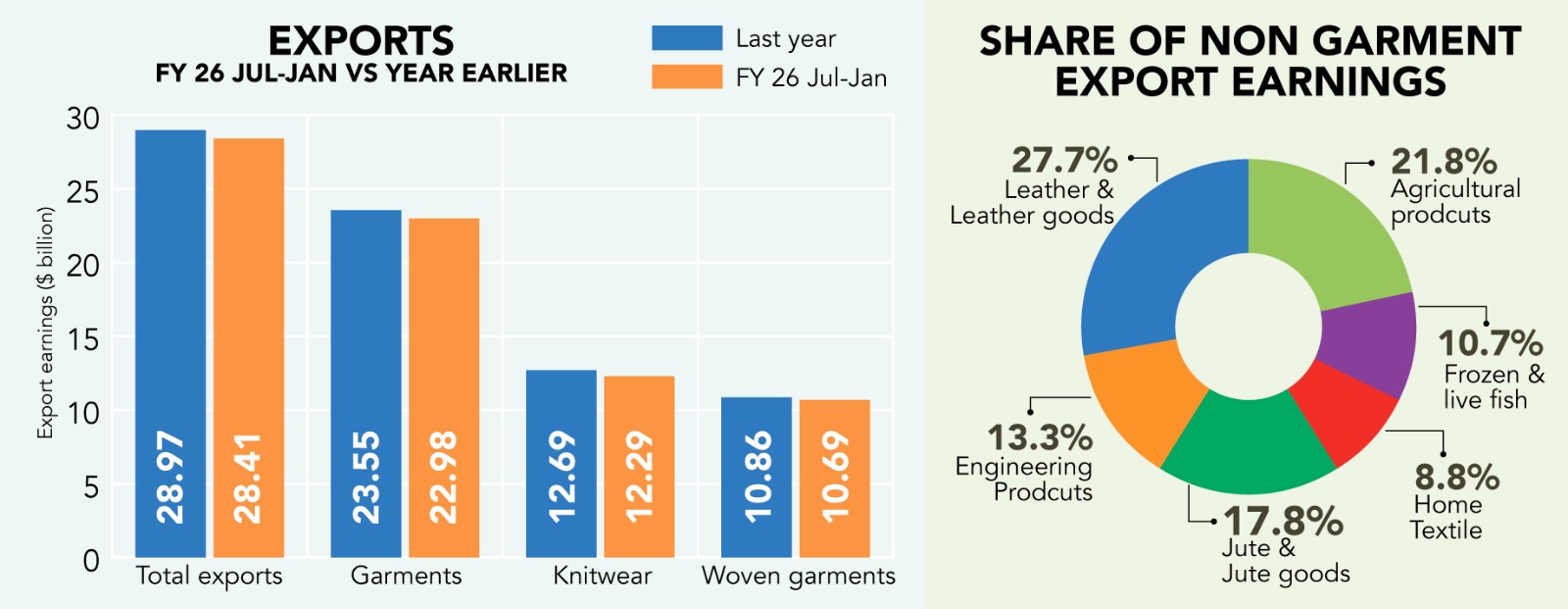
Besides, total export receipts in the July-January period of the current fiscal year fell 1.93 per cent to $28.41 billion.
So, although exports rebounded 11.12 per cent month-on-month from December, this performance reflects continued pressure on external trade amid weak global demand, the data shows.
Md Rezwan Selim, vice-president of the Bangladesh Garment Manufacturers and Exporters Association (BGMEA), said several uncertainties persist despite recent improvements.
He said foreign buyers remain concerned about election-related tensions and the ongoing instability at Chattogram port, warning that export trade could come under threat if these issues are not resolved.
The slowdown was largely driven by the garments sector, which accounts for more than 80 per cent of export earnings.
Apparel exports fell 2.43 per cent to about $22.98 billion in the past seven months. Of the total, knitwear exports dropped 3.13 per cent to contribute $12.29 billion, while earnings from woven garments declined 1.60 per cent to $10.69 billion.
The value of garment exports in January was $3.61 billion, down 1.35 per cent year-on-year. Knitwear fetched some $1.80 billion over the month, while woven garments earned about $1.81 billion, with both registering slight declines.


After a strong start in July, the sector experienced several consecutive months of contraction, culminating in a sharp fall in December before easing in January.
Industry insiders attributed the weaker performance to subdued consumer spending in the Western markets along with persistent inflation and cautious order placements by foreign buyers.
“Global demand remains soft due to inflationary pressure and geopolitical uncertainties, which is affecting the order volumes,” said Mohiuddin Rubel, former director of the BGMEA.
He added that exports could gradually stabilise as inventories ease and sourcing activities pick up.
Despite the drag from garments, several sectors posted solid growth, helping cushion the overall decline.
Earnings from leather and leather goods exports edged up 5.71 per cent to $770.24 million in the July-January period thanks to higher sales of footwear.
Engineering products emerged as a standout, with exports surging 25.87 per cent to $369.40 million driven by iron and steel items, electric goods and bicycles.
The jute and jute goods sector notched 1.97 per cent export growth, reaching $493.85 million due to strong demand for sacks and bags despite weaker raw jute and yarn exports.
Home textiles saw robust expansion of 32.36 per cent, with export receipts hitting $243.92 million over the past seven months.
Meanwhile, frozen and live fish exports rose 23.5 per cent to $297.56 million, while shipments of agricultural products declined 9.88 per cent to $607.28 million.
Overall, stronger performance of non-garment sectors indicates gradual diversification of Bangladesh’s export basket, partially offsetting weakness in the apparel industry.