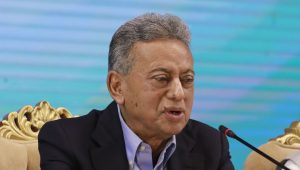



EXIM Bank, one of five crisis-stricken shariah-based banks under pressure to merge, has requested two years to recover independently. The bank’s chairman and sponsor shareholder, Nazrul Islam Swapan, said on Sunday that steps were already being taken to reduce non-performing loans and restore solvency.
“If we are given two years, EXIM will recover,” Swapan told reporters after arriving at Bangladesh Bank’s headquarters for a scheduled meeting with Governor Ahsan H Mansur. The meeting, part of the central bank’s formal consultation process with troubled banks, was postponed after the governor fell ill.
From the outset, EXIM Bank has been reluctant to join the merger process. Instead, it has argued for time to implement reforms. However, the central bank has made it clear that EXIM can only avoid consolidation if it clears Tk 8,000 crore borrowed from Bangladesh Bank and meets regulatory requirements, including the cash reserve ratio (CRR) and statutory liquidity ratio (SLR).

Swapan said the bank’s directors had come prepared with a roadmap outlining how EXIM could stabilize within two years. “We came to present our proposal to recover without a merger. Now that the meeting is deferred, we will return with even better preparation,” he added.
Bangladesh Bank sources confirmed that the ongoing meetings with EXIM and other banks aim to assess each institution’s position on the merger and their proposed recovery strategies. Boards were instructed to discuss the matter in advance. EXIM held its board meeting on August 28, while Social Islami Bank’s board met on Sunday.



Regulators are expected to demand updates on capital adequacy, liquidity support, non-performing loans, CRR, SLR, and provisioning shortfalls. They will also share findings from the recent asset quality review (AQR), conducted by foreign audit firms. The review, commissioned after the August 5 change in government, has revealed the depth of the sector’s crisis.
The AQR showed that the five banks together hold deposits of Tk 1,47,368 crore against loans of Tk 1,90,484 crore. Of this, Tk 1,46,918 crore has defaulted—nearly 77 percent of the total loan portfolio. In effect, the defaults almost match the value of total deposits.
The picture across individual banks is dire. Union Bank has defaulted on nearly 98 percent of its loans, First Security Islami on more than 96 percent, and Global Islami on 95 percent. Social Islami Bank has defaulted on about 62 percent of loans, while EXIM Bank’s figure stands at 48 percent. Although EXIM’s ratio is lower than the others, nearly half of its loan book remains non-performing.
According to officials, Bangladesh Bank will continue discussions this week, meeting one troubled bank per day. Each bank will be required to explain how it plans to address gaps in capital, provisioning, liquidity, and overall governance. The central bank has signaled that mergers remain the preferred route unless individual banks demonstrate credible plans backed by measurable improvements.