




US President Donald Trump’s threat to impose new tariffs on eight European allies opposed to his proposed takeover of Greenland has drawn sharp condemnation from EU leaders.
UK Prime Minister Keir Starmer branded the move “completely wrong”, while French President Emmanuel Macron called it “unacceptable”, reports BBC.
Trump announced that a 10 percent tariff on goods from Denmark, Norway, Sweden, France, Germany, the UK, the Netherlands and Finland would take effect on 1 February, potentially rising to 25 percent later in the year. He said the measure would remain until a deal was struck for the “Complete and Total purchase of Greenland.”
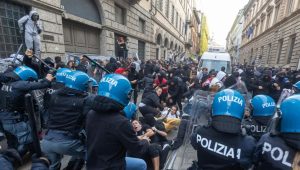
Insisting the autonomous Danish territory is vital for US security, Trump has not ruled out taking it by force. His stance has triggered protests in Greenland and Denmark, where thousands marched on Saturday against the proposed US takeover.
Greenland, sparsely populated but rich in resources, occupies a strategic position between North America and the Arctic, making it key for missile early-warning systems and regional surveillance.

Trump has previously warned Washington would secure the territory “the easy way” or “the hard way.” European nations have rallied behind Denmark, arguing Arctic security should remain a collective NATO responsibility. France, Germany, Sweden, Norway, Finland, the Netherlands and the UK have already deployed small contingents to Greenland on a reconnaissance mission.
In a post on Truth Social, Trump accused those countries of playing “a very dangerous game”, claiming the issue concerned the “Safety, Security, and Survival of our Planet.”
Starmer said, “Applying tariffs on allies for pursuing the collective security of Nato allies is completely wrong. We will of course be pursuing this directly with the US administration.”




Macron said, “Tariff threats are unacceptable in this context… We will not be swayed by any intimidation.”
Swedish Prime Minister Ulf Kristersson added, “We won’t let ourselves be blackmailed. Sweden is currently having intensive discussions with other EU countries, Norway and the United Kingdom to find a joint response.”
The 10 percent tariff rate would climb to 25 percent on June 1 if no deal was in place for “the Complete and Total purchase of Greenland” by the United States, he said.
The Republican president appeared to indicate that he was using the tariffs as leverage to force talks with Denmark and other European countries over the status of Greenland, a semiautonomous territory of NATO ally Denmark that he regards as critical to US national security.
“The United States of America is immediately open to negotiation with Denmark and/or any of these Countries that have put so much at risk, despite all that we have done for them,” Trump said on Truth Social.
The tariff threat could mark a problematic rupture between Trump and America’s longtime NATO partners, further straining an alliance that dates to 1949 and provides a collective degree of security to Europe and North America. Trump has repeatedly tried to use trade penalties to bend allies and rivals alike to his will, generating investment commitments from some nations and pushback from others, notably China.
Trump is scheduled to travel on Tuesday to the World Economic Forum in Davos, Switzerland, where he likely will run into the European leaders he just threatened with tariffs that would start in little more than two weeks.
French President Emmanuel Macron pushed back against Trump in a social media post that seemed to equate the threat to Russian leader Vladimir Putin’s war in Ukraine.
“No intimidation or threats will influence us, whether in Ukraine, Greenland or anywhere else in the world when we are faced with such situations,” Macron said in a translated post on X. “Tariff threats are unacceptable and have no place in this context. Europeans will respond in a united and coordinated manner.”
There are immediate questions about how the White House could try to implement the tariffs because the EU is a single economic zone in terms of trading, according to a European diplomat who was not authorized to comment publicly and spoke on the condition of anonymity. It was unclear, too, how Trump could act under US law, though he could cite emergency economic powers that are currently subject to a US Supreme Court challenge.
Trump has long said he thinks the US should own the strategically located and mineral-rich island, which has a population of about 57,000 and whose defense is provided by Denmark. He intensified his calls a day after the military operation to oust Venezuela’s Nicolás Maduro earlier this month.