




Finance and Planning Minister Amir Khosru Mahmud Chowdhury has said Bangladesh’s economy has once again been turned around from a difficult situation, attributing the achievement to the country’s private sector-led growth model.
“Bangladesh has been unfortunate that whenever the BNP comes to power, it inherits the country at a time when the economy is in a devastated condition. The good thing is that we have been able to turn around the economy like in the past, even after taking responsibility during difficult times,” he said.
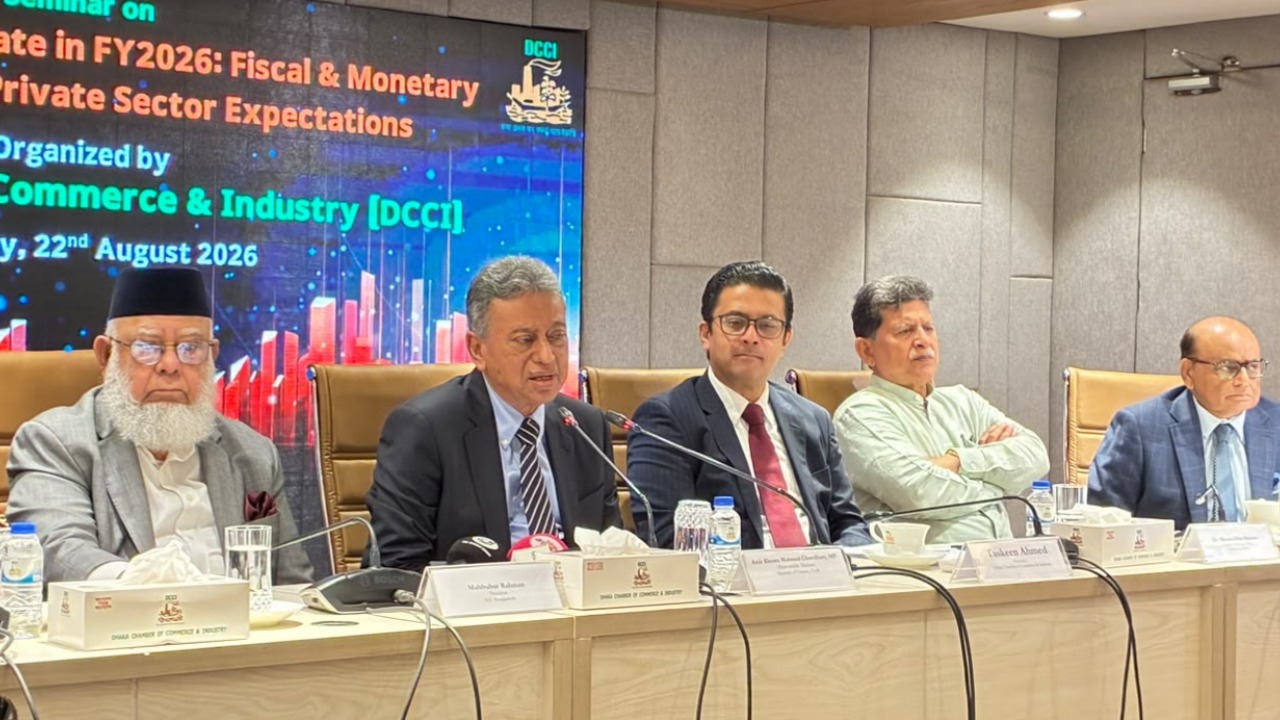
The minister made the remarks on Saturday while addressing a seminar titled “Biannual Economic State in FY2026: Fiscal & Monetary Perspective and Private Sector Expectations” organised by the Dhaka Chamber of Commerce and Industry (DCCI) at its auditorium.
DCCI President Taskeen Ahmed delivered the welcome remarks and presented the keynote paper at the seminar.
Policy Research Institute of Bangladesh Chairman Zaidi Sattar, International Chamber of Commerce Bangladesh President Mahbubur Rahman, and Power and Participation Research Centre Executive Chairman and BRAC Chairman Hossain Zillur Rahman attended the event as special guests.
Managing Director and CEO of Mutual Trust Bank PLC Syed Mahbubur Rahman, Group CEO of Transcom Limited Simeen Rahman, Bangladesh Institute of Development Studies Director General A K Enamul Haque, and Centre for Policy Dialogue Distinguished Fellow Professor Mustafizur Rahman took part in the panel discussion.
Khosru said private sector-led growth was one of the core principles of the BNP’s economic philosophy, with the government’s role being to create an enabling environment for businesses.
“The Prime Minister’s economic philosophy is that Bangladesh will have a private-sector-driven economy, where the private sector will drive growth and the public sector will facilitate that process. We are trying to do that together with all of you,” he said.
The finance minister said increasing investment was essential to overcoming the country’s economic challenges.
“If there is no investment within the country, foreign investors won’t come. The confidence and incentives needed to attract foreigners won’t be created unless Bangladeshi businesses themselves invest,” he said.
He acknowledged that many barriers to investment and ease of doing business were deeply rooted and could not be removed overnight.
Khosru said the government was working to reduce regulatory obstacles and had formed a committee and planned a dedicated website where businesses could report challenges in implementing deregulation measures.
He said the government was also introducing time-bound measures in customs and port operations to reduce business costs and speed up import clearance.
“We are not leaving anything open-ended. Every decision of this government is being given a timeframe,” he said.
On the energy crisis, Khosru said the government had inherited a difficult situation and could not resolve electricity and gas shortages overnight.
He said negotiations were underway to bring in two or more floating storage and regasification units (FSRUs), while efforts were also continuing to increase gas reserves.
The minister said energy reserves, which stood at only 15–17 days when the government took office, had now increased to around one month, with a target of building reserves equivalent to three months.
“The energy crisis will improve slowly. It will improve, but slowly. I know the industry is suffering because of this,” he said.
Regarding banking sector reforms, Khosru said the government had introduced a package for businesses affected by circumstances beyond their control, including loan rescheduling facilities, grace periods and exit options.
He also mentioned a Tk60,000-crore financing package for small and medium enterprises, stressing that political influence would not be allowed in loan distribution.
“Those who fulfil the criteria will receive the loans. There will be no political influence in giving loans,” he said.
Khosru said the government was working to bring artisans, cottage industries, sports, entertainment, theatre, music and other creative sectors into the mainstream economy under its concept of “democratisation of the economy”.
He said support would include credit facilities, skills development, design, branding and marketing assistance, along with opportunities to sell products globally through online platforms.
The minister stressed the need to increase the tax-to-GDP ratio to expand fiscal space for welfare programmes, infrastructure development, business support and subsidies.
He said the government was pursuing automation in taxation and port systems to reduce physical contact, improve transparency and curb corruption.
On alternative financing, Khosru said the government was working to revive the capital market and attract global fund managers. Bangladesh was also preparing to issue dollar bonds and explore other financing instruments to reduce dependence on bank financing.
Regarding renewable energy, he said solar power was currently the fastest option for expanding Bangladesh’s energy supply, with the government setting ambitious targets for solar generation.
He added that the government was also exploring coal and nuclear power while seeking to reduce dependence on imported energy.
Khosru said the government was reviewing the work of the Bangladesh Bureau of Statistics to improve the credibility of economic data.
The finance minister thanked DCCI for organising the seminar, saying such discussions provided the government with a “constant reminder” of issues that might otherwise remain outside its system.
“I can’t do anything alone. The finance minister can’t do anything alone, and the government can’t do anything alone. I believe in partnership and teamwork. Without that, progress will not be possible,” he said.
He urged the private sector to remain engaged with the government in addressing economic challenges and implementing reforms.


