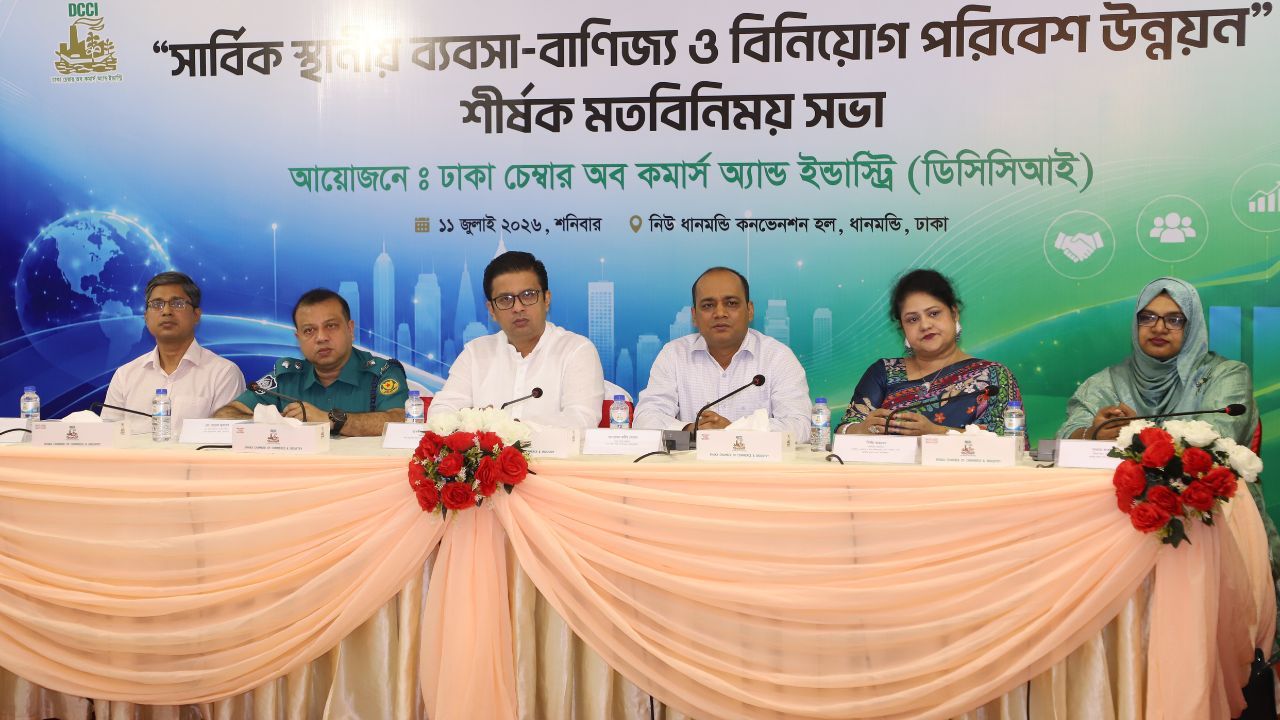

Small and medium-sized businesses urged policymakers on Saturday to cut the cost of doing business by simplifying regulations, improving access to finance and restoring law and order, arguing that a combination of global trade uncertainty and domestic bottlenecks is undermining investment and slowing economic activity.
The concerns emerged at an exchange of views organised by the Dhaka Chamber of Commerce and Industry (DCCI), where entrepreneurs from the Dhanmondi-Mohammadpur area met officials from the National Board of Revenue (NBR), Bangladesh Bank, Dhaka Metropolitan Police and Dhaka South City Corporation (DSCC).
Business representatives said reducing administrative hurdles, digitising trade licence and government services, easing letter of credit (LC) procedures and improving public security have become critical to sustaining business growth.
DCCI President Taskeen Ahmed said businesses continue to face regulatory complexity, ambiguity in tax and value-added tax (VAT) rules and deteriorating law and order, despite being a major contributor to the economy.
He said persistent gas and electricity shortages have increased transport costs, while the requirement for shopping malls and retail outlets to close by 7pm has sharply reduced sales and business turnover.

Taskeen welcomed several measures in the FY2026-27 budget, including treating tax deducted at source as advance tax, reducing source tax on imports of industrial raw materials, allocating Tk5,000 crore for the cottage, micro, small and medium enterprise (CMSME) sector and introducing a five-year stable tax framework.
However, he said the government’s ambitious revenue target and growing reliance on bank borrowing to finance the budget deficit risk crowding out private-sector credit and discouraging investment.
Mahmudun Nabi, director of the Foreign Exchange Investment Department at Bangladesh Bank, said foreign exchange shortages continue to delay the opening and settlement of LCs, creating difficulties for import-dependent businesses.




He also said persistently high non-performing loans (NPLs) are preventing lending rates from falling, increasing financing costs for businesses.
Mahmudun suggested stronger collaboration between the public and private sectors with international shipping companies to reduce import logistics costs.
Nusrat Farzana, second secretary (Tax Policy) at the NBR, said the government is seeking to balance revenue collection with tax incentives to improve the business climate.
She said the Finance Act 2026 includes several measures designed to simplify business operations and noted that a recent NBR circular extended tax exemptions for renewable power generation projects until 2035 to encourage investment.
Nirjhar Ahmed, additional commissioner at the Customs, Excise and VAT Commissionerate, Dhaka (West), said global supply chain disruptions and capacity constraints among local businesses have slowed trade and investment.
She said allowing businesses to submit VAT returns every three months would improve working capital management and urged companies to adopt advanced technologies to strengthen competitiveness.
Md Tareq Zubair, deputy commissioner (Crime) of Dhaka Metropolitan Police, said police maintain zero tolerance against extortion and continue arrest drives targeting offenders.
He said the force is also considering expanding artificial intelligence-based traffic management across Dhaka under a proposed “Smart Policing, Smart City” initiative after successful pilot programmes.
Jonayed Kabir Sohag, chief revenue officer of Dhaka South City Corporation, said the city authority has adopted a zero-tolerance policy against harassment in issuing trade licences and other civic services.
He said DSCC plans to organise a trade licence renewal week at DCCI to make the renewal process easier for businesses.
During the discussion, entrepreneurs called for easier imports of machinery for the optical industry, lower taxes on signing money in the real estate sector, policy support for freelancers and digital marketers, faster container movement between seaports and the Dhaka Inland Container Depot, simplified LC procedures for new entrepreneurs, easier financing for women-led businesses and extending trade licence validity from one year to five years.
The event concluded with DCCI awarding membership certificates to 39 new member businesses. Representatives of around 100 business organisations attended the programme alongside DCCI board members.