



Kanon Nehar Proma, a student at the University of Dhaka, was returning to her dormitory after private tutoring in Farmgate. As her stop approached in Shahbagh, she tried to make her way from the back of the bus towards the exit. But before she could reach the narrow door, the bus started moving again.
Unable to clearly see the steps in the rush, she stumbled while attempting to get down and suffered a serious leg injury.
“There is always a crowd, and the helper often stands at the door. You have to get on and off in that condition, which is very uncomfortable,” she told TIMES of Bangladesh.
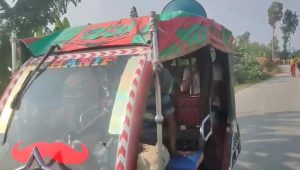
Most minibuses operating in the city are fitted with a single, narrow door – typically around 20 inches wide. In some vehicles, the door is positioned near the engine at the front, making access even more difficult, particularly during peak hours.
The height of the bus floor from the road adds to the difficulty. Even in less crowded conditions, children, elderly passengers, women, and those with illnesses often struggle to get on and off safely.
There have been many instances of passengers falling from buses, sometimes with fatal consequences.
“Those who don’t travel by bus cannot understand how frustrating it is,” said lawyer Nahida Khanam, who commutes by bus to court on working days.
The idea of phasing out minibuses in favour of larger buses has been raised multiple times in Dhaka, but has yet to be implemented by the Bangladesh Road Transport Authority (BRTA).
Larger buses typically have two doors, allowing passengers to board and alight more efficiently. In many cities around the world, urban buses are designed with wider doors to facilitate faster movement of passengers.
Transport expert Professor Mohammad Hadiuzzaman from the Bangladesh University of Engineering and Technology (Buet) says the current system is ill-suited to a dense urban environment.
“The single-door buses currently operating are more appropriate for long-distance travel, not for moving passengers quickly within a city,” he said.

“In a densely populated city like Dhaka, ensuring quick boarding and alighting is crucial, as road capacity is limited. Double-door buses could be an effective solution.”
From the outside, many buses appear dilapidated. Inside, conditions are often worse – dirty, greasy seats, broken fans even in extreme heat, and frequent stops to call for passengers.
Transport specialist Professor Md Shamsul Haque blames the regulator for the situation.
“It is not enough to promise that minibuses will be removed or that risky travel through narrow doors will be stopped,” he said. “The BRTA is a sleeping institution. It needs to be awakened – or restructured entirely. Reforming this body should be the priority.”
Md Shihab, an assistant to a bus driver on the Gabtoli-Demra route, says a second door would benefit both passengers and staff.
“When there is a crowd, it becomes difficult for passengers to get on and off. Two doors would be better for us as well,” he said.
So why not introduce them?


“That would require larger buses, which are more expensive. Owners run smaller buses to reduce costs,” he explained.
Even on some routes where larger buses operate, many have only one door. Operators have reportedly removed the second door to avoid hiring additional staff.
State-run double-decker buses operated by the Bangladesh Road Transport Corporation (BRTC) offer a contrasting example. These buses have two doors – one at the front, about 24 inches wide, and a wider rear door measuring around 40 inches.
This allows four to six passengers to board or alight simultaneously.
Observations at two busy intersections showed that with two doors, passengers could get on and off within seven to 15 seconds. In contrast, on crowded minibuses, the process can take between one and one-and-a-half minutes.
Interiors ill designed, no regulatory standards
In most minibuses, the aisle between two lines of seats measures around 16 inches – just enough for a single person to pass through. However, during peak office hours, the space is typically occupied by standing passengers, making movement extremely difficult.
By contrast, buses operated by BRTC have wider aisles of around 30 inches. This allows standing passengers to occupy the space with comparatively less discomfort.
Transport expert Shamsul Haque says overcrowding is often exacerbated by deliberate design changes.
“Minibuses are supposed to have 31 seats, but owners often increase that to 40,” he said. “The standard distance between seats should be about 26 inches, but in many cases it is reduced to between 14 and 16 inches.”
Experts say the problem is compounded by the absence of clear regulatory standards.
Under current rules set by BRTA, there are no specific guidelines governing bus or minibus body design, seating capacity, or passenger safety features.
While vehicle fitness checks require inspectors to examine elements such as door locking systems and overall mechanical condition, there are no binding requirements on fundamental safety issues – such as minimum door width, engine placement, or the provision of emergency exits.
Repeated initiatives fail to deliver change
Over the past two decades, successive governments have launched a number of projects aimed at making Dhaka’s public transport system more passenger-friendly. Yet, despite significant investment, commuters say little has changed.
Improving bus services in the capital has cost the public purse heavily.
One of the earliest major initiatives, the Dhaka Urban Transport Project, was implemented between 1999 and 2005 with a total cost of $234.2 million – of which $177 million came as a loan from the World Bank.
The project aimed to develop an economically and environmentally sustainable urban transport system, while strengthening institutions and policy frameworks and laying the groundwork for long-term integrated planning.
Another flagship project, the Strategic Transport Plan 2005, was intended as a comprehensive roadmap for the city’s transport sector between 2004 and 2024. Its goal was to address chronic traffic congestion, environmental pollution, and unplanned urbanisation through a modern, coordinated system.
In December 2012, the Greater Dhaka Sustainable Urban Transport Project was launched with support from the Asian Development Bank. A centrepiece of the plan was a 20-kilometre bus rapid transit corridor linking Gazipur City Corporation with Hazrat Shahjalal International Airport.
Although parts of the infrastructure have been built, the system has yet to become operational, and buses for the project have still not been procured.
In 2021, authorities introduced a pilot project, Dhaka Nagar Paribahan, to restore order to the city’s fragmented bus network. Initially launched with 50 buses on a route from Ghatarchar in Keraniganj to Kanchpur, the service later expanded to around 100 buses.
The scheme aimed to introduce a franchise-based model, where a single company would operate buses on a given route, with fixed salaries for drivers and helpers and improved service standards.
While the project received a positive response at the outset, it later lost momentum amid reluctance from private bus owners, financial complications, and political pressure, and some routes were eventually closed.
During the tenure of the interim government, there were renewed efforts to revive the scheme, including plans to reorganise 42 routes into nine clusters under the same model. However, that initiative failed to materialise.
The Dhaka Nagar Paribahan project has since been discontinued.
High demand, low investment
Despite carrying a huge number of passengers each day, Dhaka’s bus sector continues to suffer from chronic underinvestment, according to transport experts.
Data from the Sustainable Urban Transportation Index suggests that around 21 million people use public transport in the capital daily. Around 64% of them – more than 13.4 million – depend on buses.
The Dhaka metropolitan area currently has more than 150 bus routes in operation, reflecting the scale of demand.
Yet, experts say the level of investment has not kept pace.
“Even with a large passenger base, investment remains low. One major reason is the market structure,” Buet Professor Mohammad Hadiuzzaman told TIMES.
“If operators can still make a profit using old, unfit buses, there is little incentive to invest in newer, better-quality vehicles. As a result, outdated and unsafe buses continue to dominate the roads.”