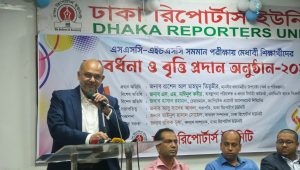
Deputy Speaker Barrister Kayser Kamal on Sunday stressed the need for long-term, sustainable and coordinated initiatives to protect the lives and livelihoods of people living in the country’s haor areas.
He also called for forming a special taskforce to identify the real challenges in the haor region and recommend effective solutions.
He made the remarks while speaking as chief guest at a seminar titled “Haor Disaster: Relevance of the Book ‘Chashabhushar Shontan’ and the Way Forward”.
The seminar was organised by Netrakona Journalists Forum Dhaka at the Shafiqul Kabir Auditorium of Dhaka Reporters Unity in the capital.
The event featured discussions on natural disasters in the haor region, farmers’ struggles, sustainable embankment management, climate change impacts and future development planning.
“I am a son of the haor,” Barrister Kayser Kamal said.

“My birth and upbringing took place in the middle of the haor region. From my childhood, I have closely witnessed the suffering, struggles and deprivation of the people there,” he said.
He said haor farmers continuously face natural disasters while contributing significantly to the national economy. Yet, he added, very few effective and sustainable initiatives have been taken for the region since independence.
He observed that discussions on haor issues usually take place only after major damage occurs, while long-term solutions remain neglected.




“When losses occur, only then do discussions about the haor begin. But permanent solutions require research-based planning and practical initiatives,” he said.
Referring to the book Chashabhushar Shontan, the Deputy Speaker said it reflects the realities of the haor region, the struggles of its people and the impacts of disasters.
He said such research-based publications can play an important role in policymaking and raising public awareness.
Barrister Kamal also alleged irregularities in the leasing system for fish farming in haor areas.
“Through the so-called leasing system, a section of dishonest individuals is occupying haor resources. Genuine fishermen do not get leases,” he said.
He added that large pits are being dug in wetlands to create ponds, disrupting the natural flow of water and affecting farmers.
“As a result, farmers are being severely affected and have long been subjected to neglect and exploitation,” he said.
He further said haor farmers often fail to get fair prices for their produce and are also unable to catch fish due to the leasing system.
“I myself am a witness to these injustices and inequalities,” he added.
The Deputy Speaker stressed effective water management, scientific research, technology-based early seed planning and proper identification of affected people in the haor region.
“Since independence, the country has been run within a fixed framework. Obstacles emerge at every step. Therefore, everyone must come forward in unity,” he said.
He also called for collective efforts to build a humane Bangladesh in line with the spirit of independence.
Lawmaker Anwarul Haque, journalists, researchers, writers, distinguished citizens and stakeholders from the haor region also attended the seminar.
Speakers at the event echoed the call for coordinated initiatives to protect lives and livelihoods in haor areas.