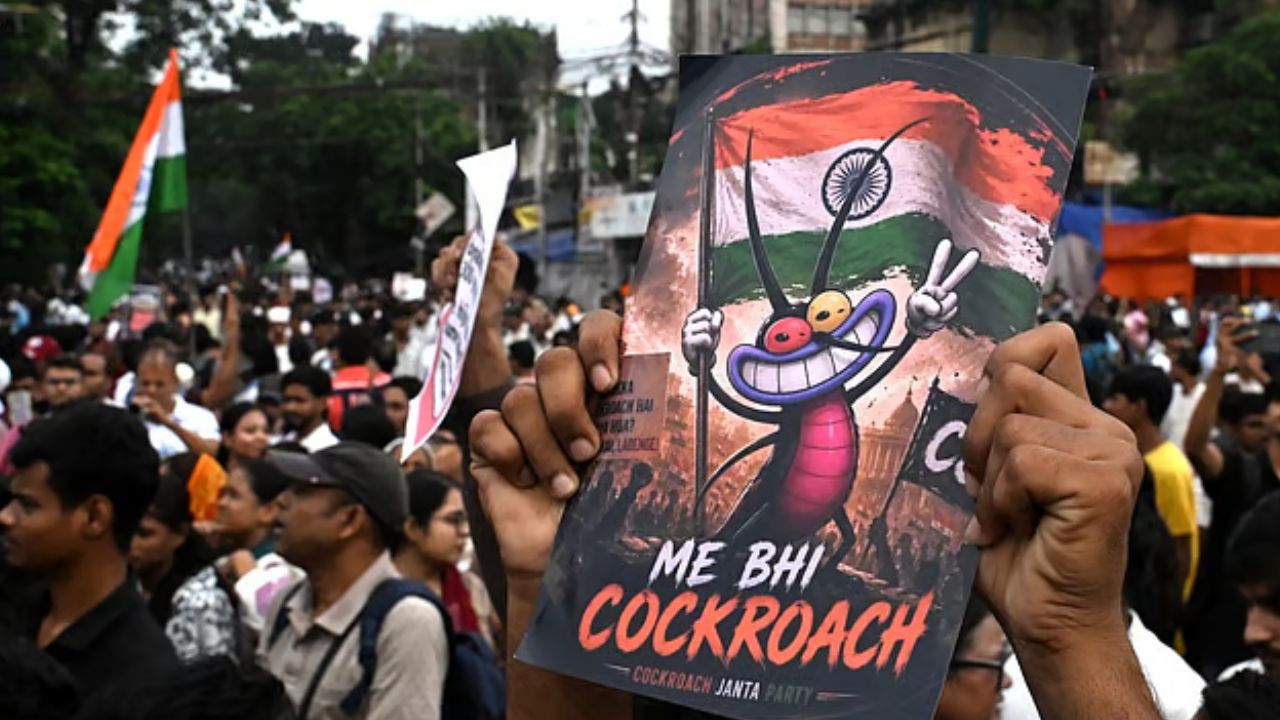



The Cockroach Janata Party (CJP) on Tuesday withdrew its call for a September 5 protest march in the Indian capital, after the federal government assured the Supreme Court it would not pursue cases against those who took part in demonstrations held between 20 and 25 July, reports NDTV.
The Supreme Court accepted the government’s submission and ordered that all First Information Reports (FIRs) lodged against protesters in every state and union territory over the July unrest be quashed, clearing the way for the CJP to call off its planned march at India Gate.
Solicitor General Tushar Mehta told the bench that the central government, acting through Delhi Police, along with the state governments of Bihar, Assam, West Bengal and Maharashtra, had filed applications seeking withdrawal of the FIRs linked to the student-led protests.
He said the applications also carried an assurance that no fresh cases would be registered in connection with the same events, fulfilling a commitment made to CJP leaders on July 25.
CJP spokesperson Saurav Das welcomed the development before the court, saying the party had decided to call off the September 5 march in light of the government’s assurance and the judicial backing it had now received.

He thanked the bench and legal counsel on both sides, and said the party looked forward to the court’s order being implemented in full.
The CJP had announced the September 5 protest after accusing the Centre of reneging on undertakings given during negotiations on July 25, when the two sides had reportedly agreed on a process for withdrawing FIRs against demonstrators.



The party said the government had dragged its feet on the withdrawals and had refused to put its commitments in writing, prompting the fresh call to mobilise.
The planned march was to begin at India Gate and head towards the Delhi Police headquarters, a route that has become a familiar staging ground for demonstrations in the capital.
Organisers had said the protest would be led by families of NEET aspirants who took their own lives, as well as people who said they had been targeted by police during the July unrest.
The July protests, which unfolded over roughly a week from July 20, drew significant numbers of students and young people onto the streets of Delhi and other cities, resulting in a wave of FIRs being filed against participants across several states.
The demonstrations had put pressure on the government to address grievances raised by the CJP, and the July 25 talks were widely seen as an attempt to defuse tensions before they escalated further.
Tuesday’s Supreme Court order effectively draws a line under that chapter of the standoff, with the quashing of FIRs applying uniformly across states and union territories rather than being confined to Delhi alone.
The inclusion of Bihar, Assam, West Bengal and Maharashtra in the applications filed before the court indicates that the protests, and the legal fallout from them, had extended well beyond the capital.
For now, the CJP’s decision to stand down removes the prospect of a fresh confrontation with authorities just as the case appeared headed for resolution.
Whether the truce holds is likely to depend on how swiftly the assurances translate into the formal withdrawal of cases on the ground, and on whether further disputes emerge over the treatment of protesters in the affected states.
The Supreme Court’s involvement, however, gives the settlement a degree of legal weight that a purely political agreement would have lacked.