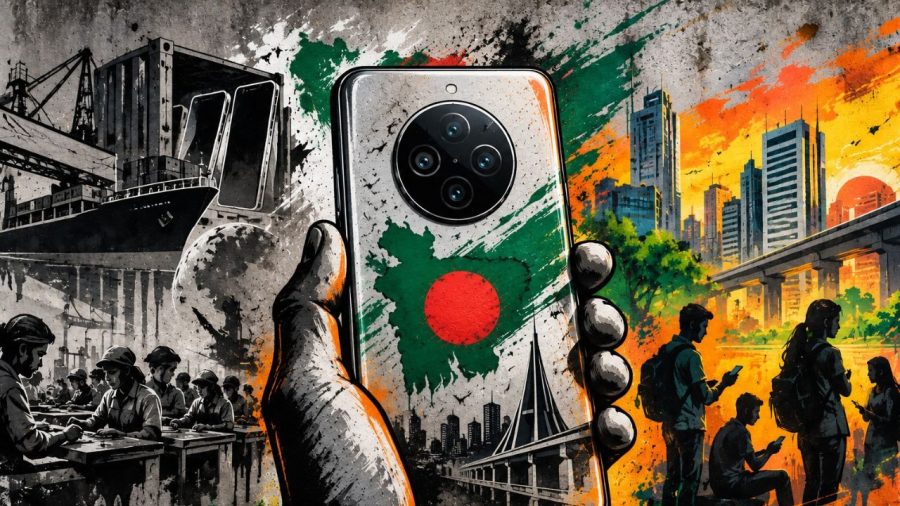



For the past few years, “Made in Bangladesh” on a phone box has been something to be proud of, it has been a sign of the country’s industrial growth. Yet, according to the data from Bangladesh Telecommunication Regulatory Commission (BTRC), local handset production fell to 16.29 lakh units in June 2026 – down from 21.47 lakh units a year earlier. This marks a dramatic reduction of 5.18 lakh units, a 24.1 per cent drop year-on-year.
There are several reasons for this including tax policy, logistics, and shifting market conditions but the elephant in the room is undoubtedly the vast grey market.
According to industry experts and BTRC data, grey smartphones now account for 40-50 per cent of the market. In the high-end side of the market, where price difference matters most to customers, the effect is the worst. These imports cost the government somewhere between Tk5,000 and Tk6,000 crore in lost duties every year.
The government tried to close that gap by cutting import duty on phones from 25 per cent to 10 per cent, for imports made between January to June 2026. But officials ended up not extending the cut past June, arguing it didn’t do much to boost either imports or local assembly.

The cumulative tax on imported phones now stands at 64.25 per cent, up from 43.43 per cent before. That’s high by regional standards as well: India’s is around 22-24 per cent, Pakistan’s 15-25 per cent, Nepal’s 18-25 per cent, Sri Lanka’s 15-20 per cent. The Maldives, which relies entirely on imports, taxes phones at close to zero. Bangladesh’s rate raises real questions about how it will compare with these markets when global manufacturers decide where to invest.
In any case, since the end of June 2026, legal imports have done even worse, particularly for higher-priced smartphones. Grey market phones continue to sell at lower prices which makes it less worthwhile for companies to expand local assembly.




Apart from the challenges posed by prices, there are also limitations to what “local manufacturing” is in Bangladesh. Most “Made in Bangladesh” phones are actually produced through CKD/SKD assembly processes, where more than 90 per cent of components like chipsets, displays, camera sensors, and circuit boards are imported. All that is done domestically is mostly labour: assembly, plastic moulding, packaging etc. The backward linkage system required for producing high-value components does not exist in this country which involves huge investments. Heavy reliance on imported semiconductors and displays also leaves local production exposed to currency swings and dollar shortages. To keep prices low, options include government subsidies or using older generation and used components, but neither is sustainable. Ultimately, reducing dependence on these items would require greater confidence that investments from foreign OEM manufacturers are protected.
Consumer demand hasn’t made matters any easier either. Consistent inflation has reduced people’s purchasing power along with rising prices of chipset and memory components worldwide, driving most consumers into opting for less expensive grey market purchases, cheaper or refurbished phones. It’s an understandable choice for individual consumers. However, this hampers the broader goal of building a digital and inclusive economy.
Going forward, companies that have already committed money to manufacture locally now need something else to keep going: predictability.
Primarily, what is needed is a long-term effective tax and duty map for the smartphone industry. Predictability and consistency in policy help protect capital investments and give international brands confidence to move from simple assembling to local manufacturing of high-quality smartphones at relatively lower costs.
Ultimately, if a robust and consistent policy framework is implemented in the next 10 years, it will greatly support local value addition. Companies would gain confidence to invest more to full manufacturing, backed by govt. support. It will lead to longer assembly lines, technology and knowledge transfer, and a healthy employment market for Bangladesh’s young workforce. The economy will roll forward.
Bangladesh has already shown it can assemble phones at scale. What comes next depends on whether policy stays consistent enough to turn that capability into something more – more assembly lines, more skilled jobs, and a manufacturing base that can withstand the pressure ahead.
Views expressed in this article are the author’s own and do not necessarily reflect the views of TIMES of Bangladesh.
The author is a Communication Strategist.