



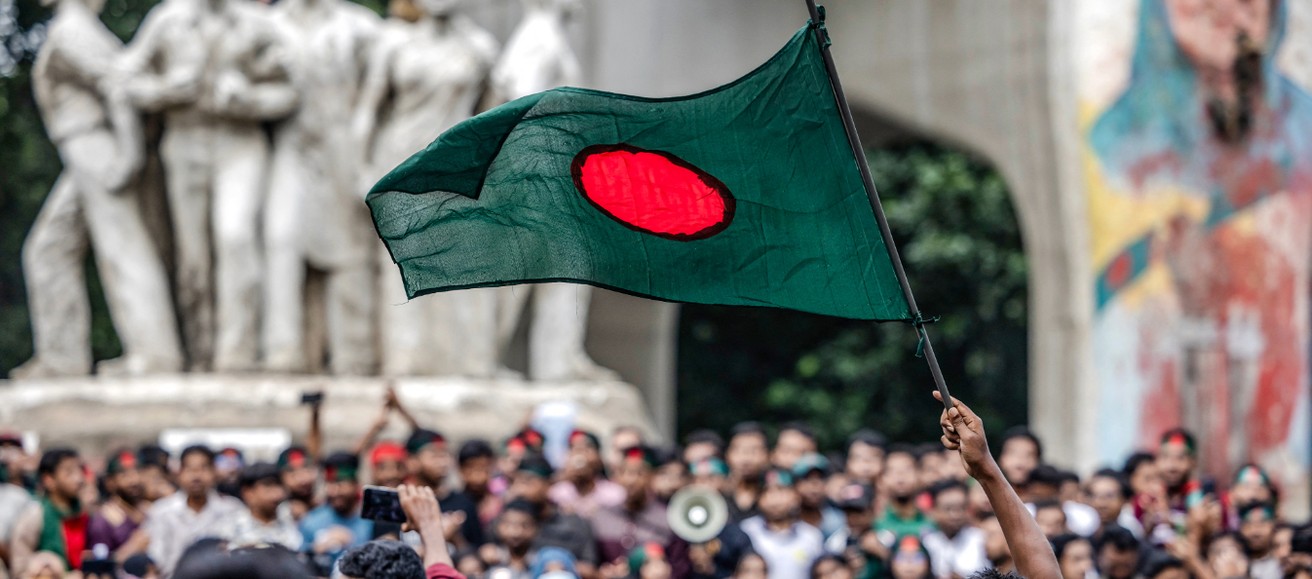
Following the 2024 mass uprising, a prolonged period of political instability, and nearly one and a half years of state reconstruction under the interim government, Bangladesh once again established an elected government through the National Election 2026. After a long time, the national and international media viewed this country’s election as relatively acceptable. For citizens this election was much more than a change of government; it was the return of democracy.
It’s been just a couple of months since the new government was elected. So, it would not be realistic and even the aim of this article is not to assess the government’s achievements or failures in the first six months. But remember, it is a new government taken on in unprecedented circumstances. On the basis of their experiences and observations over the last six months, a crucial question arises: Was it only a change of government that the people of post-2024 Bangladesh wanted? Political philosopher, theorist and a writer, Frantz Fanon said, “If after a successful uprising only the faces change and the system doesn’t, then it is not a revolution, it is only a transfer of power.”
In this regard, people’s expectations from the new government elected in 2026 were quite different. The country’s students and citizens were not merely looking for new faces in government but a new political culture to be introduced. One of the main expectations of the people was that the power change would come to an end of political revenge, and that true law and order will be restored. In addition, they envisioned a culture that would prize merit rather than party loyalty, action in place of promises, and a strengthening of institutions over people in the governance of the state.
These expectations are based on the fact that Bangladesh has suffered from one crisis after another in this last two decades at the hands of the political elites. All these factors – politicisation on all levels, the weak electoral system, too much concentration of power, political manipulation of administration, doubts about judicial independence, limitations to freedom of expression and allegations of corruption – put together an environment of distrust between the people and the state. This pent-up dissatisfaction was expressed in the movement of July 2024. Immediately after, steps were made to reform the state institutions under the leadership of the interim government. In the election of February 2026, the citizens were able to vote on the basis of candidates, parties, alliances, individuals and promises. Lastly a new political chapter started with a competitive election.
As a part of the electoral campaign, the government had pledged accountability, firmness against corruption, job creation, control of commodities price, independence of judiciary, and improvement of administrative system and strengthening of local government institutions. Additionally, their agenda featured pledges for youth, women, minority and marginalised communities’ increased participation.
But in the first few months of the government, it is obvious that a change of culture is far harder to work with than a change of government. The high prices of commodities have been one of the major concerns of the common people during these six months. Inflation has not been completely brought under control. The government has its serious problem in reforming the banking sector, collecting more revenues, providing jobs and foreign investment. The new budget has focused on economic stability, inflation control and structural reforms but there is still a lot of work to be done.
Meanwhile, issues remain regarding law and order, political tolerance and administrative neutrality. People hoped for more tolerance of opposing viewpoints after the elections and expected that opposing views would not be considered as statements against the state. In a democracy, opposition is not a sign of weakness but is a part of its strength.
But as per the data released by the Human Rights Support Society (HRSS) in various newspapers in the country, 56 have been killed in political conflicts and election-related violence in these six months. During the same time 404 women and children were gang raped. There were 384 cases of journalist harassment and attacks. The media reports of murder, rape, extortion, robbery, attacks and other crimes daily from Dhaka and various parts of the country. However, the foremost and most fundamental duty of any government is to keep the people safe without any doubt.
Another important issue is the reform of state institutions. In Bangladesh, power has accrued to individuals and weakened institutions for a long while. Administrative culture has been largely unchanged, while the governments have changed. In these conditions, a sustainable democracy can only be established when the administration is politically neutral, an effective Anti-Corruption Commission is in place, and local government is independent.
The election commission announced that local government elections will start soon, by the end of September. Hence, the enhancement of local government is an issue of paramount importance at the present time for the entire nation. If the government that is closest to the people is not economically and politically free from control, the advantages of democracy can never be attributed to the common people. There is no way to implement desired political reforms through a change of central government without strengthening the local government institutions.
Many aware citizens were also disappointed to see that political participation of women was not as it should be during the national election. Women’s role in the electoral process has increased but it is not the same for women to have effective representation in higher decision-making levels. Political parties should also increase opportunities for developing women’s leadership in their internal party structure. Until women are given a voice and a seat in policymaking as equals, democracy will remain incomplete.
The most difficult task for the new government is to make people’s new political expectations come true, not the economy or administration. Now, since in the political history of Bangladesh governments have changed its bodies many times, but there is not much change in the political culture. This time around, the Bangladeshis are not just calling for a change of power but a change in politics, its language, actions and ethics.
So, success of this government will not be based on the number of mega projects, the number of roads built or the number of laws that have been passed. On the contrary, the success of this endeavor will be judged by its capacity to foster accountable state, to establish independent institutions, to replace fear with trust and to establish a new culture of political tolerance.
A closer look at Bangladesh’s political history suggests that the people do not always fight for change of government, rather they fight for a just state and their dignity as citizens. So, it is an undeniable fact that people of post-July Bangladesh do not just desire a new government; they desire a transformation of the old and tarnished political culture. These expectations now squarely rest on the shoulders of the government elected.
Policymakers need to be very careful and responsible, otherwise the tiniest act of irresponsibility or negligence on their part would lead to distrust and dissatisfaction of the people. How well this government can live up to the hopes, aspirations, and sacrifices of the people who brought this about will be the ultimate measure of its success.
The views expressed in this article are solely those of the author
The writer is an academic and researcher in local government. E-mail: [email protected]


