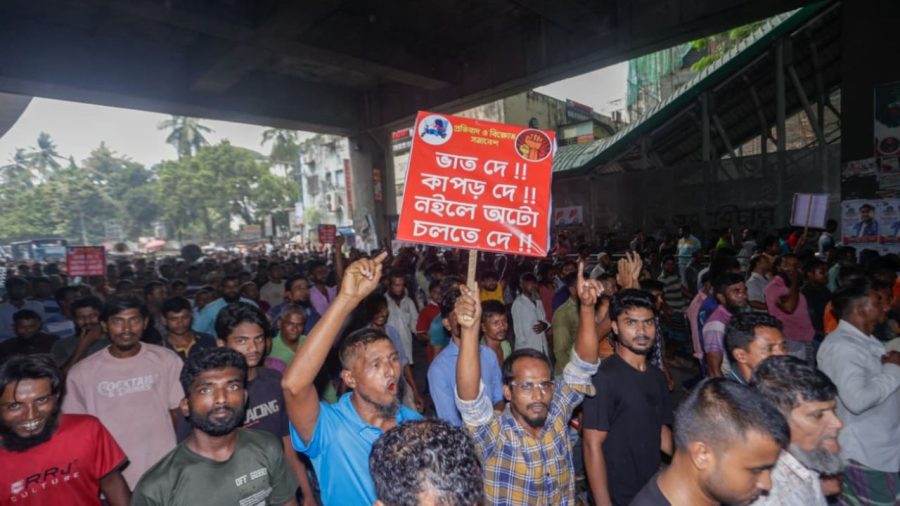



The movement of battery-operated auto-rickshaws across the capital dropped significantly on Monday morning following a drivers’ rally to press for 12 demands, including the issuance of licences through the Bangladesh Road Transport Authority (BRTA).
In several locations, participating drivers allegedly obstructed other auto-rickshaws from operating, leaving office-goers, students, and general commuters facing extreme hardship.
Visits to key areas across the capital, including Badda, Rampura, Mohammadpur, Shyamoli, Mirpur, and Agargaon, revealed a marked reduction of battery-run auto-rickshaws compared to normal hours.
At the Merul Badda bus stand, large crowds of students and office commuters were seen waiting for extended periods. People were forced to walk to their destinations.
Kakrail-bound teacher Pushpita Sikder urged the government to formulate alternative solutions, remarking that auto-rickshaws were unsustainable and noting that while commuting patterns altered after 5 August, people managed to travel even before auto-rickshaws existed.

The workers’ rally was held at 10am in front of National Press Club under the banner of Rickshaw-Van-Easybike Workers’ Union, an associate labour organisation of the Communist Party of Bangladesh (CPB).
A leaflet distributed at the rally listed 12 specific demands, including issuing auto-rickshaw licences through the BRTA, ensuring driving licences and logical route permits for drivers, permitting operations in road-suitable zones, preventing electric meter disconnections despite paid bills, and ending harassment under the guise of wrecking and dumping.
This protest follows a human chain formed on Sunday in front of the National Press Club by the Bangladesh Battery-run Rickshaw and Easybike Owner-Worker Unity Council.



The council raised an eight-point demand including registration, licensing, and livelihood protection, calling for the registration of currently operating battery-run auto-rickshaws and easybikes prior to approving new e-auto-rickshaws in the country.
Speakers at the event emphasised that they sought legal livelihood opportunities rather than eviction, arguing that registering vehicles with QR codes would generate government revenue, restore road discipline, and safeguard the livelihoods of lakhs of families.
Concurrently, the government has initiated a registration framework to regulate battery-operated auto-rickshaws, incorporating plans for vehicle determination, stopping unregistered operations, zone-based traffic control, and standardised manufacturing designs.
Under this scheme, Dhaka’s two city corporations are to be divided into eight zones with distinctively coloured auto-rickshaws. However, concerns have emerged over whether registration alone can regulate the transport sector effectively without addressing driver training, licensing, ownership control, and vehicle quotas.
Experts emphasised that registration is insufficient unless driver qualifications, training, licences, and proper ownership structures are established to prevent existing irregularities from persisting within the new legal framework.
Registration for battery-powered three-wheeler e-rickshaws across 13 city corporations officially commenced on 2 November, following an announcement at the Secretariat on 1 November by State Minister for Local Government, Rural Development and Co-operatives Mir Shahe Alam.

The initiative derives its legal authority from amendments to Section 120 of the Local Government (City Corporation) Act, 2009, under which regulatory rules were gazetted.
Under the new rules, the registration fee for a two-passenger e-rickshaw is set at Tk8,000 with a yearly renewal fee of Tk4,000, while a four-passenger e-rickshaw incurs a Tk10,000 registration fee and a Tk5,000 renewal fee, with a maximum operational lifespan capped at 12 years.
Evaluating the policy, Saidur Rahman, executive director of Road Safety Foundation, agreed that bringing battery-operated auto-rickshaws under registration is necessary, but cautioned that certain provisions in the proposed guidelines risk reinforcing the existing owner-dominated system.
He pointed out that allowing up to five auto-rickshaw registrations per National Identity Card (NID) permits affluent individuals or syndicates to control large fleets using multiple NIDs, thereby keeping actual drivers in rental arrangements.
He recommended that the framework should instead promote driver ownership by limiting registrations to individual drivers’ names and offering accessible instalment loans so drivers can progressively acquire ownership of their vehicles.