






A Memorandum of Understanding (MoU) has been signed to establish the China-Bangladesh Vocational Education, Training and Research Centre to bolster bilateral cooperation in technical education.
The agreement was formalised on Friday at the “China-Bangladesh Education Exchange Conference” jointly organised by the Jiangxi Provincial Government of China and Jiangxi Science and Technology Normal University in Jiangxi, China.
Technical and Madrasah Education Division Secretary Md Daud Miah signed the MoU on behalf of Bangladesh, while Jiangxi Science and Technology Normal University Professor Zheng Pengwu signed on behalf of China.
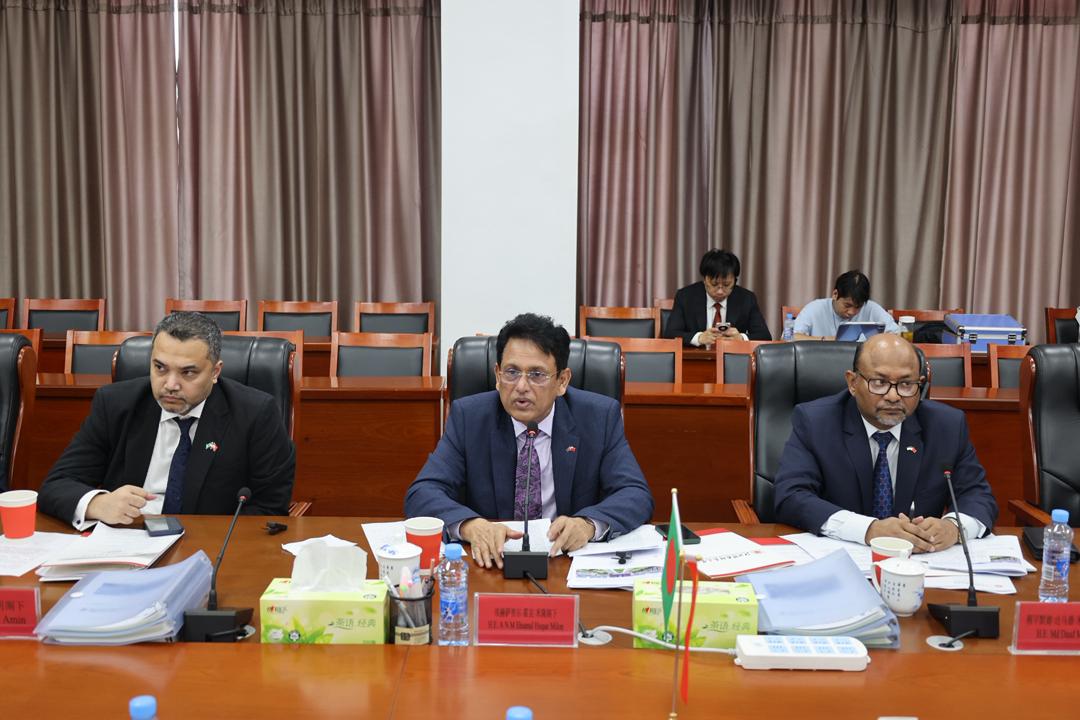
Education and Primary and Mass Education Minister ANM Ehsanul Hoque Milon and Prime Minister’s Education Adviser Mahdi Amin, were present during the signing ceremony.
Under this cooperative framework, both nations will work together in various areas, including technical training programmes, bilingual educational materials, education-industry linkage, research centres, industrial training, study visits to China, and specialised training.
Alongside the MoU, three major cooperation platforms were inaugurated during the conference.
The first platform China-Bangladesh Vocational Teacher Training Centre, jointly inaugurated by Education Minister ANM Ehsanul Hoque Milon and Jiangxi Provincial Education Department Deputy Director Fan Honghui.
The second platform Bangladesh Vocational Education Research Centre, inaugurated by Prime Minister’s Education Adviser Mahdi Amin and Jiangxi Science and Technology Normal University Prof Pei Hongwei.
And the last one Bangladesh “Chinese Language+ Skill Development” Cooperation Centre, inaugurated by Secretary Md Daud Miah and Jiangxi Science and Technology Normal University Vice-President Prof Zheng Pengwu.
These initiatives are expected to create fresh opportunities in teacher training, practical student training, industrial experience, curriculum development, research cooperation, teacher-student exchanges, Chinese language and technical education, industry-education linkage, and employment-oriented skill development.
The conference, the MoU, and the three new platforms are viewed as a significant step forward in the long-term partnership between Bangladesh and China, forging a robust connection between education, practical skills, industry demand, and future employment for the Bangladeshi youth.
A high-level Bangladeshi delegation, along with senior officials of the Jiangxi Provincial Education Department, and representatives from universities, vocational institutions, and industries, participated in the conference. Nineteen universities and vocational institutions from Jiangxi Province attended the event.
The Bangladeshi delegation, led by Education Minister ANM Ehsanul Hoque Milon, included Prime Minister’s Education Adviser Mahdi Amin and Technical and Madrasah Education Division Secretary Md Daud Miah.
Speaking at the conference, the education minister said that Bangladesh’s youth population is the country’s greatest strength, capable of becoming a world-class competitive workforce through quality technical education, practical training, and modern skills.
He emphasised that technical and vocational education must be closely aligned with the real demands of the industrial sector and the job market.
He urged for enhanced Bangladesh-China cooperation in curriculum development, teacher training, institutional partnerships, modern technology, practical education, and employment-oriented instruction.
Milon noted that deeper cooperation with Chinese universities, vocational institutions, and industries would help reinforce Bangladesh’s technical education system, build industry-ready human resources, and generate new opportunities for the youth.
He expressed hope that this bilateral cooperation would contribute to Bangladesh’s long-term human resource development and create wider opportunities for future generations.
Prime Minister’s Education Adviser Mahdi Amin remarked that the MoU for establishing the centre marks the beginning of a new chapter in technical education cooperation between the two nations.
“Our main objective is not to keep this cooperation confined to a formal MoU, but to implement it effectively on the ground to create employment and opportunities for the youth,” Amin said. “Our core objective is to turn education into skills, skills into employment, and employment into opportunities.”


