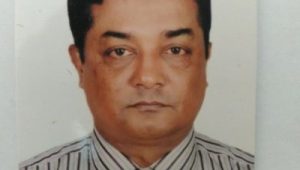
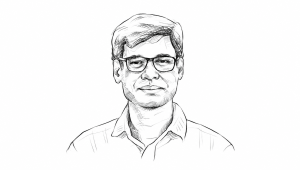
M M Razzaq
A Tale of a Teller follows the journey of a man’s transformation — from Olive to Black and White.
Born in 1963 in the southeastern region of then-East Pakistan, he was raised in a serene township cradled by hillocks, tea gardens, and the Kushiara River. The town, purpose-built for a chemical industry, offered a rare blend of urban order, rural charm, and natural beauty.
Home to professionals from across the country and beyond, the community thrived on discipline, cultural diversity, and a shared professional spirit. Life was vibrant yet structured, marked by high living standards and a strong collective identity.
He grew up in this dynamic setting, deeply influenced by nature and shaped by a progressive school that offered early education, co-curricular activities, and a culture of exploration.
Encouraged by his mother, he joined the Scouting movement — an experience that instilled in him discipline, independence, and leadership. It laid the foundation for the transformation that would define his life’s journey
By 1971, at just eight years old, he was thrust into a world of sudden darkness and fear. The country was in turmoil. Protests shook the streets, police cracked down, and whispers of rebellion turned into roars. Too young to understand politics, he nonetheless felt the weight of unrest pressing down on every household. Tension hung in the air. Faces once familiar now looked anxious, watchful — waiting for something to snap.
Slowly, he began to grasp the truth: the people of East Pakistan were being denied justice, dignity, and even the right to live in peace. The very soil beneath his feet trembled with the burden of oppression. It was his first encounter with injustice — a lesson etched not in books, but in lived reality. And from that darkness, he began to see. Not with fear, but with clarity.
Feeling the Fire
March 1971 brought both personal worry and national tension. His mother, recovering from gallbladder surgery at Dhaka Medical College, lay in a fragile state. The hospital corridors were hushed — but outside, the city roared.

On March 7, a tidal wave of people surged towards the Racecourse. Slogans thundered through loudspeakers. From a hospital window, the boy watched the crowd — not fully understanding, but deeply moved.By chance, he witnessed a moment that would shape history — Bangabandhu’s fiery speech. Though the words flew above his young mind, their rhythm struck his heart. The voice, fierce yet fatherly, stirred something unspoken — a memory engraved in sound.
He didn’t yet know what independence meant. But he felt it — in the crowd’s cry, in his mother’s silent endurance, in the pulse of a nation on the edge of change. That day, the fire touched him
Pitch Dark
The night of 25 March 1971 descended like a curse — a night soaked in betrayal and blood. From the shadows, Pakistani forces struck with ruthless precision. Machine guns tore through silence, mowing down civilians in a calculated massacre. What followed on 26 March was resistance: Bengali soldiers rose in defiance, and the War of Liberation began.
In time, the movement became a people’s war. Farmers, students, workers — all joined the cause. Nine months of pain and perseverance culminated in victory on 16 December.
From the Memory Line


There was no gunfire where he stood — only silence pierced by sorrow. No mortars thundered near him, but the war raged in every trembling breath. The air was thick with fear, days blurred into nights of sleepless dread. Those who believed in freedom clung to it — even when the cost was everything. Time has dulled some memories, but others burn eternal.
He was just a child, but the fire of 1971 singed his soul. Too young to carry a weapon, yet old enough to carry the weight. He saw the fear, felt the silence of curfews, the tremble of bomb blasts, the emptiness left by those who didn’t return. The war, though not fought by his hands, lives on in his heart — a pulse, a scar, a silent witness. Even now, words fail to capture the depth. But his memories remain — flickers of courage, terror, and a nation’s rebirth, all engraved in the fragile thread of a boy’s recollection.
He still sees bodies drifting down the rivers. Crows and vultures battling over what was once human. Small limbs jutting from shallow graves, frozen in silent pleas. The stench of death — heavy, unforgettable. He remembers watching his home burn — not just bricks and beams, but the laughter, the warmth, the dreams within. He remembers neighbors’ screams, fleeing feet, and the silence that followed — deeper than darkness itself.
And Jessore Road — that haunting march of barefoot exodus. Mothers hollow-eyed, children clinging, old men bent by hunger. Cries for water, for rice, for hope. Jessore Road became a wound with no bandage — a song of survival, etched in ash and tears.
This was the War of Liberation.
Not just a chapter in history, but a wound stitched into the soul of a small, bewildered boy. He didn’t fight with arms, but he endured with eyes wide open — and the fire still flickers within. Some wars never end. They live on in those who saw too much, too soon.
Midway Treasure
After independence, life led him to Dhaka. There, he found new roots — schooling in one of the city’s top institutions, and later, a cadet college that would shape his discipline and ambition.
Fueled by purpose, he joined the Bangladesh Army. Two years of intense training forged him into an officer — the beginning of a military journey that would span 36 years. He entered the olive-green world with a heart full of dreams: to serve, to protect, to give all without hesitation. Challenges came, as they always do, but he pressed on — determined, unshaken.
“My blood group is ‘S’ — for Soldier,” he would say, a belief not worn for pride but lived in sacrifice. In that uniform, he gave his youth, his peace, his ease — for the nation. From the battlegrounds of Chittagong Hill Tracts to UN peacekeeping missions abroad, he met danger with courage and duty with dignity. But even as his stripes grew, so did his wisdom. He became more than a soldier — a strategist, a planner, a leader who could navigate war zones and boardrooms alike.
With hands once trained to steady a rifle, he shaped policies, led teams, managed crises. Whether in defense, trade, or development, his mission remained unchanged — to serve.
Transition Begins
After retiring from government service, ‘Mr. Some One’ entered the corporate world but outside his office walls, the nation was spiraling.
July 2024 became a turning point — not just a political crisis, but a collective awakening. Years of repression under the Hasina regime had smothered dissent. Freedoms were silenced, and democracy had become an illusion. The resistance began with students — hopeful, principled. But soon, it grew into a tidal wave demanding the fall of authoritarian rule.
The state’s response was brutal — police, BGB, even the military were unleashed. What followed was the deadliest unrest since 1971: firebombs, sniper shots, mobs, and tears. Streets once silent echoed with resistance and grief. Initially, the nation stood united. But as violence escalated, hope blurred into horror. The line between justice and anarchy faded. Mr. Some One, now a civilian, watched the country he served descend into flames.
Then came the caretaker government — a flicker of hope. Promises filled the air, yet delivery remains elusive. One year on, uncertainty looms. In this fog, hard truths emerge democracy must be more than a slogan. Politics must serve people — not power. Ideologies may differ, but no party owns the nation. True freedom means choice, not imposition.
Sadly, history repeats itself. From British divide-and-rule to internal betrayal, Bangladesh’s journey has been fraught. Independence was won, but the democratic dream still limps forward — scarred, yet stubbornly alive. And Mr. Some One, like many others, continues to carry that ache — the burden of survival, service, and hope.
The Last of the Mohicans
In the aftermath of the 2024 uprising, a troubling narrative began to surface — that Bangladesh had won its “second independence.” Fueled by voices that once opposed the Liberation War, this dangerous rhetoric sought to erase 1971 from our national soul. Even our anthem, our martyrs, our very origin, faced denial.
To Mr. Some One, this was not just false — it was sacrilege.
He has lived the journey: the birth of a nation, the agony of war, the fire of freedom. He has seen the cost of sovereignty etched in blood and silence. And now, in his twilight years, he carries a truth that refuses to die. He is not just a veteran of memory — he is its last living sentinel. The distortion of history by political agendas has deeply pained him. What should have been sacred has been rewritten, manipulated, and reduced to convenience. The past is not a weapon — it is a foundation.
And so, ‘Mr. Some One’ has taken up a final vow: to be a bridge — bridge between what was and what must never be forgotten. Like the ‘Last of the Mohicans’, he stands alone, perhaps, but not silent. If he breathes, he will speak — not for revenge, not for power, but for truth.
A Black and White
But how, really, does one become the “Last of the Mohicans”?
For Mr. Some One, the answer lay not in fading into history, but in shaping the future. With pen and purpose, he channeled his strategic mind into action — advocating education, ethical leadership, and truth-telling through the media. His goal: to leave behind a legacy of impact across public and private sectors, and above all, to serve the Nation till he breathes.
Today, we stand on soil won through sacrifice — sovereign, free, and still unfinished. Freedom is not a gift, but a responsibility. It demands that we remember, we speak truth, and that we honor those who paid the price. The war may be history, but the struggle — to preserve identity, uphold dignity, and protect sovereignty — is never done. To live as a free citizen of Bangladesh is a privilege carved in blood and hope. And that, Mr. Some One knows, is a truth worth carrying forward — in black and white.