


Raqib Zaman
Over the past two decades, Bangladesh has made remarkable strides in its development journey. Poverty rate has declined dramatically, from 40% in 2010 to just 18.7% in 2022, driven by consistent economic growth, increased connectivity, and expanding access to basic services, according to the World Bank in 2024. As the Asian Development Bank (ADB) reported in 2023, the economy has maintained a growth rate of approximately 6–7% annually, even weathering global shocks like COVID-19 and the Ukraine war with considerable resilience. As per UNESCO, primary school enrollment exceeds 98%, and the literacy rate has risen to 75.6% as of 2023. Health indicators tell a similarly hopeful story: child mortality has dropped to 27 per 1,000 live births, and life expectancy has climbed to 73.4 years, outpacing several South Asian countries.
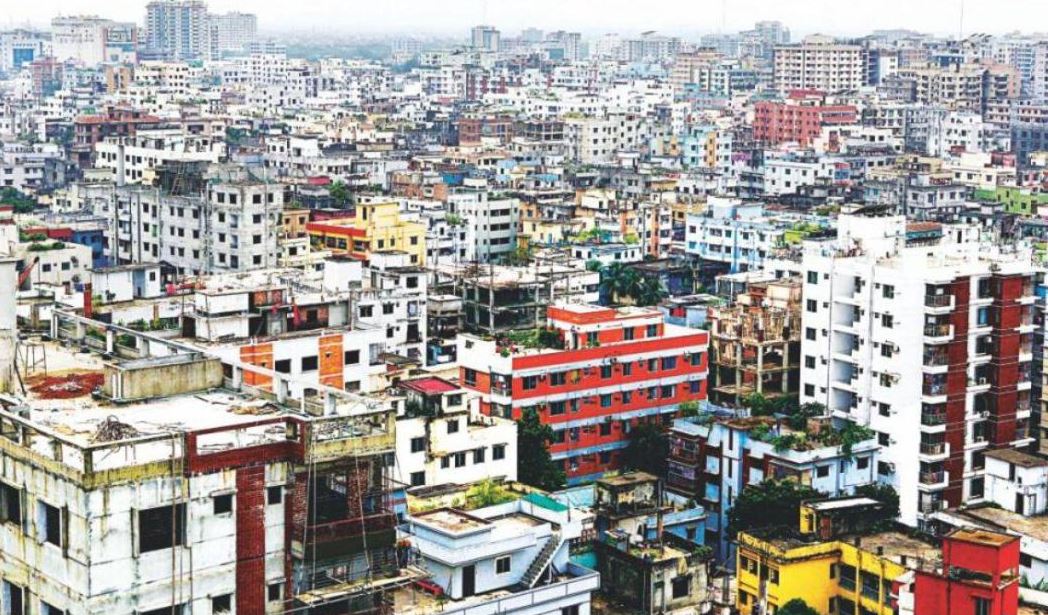
However, there is a more somber reality of systemic exclusions, pervasive inequality, and impending sustainability risks. One of the most overlooked areas of disparity is in urban housing. According to assessments taken by the International Finance Corporation (IFC), nearly “69% of urban households, or about 11.9 million families, reside in informal settlements”. The majority of low and middle-income citizens live in unstable, overcrowded conditions, without tenure security or basic services.

The policy dilemma confronting Bangladesh is similar to what the UK faced a century ago. In 1919, after World War I, Dr Christopher Addison, then Minister of Health, proposed the famous Housing, Town Planning Act, which marked the state’s responsibility to provide affordable homes. This dawned the beginning of the council flat system. These were houses built, owned, and managed by local governments where residents could live with capped, affordable rents.
The council flat system proved to be very effective and beneficial. According to research conducted by Stephens and van Steen, cited in a policy analysis from the London School of Economics (LSE), social housing in the UK reduced the official poverty rate by 30% and the national Gini coefficient (a measure of inequality) by 5 points, owing mostly to “housing income” generated by below-market rent benefits. While the gap between rich and poor never entirely vanished, as a feature by British Broadcasting Corporation (BBC) notes, affordable council housing became a ladder out of poverty for millions, creating stable neighbourhood and upward mobility.


By the 1930s, over 500,000 council homes had been constructed. The movement accelerated post-WWII: from 1946 to 1960, with nearly 2 million additional council homes being built, driven by New Towns Acts and slum clearance programmes. By the 1970s, council housing accounted for about one-third of all homes in the UK, becoming a major pillar of the welfare state.
Presently, Bangladesh’s urban housing deficit is serious and worsening. As per IFC reports, the present unmet demand for affordable housing units for lower and middle-income households is estimated to be 6 million units, and is expected to grow to 10.5 million by 2030. In order to address the problems, a council flat-like programme in major cities like Dhaka and Chattogram, could be a bold, systematic intervention.
As ADB’s assessment argues, “inclusive urban growth relies fundamentally on access to decent housing as a public good, not just a private commodity,” the council housing model stands as the most evidence-backed approach to narrowing the housing divide. If implemented, such a housing scheme would cover about 10% of the estimated deficit, giving Bangladesh’s urban poor and emerging middle class a chance at safe living and social inclusion. Higher-quality, inclusive, and sustainable living environments would encourage economic activity, lower health concerns, and strengthen the country’s developmental trajectory.
According to IFC, “mortgage finance penetration in Bangladesh’s housing market is low at 3%,” thus public housing may be an effective route to inclusivity. Direct quotation from UK policy history demonstrates, “the building of new houses… marked the start of a long tradition of state-owned housing in planned council estates” that successfully narrowed ingrained gaps. If Bangladesh adopts UK lessons, it has the potential to raise millions out of precarious tenancies, develop mixed communities, and establish new norms for dignity and opportunity in urban life.
The writer is a Student, North South University