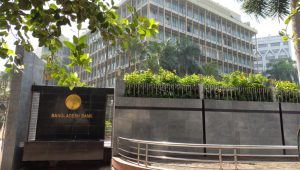
The Bangladesh Bank has made it mandatory for all banks, mobile financial services (MFS), and payment service providers (PSP) to join the interoperable transaction network under the National Payment Switch Bangladesh (NPSB) from 1st November.
This will enable people to withdraw their MFS money through their bank accounts at nearly half the cost.
“At the same time, it will boost cashless payments through PSPs and break the ongoing MFS monopoly,” said Adnan Imtiaz Halim, CEO of Sheba Platforms.
A circular issued by the central bank on Monday stated that interoperability will allow seamless fund transfers across all bank, MFS and PSP accounts.
The NPSB currently supports only instant transfers between bank accounts. The inclusion of MFS and PSP accounts in the NPSB network is being seen as a major step towards a cashless economy.
Banks will be allowed to charge up to Tk1.5 per Tk1,000 sent through NPSB interoperability, including VAT.
PSPs will be allowed to charge up to Tk2 for sending the same amount. MFS providers will be allowed to charge a maximum of Tk8.5 per Tk1,000 sent through the interoperable platform.

Analysts said interoperability will increase transactions through PSPs, as wallet balances will be transferable across banks, MFS platforms, and PSPs.
They said a significant impact will be seen in MFS withdrawal costs if users shift to withdrawing through bank accounts. Withdrawal of MFS funds through banks will cost a maximum of Tk8.5 per Tk1,000.
Withdrawals from MFS agent outlets currently cost from Tk14.5 to Tk18 per Tk 1,000.
Chaldal CEO Waseem Alim, whose company runs a PSP under a provisional Bangladesh Bank licence, said MFS withdrawal costs should be reduced further.



bKash, the largest MFS operator with 8.2 crore users, declined to comment immediately. Nagad said it had already applied to the Bangladesh Bank to join the interoperability framework.
Bangladesh Bank officials said the announced rates are ceilings, and operators are free to lower charges to compete.
Sheba Platforms’ Adnan Imtiaz said interoperability will boost money flow through PSPs and strengthen digital payment infrastructure.
Over a dozen PSPs together have acquired less than four lakh users, as it is yet to be popular.
Bangladesh spends around Tk20,000 crore every year to print banknotes, and that money could be saved if cash-based transactions decline.
Bangladesh has made slow progress in digital payments compared to India and Pakistan, despite starting the journey at the same time.
The Binimoy interoperability platform, scrapped after the political regime change last year, was developed during the ousted Awami League government at a cost of over Tk65 crore in state funds.
The platform bypassed NPSB and was pushed through to allow a company linked to the family of former state minister for energy Nasrul Hamid to earn half of the revenue as an operating partner.
MFS platforms transformed domestic money transfer and helped unbanked people access financial services nationwide. However, high cash-out charges remained the biggest concern for MFS users despite its reach and accessibility.
Sheba’s Halim said, “The need for cash-outs should decline with more merchants accepting digital payments from wallets.”
Pathao CEO Fahim Ahmed said the pricing gap between MFS and PSP transactions should be narrowed.
“While we welcome the long-overdue expansion of NPSB to facilitate interoperability, we strongly urge a review of a potentially distortionary pricing framework,” he told TIMES.
He said cards remain a key channel for cash-in for PSPs and will continue to be used unless NPSB allows users to pull funds from authorised bank and wallet sources more efficiently.
He said PSP cash-out charges allowed would not cover the cost of cash-in through cards, which would not be the case for MFS, and it would create a mismatch.
The government recently announced it would make Bangla QR mandatory for all merchants before issuing trade licences.
QR-based payments at shops and service points will drive faster adoption of cashless transactions across the country, officials expect.