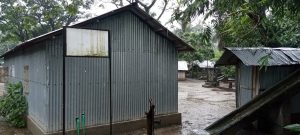
For the past eight years, students and teachers at Pariyali Government Primary School in Monirampur Upazila of Jashore have been struggling to continue primary education in dire conditions. Since the demolition of the school’s permanent building in 2020, all academic and administrative activities have been conducted in temporary, rundown tin-roofed sheds.
The original school building was declared abandoned in 2017 due to structural concerns and was subsequently torn down three years later. However, construction of a new facility has yet to begin. The absence of a proper structure has left students and teachers exposed to extreme heat, rain, and muddy surroundings, creating severe challenges for effective learning.
On one side of the school field, remnants of the demolished building still lie scattered. In their place, three small tin-roofed sheds now serve as makeshift classrooms. Even light rainfall renders the field unusable, turning it into a muddy quagmire and causing water to seep into the classroom floors.

Jeba Islam, a third-grade student, shared her struggles: “When it rains, water accumulates on the floor. And during hot weather, the tin roof becomes unbearably hot. It’s always very difficult for us. We can’t attend classes properly.”
Faruk Hossain, a student in the fourth grade, echoed her sentiments. “I don’t like coming to school. There’s no place to play here. My friends don’t come to school either. So I don’t feel good about it.”


Parents, too, are deeply concerned. Tarikul Islam, a guardian, said, “There is not even a minimum learning environment at this school. It hurts to see the children suffer. The number of students is decreasing day by day because parents don’t feel confident sending their children to school in such conditions.”
Established in 1960, the school once had a strong presence in the community. Even after being declared unsafe, it had 110 enrolled students in 2018. However, due to the ongoing lack of infrastructure, that number has dropped to 70 on paper, and actual attendance is falling further.
Acting head teacher Reshma Khatun noted the growing challenges: “Due to the lack of a permanent building, both teachers and students are constantly at risk. The environment is not conducive to learning, and it’s affecting student morale and participation.”
According to District Primary Education Officer Mohammad Ashraful Alam, the delay in reconstruction is due to land-related complications. “Out of the school’s total 48 decimals of land, there is a dispute over five decimals,” he explained. “Because of this issue, tenders for a new building could not be invited. We are working to resolve the matter as quickly as possible so that construction can begin.”
As students continue their education in unsafe and inadequate conditions, the situation underscores the urgent need for infrastructural development in rural educational institutions across the country.