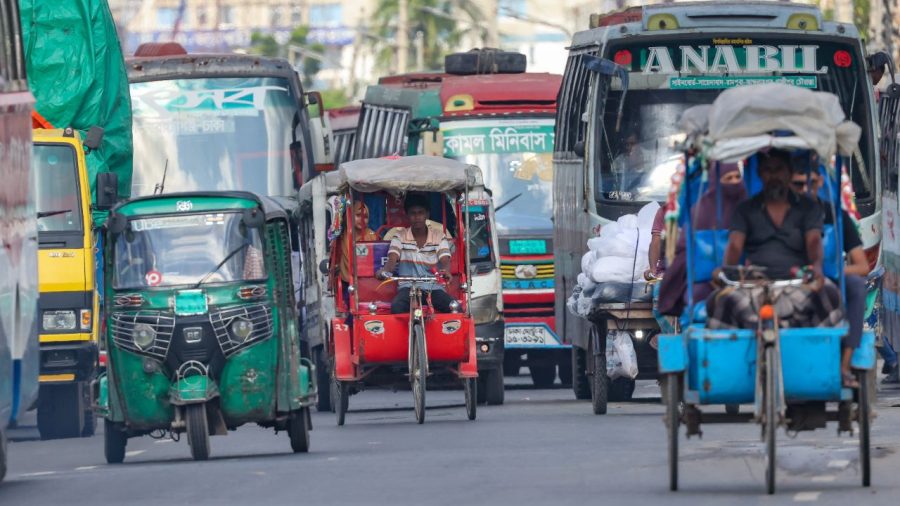



The government will begin registering battery-powered three-wheeled e-rickshaws in all 13 city corporations on Monday, bringing the vehicles under a formal regulatory framework after decades of largely unregulated operation.
Drivers will be brought under a licensing system in phases, while the authorities will introduce designated operating zones, vehicle fitness requirements and kilometre-based fares.
State Minister for Local Government, Rural Development and Cooperatives Mir Shahe Alam announced the measures at a press briefing at the Secretariat on Sunday.
He said battery-powered three-wheelers had operated without a formal regulatory framework for 15 to 30 years, and the new rules would bring them under legal oversight.
The regulatory framework follows an amendment to the Local Government (City Corporation) Act, 2009, passed in 2026.
The relevant provision was incorporated into Section 120 of the Act. The rules have since been vetted by the Law Ministry and published in the official gazette, removing legal barriers to registration.
Under the rules, owners of two-passenger e-rickshaws will pay Tk8,000 for registration and Tk4,000 for annual renewal following a fitness inspection.

Four-passenger e-rickshaws will require a registration fee of Tk10,000, with a renewal fee of Tk500 after one year.
The vehicles will have a maximum operating lifespan of 12 years. Owners will also pay an additional Tk1,000 for displaying a city corporation-issued fitness certificate containing a QR code.
To regulate manufacturing, the government has formed a seven-member committee comprising representatives from the Local Government Division, Bangladesh University of Engineering and Technology (BUET), city corporations, police traffic departments and district administrations.
The committee will oversee production and recommend approval of manufacturers.
Shahe Alam said new e-rickshaws must follow BUET-approved designs, while existing vehicles would have to be modified to meet the prescribed standards.




Manufacturers will carry out the modifications in accordance with the approved designs and with permission from the relevant city corporations.
The rules also prohibit breaking or melting down e-rickshaw batteries.
Operating without registration, exceeding speed limits, carrying excess passengers, using unauthorised batteries and making unapproved changes to motors or vehicle structures will be treated as offences.
Other violations include entering restricted areas, reckless driving, transporting goods without passengers, disobeying traffic signals and fleeing after an accident. Offenders will face legal action.
In Dhaka, the government plans to divide e-rickshaw operations into eight zones, with four under each of the two city corporations.
Vehicles in each zone will have a distinct colour and will not be permitted to operate outside their designated areas.
The number of vehicles allowed in each zone will be determined jointly by the traffic police and city corporations, taking traffic congestion into account.
However, no overall limit on the number of e-rickshaws has been fixed.
Although the rules provide for driving licences, the government will not introduce them immediately.

Shahe Alam said processing a large number of applications simultaneously would be difficult for city corporations. Vehicle registration would therefore take priority, with driver licensing to follow through a separate notification.
He also assured existing e-rickshaw operators that there would be no immediate drive to remove their vehicles from the roads.
“Everyone is requested to continue operating as they are for now. We will gradually register vehicles in accordance with the rules and take steps to remove illegal battery-powered rickshaws in phases,” he said.
Registration could take several days or weeks, depending on the process, he added.
The government will also regulate charging stations, allowing them only at designated locations.
Establishments capable of providing solar-powered charging facilities will be eligible for city corporation approval or trade licences.
Unauthorised electricity use for charging e-rickshaws will be subject to legal action, with city corporation magistrates regularly monitoring compliance.
Fares will be fixed on a per-kilometre basis following consultations among e-rickshaw owners, traffic authorities and city corporations after registration begins.