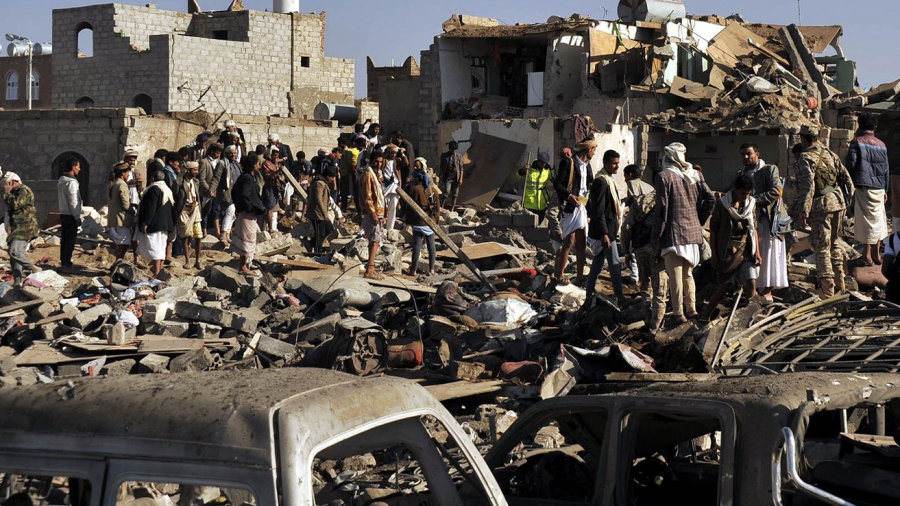



Saudi Arabia and the Yemeni Houthis are again engaging in a battle; however, one should remember that winning a battle does not always equal a victory in a war. Yemen’s political future conflict has grown into a regional crisis, which is jeopardising civilian lives, international commerce and energy markets and which has repercussions as far as Bangladesh.
The political fragmentation in Yemen is at the roots of the conflict. The Houthis took advantage of the chaos of the Arab Spring in 2011 and in 2014 took control of the capital, Sana’a. A Saudi-led military coalition stepped in in March 2015 to aid Yemen’s internationally recognised government. The Houthis’ march was seen as a security threat to Riyadh and an opportunity for Iran to increase its regional influence. Meanwhile, the Houthis framed their campaign as a fight against foreign interference. Saudi Arabia has not been able to defeat the Houthis via prolonged war, nor has it been able to kill off their ability to attack or create a stable Yemen state with its military capability. In April 2022, a truce was negotiated by the United Nations that brought a halt to large-scale fighting but not to the political splits. The precarious calm has been marred by recent violence.
The battle is not just between Saudi Arabia and Iran. Saudi security concerns have intensified due to Iran’s connections with the Houthis, their missile and drone power. But to describe the Houthis as being an Iranian proxy ignores Yemen’s domestic political dynamics and the Houthis’ own interests. The crisis needs to be addressed through both external support as well as local grievances. Saudi territorial incursions could be a way for the Houthis to seek retribution, prove their military prowess and give them leverage in the talks. Saudi Arabia, on the other hand, has very real fears to protect its citizens and critical infrastructure. But the substitution of war for political compromise is unacceptable. The Houthis’ attacks on civilian facilities or Saudi military superiority will not guarantee a lasting legitimacy or solve the political disunity of Yemen.
There have been a number of incidents that have occurred in the airport recently, which have caused additional concern regarding civilian infrastructure. Security restrictions, and reported attacks, have disrupted aviation and led to flight suspensions. These worries were exacerbated by a reported attack on King Fahd International Airport in Dammam on 21 October. Airports are not just a means of transport; they are a lifeline for international connectivity, labour mobility and millions of livelihoods. Escalation’s humanitarian impacts may be dire. Migrant workers, passengers at civilian airports and civilians are at risk of additional casualties and damage to civilian infrastructure if there is fighting in Yemen. Under international humanitarian law, all parties are obliged to make a distinction between civilians and combatants and protect civilians from indiscriminate or disproportionate attacks. Violations of international law cannot be made in the name of national security.

Years of conflict have left Yemen’s people to suffer economic breakdown, poor infrastructure and lack of basic services. Any further escalation may affect food security, the provision of health services, humanitarian aid and livelihoods. Civilian protection and impartial investigations of alleged violations still need to be a priority, therefore.
The world trade is also at risk. The Bab el-Mandeb Strait that links the Red Sea and Gulf of Aden is a key shipping lane for trade between Asia and Europe via the Suez Canal. Security threats can make ships take longer routes, driving up shipping costs, insurance premiums and delivery times. Such interruptions could drive up the cost of fuel, food, industrial supplies and fertiliser, resulting in further inflationary pressures. The impacts are especially great for Bangladesh. Saudi Arabia is one of the key countries of destination for the Bangladeshi migrant workers and a source of remittance. Declines in security may impact recruitment, jobs and workers’ incomes. As shown by the recent aviation disturbances, a faraway conflict can have a tremendous impact on Bangladeshi families.




As of 25 October 2026, security restrictions at Saudi airports were cited as the reason for the cancellation or suspension of 146 flights involving 22,231 passengers, according to figures cited by the Civil Aviation Authority of Bangladesh (CAAB). In total, 69 of these services were direct and 77 were transit. Among the direct services, Biman Bangladesh Airlines, Saudia, Riyadh Air and US-Bangla Airlines’ services were affected, and several international airlines also faced disruption. Later, Biman Bangladesh Airlines said its flights to Riyadh and Dammam would continue to be suspended till 4 November 2026. Two flights between Dhaka and Jeddah were set to operate until that day and regular flights were operating from Dhaka to Madinah. Passengers were urged to think about alternative entry points, if available, and as directed by their airline.
These disturbances have led to uncertainty among the expatriate workers returning to their jobs, travelling for work or responding to urgent issues of their families. Delays may result in problems with employment, visa issues and extra living and travel costs. Families living on remittances are especially sensitive to the loss of remittances and/or wages from their working members.
The price of energy and maritime transportation may also go up, driving up the bill for imports for Bangladesh. This crisis, if extended, would add to foreign exchange reserves and inflation and household purchasing power. The economic effects of increases in international prices in an import dependent economy include increases in transport costs, production costs, and prices of products necessary for survival.
Preparation and coordination of the Bangladeshi diplomatic missions and the concerned authorities should be enhanced with the airline companies. Assist passengers who have been affected in terms of other flights, ticket rescheduling and emergency. There is also a need for engagement with Saudi authorities and employers to tackle the employment and visa issues for workers who cannot return on time. The government needs to pay keen attention to energy and shipping costs, diversify its energy suppliers and boost economic resilience. Diplomatically, Bangladesh needs to be careful to avoid quick alignment with rival regional camps and must keep championing civilian protection, humanitarian access, freedom of movement and peaceful dialogue. The principle of neutrality is not synonymous with indifference; it is equivalent to adhering in an equitable manner to those principles of international law.
A permanent solution should involve political compromise, viable security guarantees, institutionalised public sectors and consensus on public-sector wages and state revenues. Yemen’s political future needs to address other interests than just those of the Houthis and their main opponents. The immediate priorities must be to stop attacks against civilians and civilian infrastructure, stop further escalation in the region and get diplomacy back. The security of Saudi Arabia cannot be ignored in tandem with rights and safety of Yemen’s people.

Finally, it is not a war that can be measured in the quantity of missiles shot down, or targets destroyed or territory conquered. Success should be defined as lives saved, trade revived and a peaceful political future restored for Yemen. Without these objectives, however, apparent military successes will be open to challenge and will only sustain an even more damaging and expensive war for the entire region and beyond.
The views expressed in this article are solely those of the author
The writer is an Associate Professor, Department of Public Administration, University of Rajshahi. E-mail: [email protected]