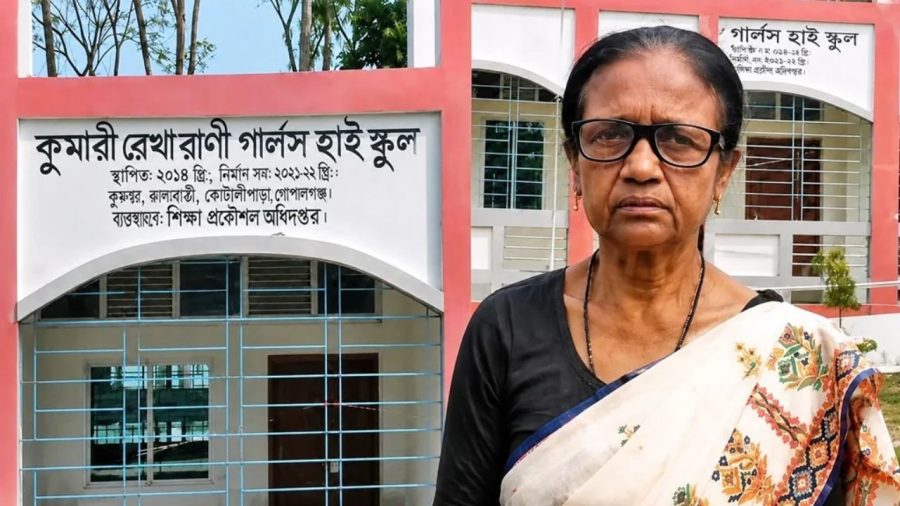



Rekha Rani Ojha once dreamt of becoming a teacher. Life took her into nursing instead, but she never abandoned her passion for education. Now, at 77, she has devoted her life’s savings to building a school for girls in Gopalganj, leaving herself without a home of her own.
The retired government nurse spent her savings and retirement benefits on buying land, putting up a tin-shed classroom and developing a school where girls from low-income families could pursue opportunities she could once only dream of.
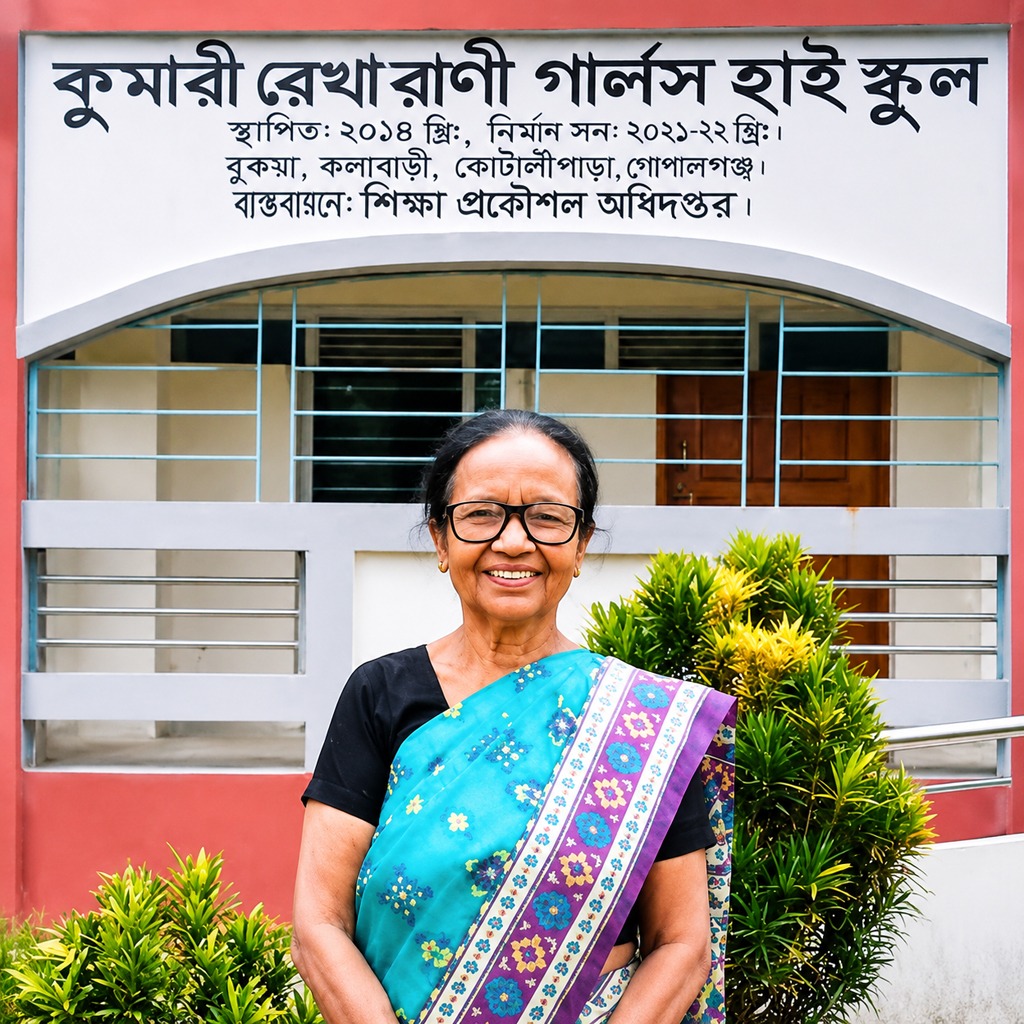
Today, Kumari Rekha Rani Girls High School in Kotalipara stands as the fulfilment of that dream. For Rekha, success lies in what her students can accomplish.
“I wanted to be a professor but could not. I could not reach any high post either. But one of my students may become a teacher one day, another a doctor, someone a government official who lifts her own family up and works for society. To me, that is success,” she told TIMES.
Despite her failing health, Rekha has one wish: that the school continue educating girls after she is gone.
Born in 1948 into a poor family, Rekha was the eldest of four sisters and two brothers. She hoped to become a teacher or enter a profession where she could serve others.
Poverty repeatedly threatened her ambitions. Her father, Shashi Bhushan Ojha, wanted her to stop studying, and attempts were made to arrange her marriage when she was a teenager.
Determined to continue her education, she sometimes sought shelter with relatives who supported her studies.
She eventually enrolled at a nursing institute in Dhaka.

In 1983, she began working as a senior staff nurse at Dhaka Medical College Hospital. She later served at several government hospitals before retiring from Dhaka Dental College Hospital in Mirpur in 2011.
Rekha never married. Throughout her career, she saved part of her monthly salary.
After retirement, she combined those savings with her retirement benefits and bought land in Burua village.
In 2014, Kumari Rekha Rani Girls High School opened in a modest tin-shed building with just one student.
The school has since expanded and earned a reputation for achieving a 100 per cent pass rate in the Secondary School Certificate (SSC) examinations.
Government funding later enabled the construction of a multi-storey building, with work beginning in the 2021–22 financial year and finishing this year.



The school now offers classes from Class VI to Class X, with 100 students, seven teachers and residential facilities for girls.
Initially, Rekha would go from door to door, persuading parents to educate their daughters rather than marry them off.
Drawing on her experiences, she explained to parents how putting an end to a girl’s education could close doors to future opportunities.
Her appeals won parents’ trust, encouraging families to keep their daughters in school.
Most students come from poor households. At admission, parents contribute whatever they can afford. Regular tuition fees are often waived, although government registration fees must be paid for examinations.
Feeding the girls living at the school also depends on contributions from their families. Some provide home-grown vegetables, while others send rice or lentils.
A school to call home
Having spent almost everything on the school, Rekha now lives in a corner of its library.
She suffers from several health complications and has travelled abroad for cancer treatment. With little money left for herself, her concerns centre on the school’s survival.
Despite its growth, the institution struggles financially because it has not been included in the government’s Monthly Pay Order (MPO) scheme, which provides salary support to teachers and staff at eligible non-government educational institutions.
The shortage of funds has left teachers struggling to make ends meet, prompting many to leave.
“My life is one of hardship, but what will you do hearing about that hardship? Rather, do something so that my school’s hardship is removed,” Rekha said.
Her struggle has drawn the attention of the district administration.

On 27 August, Gopalganj Superintendent of Police Md Habibullah visited the school and provided financial assistance.
Although the matter falls outside his department’s responsibilities, he assured Rekha that he would raise the issue of MPO inclusion with the relevant authorities.
Gopalganj Deputy Commissioner Md Arif-uz-Zaman said the upazila nirbahi officer had visited the school on his instructions.
In coordination with the education officer, instructions had been given to bring the institution up to the required standards and create an appropriate environment for MPO inclusion.
“I salute Rekha Rani’s noble initiative. If affluent and conscious people of society come forward from their own positions as she has, positive change in education and social development is possible,” the deputy commissioner said.
A daughter and a different kind of motherhood
Rekha never married, but she found motherhood in another way.
She took in Chandana Rani Baidya, whose mother had died and whose father subsequently remarried. With no place for Chandana in her father’s new household, Rekha raised her as her own daughter.
Chandana has since earned a master’s degree in sociology.
She is now looking for work, supporting herself through private tuition and helping Rekha run the school.
Life remains difficult for them both.
Chandana said there were times when the household had no food. On such days, they survived on rice with leafy vegetables gathered from nearby land and mashed potatoes.
For Rekha, the school remains her life’s work, and its future remains her greatest concern.