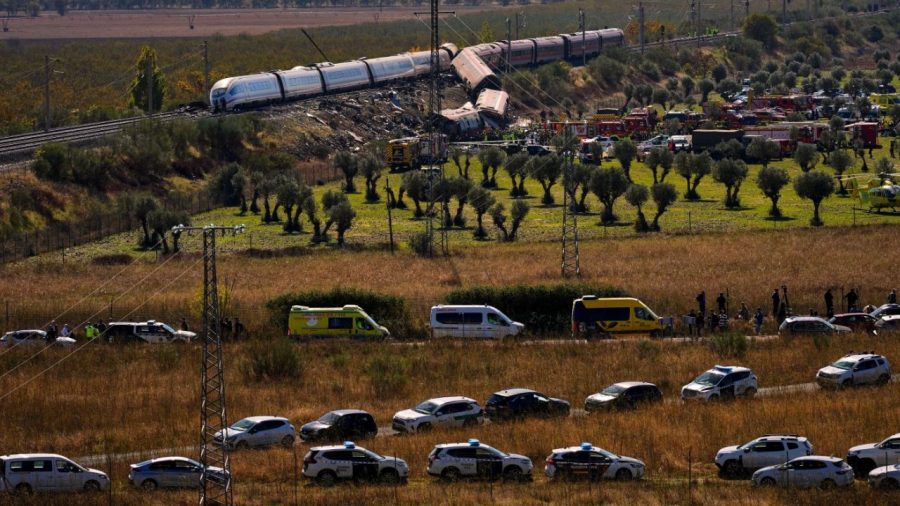



Passengers have described scenes of devastation, confusion and anger after two high-speed trains collided in Spain, leaving travellers injured and raising questions about a possible signalling failure.
At around 08:30 on Wednesday (07:30 GMT), two high-speed trains were travelling south from Madrid towards Seville, reports BBC.
One, operated by state-owned Renfe, carried 397 passengers, while the other, run by private operator Iryo, had 147 people on board.
A reported malfunction in the automatic signalling system, described as a computer failure, had forced trains to stop along the affected section of the line.
Spain’s transport minister said the situation took an unexpected turn when the Renfe train received an erroneous instruction to continue its journey.
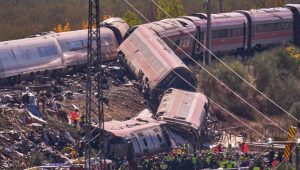
The train struck the rear of the Iryo service between the municipalities of Mora and Orgaz, around 140km (87 miles) south of Madrid.
Before the collision, passengers had been sleeping, working on laptops or scrolling through their phones when an announcement informed them of congestion on the tracks.
The delay lasted a few minutes for some passengers and longer for others.
Tangui Binier, 22, was travelling in the front carriage, number eight, of the Iryo train, while his father was in carriage seven.
Their train was among six services ordered to stop at 08:30. A few minutes later, Binier said, the train began accelerating before coming to an abrupt halt.
“The train started speeding,” Binier told the BBC, “then it came to a sudden halt”.

He looked outside and noticed wires falling on the left side, followed by heavy smoke behind the train.
Spanish journalist Roberto Gómez was resting aboard the Renfe train, which had stopped more than 25km (16 miles) away from Binier’s train.
The stop lasted only briefly. The train started moving again a few minutes later, and the collision followed.
Gómez was unaware that authorities had ordered his train to resume its journey at 08:36.
Spain’s Transport Minister Óscar Puente said the “truly unbelievable” incident occurred around 17 minutes later.
“The impact was terrible,” Gómez told Onda Cero radio.
“You can imagine, the carriage is completely destroyed. All the suitcases are all over the wrecked carriage.”
Although Gómez sustained only minor injuries, he saw another passenger fall on top of him and suffer a deep cut to the head.



“We were able to help people who had suffered severe blows to their chest and ribs,” he said.
Rafael Barcelo was travelling in one of the worst-hit carriages. A bruise on his forehead marked his escape from the disaster. He had been drinking coffee when he felt a massive impact.
“We were all thrown into the air,” he told Reuters news agency at the crash site.
“I am reasonably OK, my friend is quite worse.”
Barcelo said he was in carriage seven, which suffered some of the worst damage and had the highest number of victims.
“I was travelling in coach seven, which is the one with more victims and the one most destroyed. I at least counted eight victims in that coach,” he said, visibly shaken.
Salvador Arriza said the destruction extended to carriages farthest from the point of impact on the Renfe train. Seats had come loose, and many passengers facing the direction of travel were thrown into the air.
“It was something brutal,” he said, recalling how some people became trapped between the seats.
After escaping the wreckage, Arriza noticed a piece of railway track that had pierced the roof of one carriage.
“What caught my attention is that in one of the coaches there was a piece of train track that went through the roof of the coach, and I think that might have helped to stop or reduce the inertia of the train.”
Sebastián Herrero was aboard the Iryo train when the rear-end collision sent him crashing into the seats in front.
“After we fell, there were many people with broken noses, broken arms… We started seeing smoke everywhere.”
After the initial impact, passengers in Binier’s carriage debated whether they could safely leave the train because electrical wires lay scattered outside. Fearing another collision, some decided to get out.
Binier said the extent of the disaster became clear only after they stepped outside.
“We did not know what had happened until we took a step outside, and there was evidence of what had happened.

“We saw the other train behind ours and we saw our train completely flipped over and the back side full of debris,” he told the BBC.
He recalled being overwhelmed by the destruction and the sight of severely injured passengers and dead bodies.
“When I got out of the train I was in complete shock, complete awe. There were people in danger, it was very hard to see, there were dead bodies, there were missing limbs. ”
“I don’t know if that is something I will ever recover from.”
Despite the shock, Binier said adrenaline drove uninjured passengers to help those in need. His father was among them and managed to carry a girl with a broken hip to safety.
Local residents soon arrived at the scene, followed by police and ambulance services from the Guardia Civil.
Binier described himself as fortunate to have escaped without serious injuries, but said witnessing the suffering of others had left him questioning why he survived.
“I’m really one of the most fortunate people and the luckiest person. I feel like just I’m so fortunate and I see other people who are not so fortunate, and I see them very close up. Sometimes you just ask yourself ‘Why me?’,” he said.
The latest accident has renewed concerns over rail safety in Spain, which was still reeling from the Adamuz high-speed rail disaster outside Córdoba in January that killed 46 people.
That crash occurred on the same high-speed railway line, although much farther south. Wednesday’s collision has therefore prompted fresh questions about the circumstances surrounding the incident and the actions of the authorities.
Passengers expressed anger over the failure to prevent the collision, particularly given the brief stop before the Renfe train resumed its journey.
“It isn’t possible that our train was stopped for five or 10 minutes and that the other train wasn’t told to stop,” one passenger said.
“It’s not normal. We weren’t told anything. The person who should have been told something was the driver of the other train. We wouldn’t have cared as long as the other train had been warned. I don’t understand this.”
The passenger also questioned how the disaster could occur despite modern technology.
“How can this happen with the technology we have?” they added.