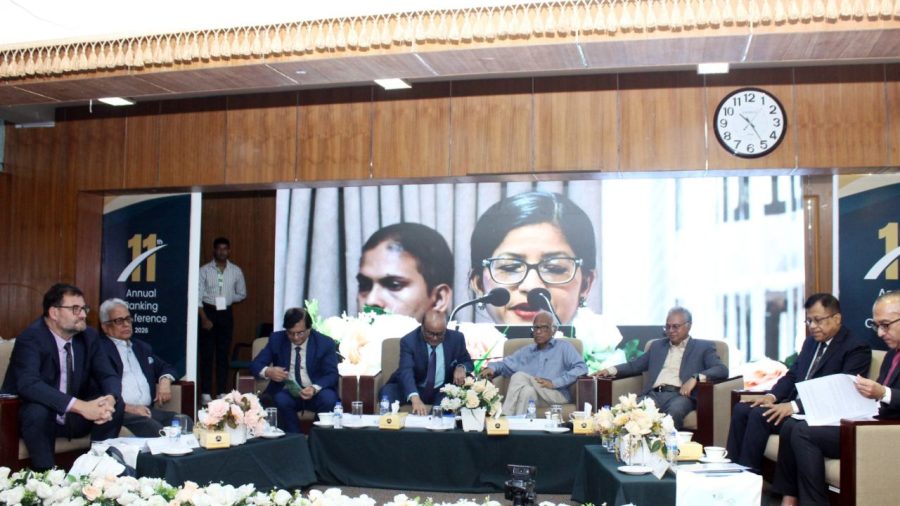



Interest-rate cuts are losing traction in Bangladesh because banks burdened by bad loans, capital shortfalls and weak balance sheets remain reluctant or unable to expand lending, economist Zaidi Sattar said on Wednesday.
Banking-sector reform has become a precondition for effective monetary policy, the Policy Research Institute chairman said while presenting the keynote paper at the Bangladesh Institute of Bank Management’s 11th Annual Banking Conference in Dhaka.
Sattar said higher policy rates can quickly raise borrowing costs and suppress credit demand, but subsequent easing may fail to revive lending when banks remain undercapitalised, risk-averse and weighed down by impaired loans.
The strain is evident across the banking system. Gross non-performing loans reached 32.8 per cent of outstanding credit, or about Tk6.07 lakh crore, in June 2026, while the system-wide capital-to-risk-weighted-assets ratio fell to negative 2.64 per cent at the end of 2025.
Private-sector credit growth has remained below 5 per cent year-on-year since March even as bank deposits grew 11.36 per cent, a divergence Sattar said points to weak financial intermediation rather than a shortage of liquidity.

The problem has been compounded by emergency liquidity support. Distressed and weak banks had received Tk84,945.71 crore in such support as of September 2026, which the paper said had weakened monetary-policy transmission.
Bangladesh Bank cut its policy rate to 9.5 per cent in late July after holding it at 10 per cent, but private credit growth remained subdued. Headline inflation stood at 8.26 per cent in August.




Sattar argued that Bangladesh’s inflation cannot be tackled through interest rates alone because price pressures also reflect supply shocks, exchange-rate depreciation and weaknesses in monetary transmission.
He said excessive tightening could suppress private investment without directly addressing supply-driven inflation, while premature easing could reinforce inflation and weaken expectations.
Sattar also called for stronger operational autonomy for Bangladesh Bank, but said legal protection alone would not be enough. Effective monetary independence also requires fiscal discipline, deeper government debt markets, sound financial institutions and limits on quasi-fiscal operations.
“The appropriate objective is therefore coordination without subordination,” he said, warning that cooperation between fiscal and monetary authorities should not turn the central bank into the residual financier of government policy.
He also proposed pairing greater exchange-rate flexibility with tariff reductions under what he called “compensated depreciation”. The approach would seek to offset the inflationary impact of a weaker taka through lower tariffs while preserving the export incentive created by depreciation.
BIBM Director General Md Ezazul Islam said high financing costs, subdued investment, infrastructure bottlenecks and global uncertainty were adding to economic pressures, while weaknesses in governance, asset quality and accountability had eroded confidence in financial intermediation.

“Banking, above all, rests on trust,” Islam said, calling for stronger corporate governance, better asset quality and capital adequacy, more effective risk-based supervision and bank resolution, and firmer protection of depositors.
Bangladesh Bank Deputy Governor Md Kabir Ahmed, World Bank Division Director for Bangladesh and Bhutan Jean Pesme, Bangladesh Association of Banks Chairman and Dhaka Bank Chairman Abdul Hai Sarker, and Association of Bankers Bangladesh Chairman and City Bank Managing Director and CEO Mashrur Arefin also addressed the inaugural session.
Economist Wahiduddin Mahmud inaugurated the conference.
The two-day conference, themed “Reshaping the Banking Sector for Accelerating Economic Growth”, features 13 plenary sessions and 104 research papers, with more than 800 participants expected.