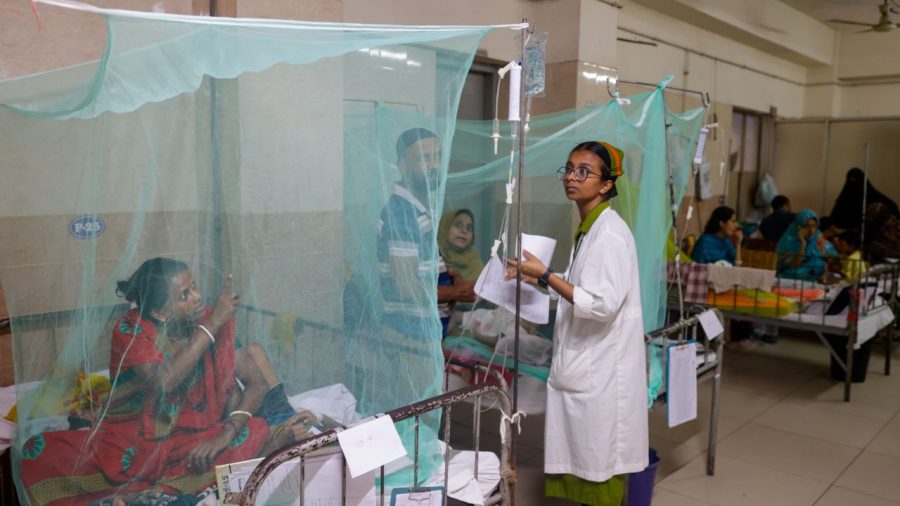



Hundreds of makeshift beds on the floors and verandas of government hospital medicine wards are now a common sight during each monsoon season in Bangladesh. Because there aren’t enough IV stands available, life-saving fluids are typically hung from windows. A large percentage of these patients arrive from slums, the outer edges of towns/cities, or remote areas. For them, dengue is no longer just a viral infection caused by mosquitoes; it is also a devastating economic pitfall. Dengue is a viral fever in medical terms; however, in the socio-economic reality of Bangladesh, dengue is rapidly becoming a disease of poverty. If a member of a low-income family contracts dengue, particularly if that person is the main source of income, the family faces not only health issues, but they also enter into an extremely serious financial crisis.
Theoretically, Aedes mosquitoes do not discriminate based on wealth. However, the conditions under which Aedes mosquitoes reproduce and transmit are based upon structural inequalities. Air-conditioned apartments, regularly maintained courtyards, and state-of-the-art mosquito repellents offer protection to wealthy and middle-class residents. However, these protections are unavailable to residents of the slums or low-income housing throughout the city. Low-income residents are much more vulnerable to Aedes mosquito-borne illnesses than other residents due to lack of adequate drainage systems, indiscriminately discarded tires or plastic containers, and high-density living spaces. As a result, even though all segments of society are affected by Aedes mosquito-borne illnesses, low-income residents suffer most from them.
The primary horror of dengue is not only the physical suffering that it causes, but the economic hardship it imposes on low-income families. On the first day of fever, a silent commerce in diagnostic testing begins. Diagnostic testing for dengue includes the NS1 Antigen Test, Complete Blood Count (CBC) and daily monitoring of platelet counts. The cost of such diagnostic tests may completely deplete the financial resources of a daily wage earner or rickshaw puller. Although diagnostic testing at government hospitals is relatively less expensive than at private facilities, the waiting time for testing and/or availability of necessary reagents can often necessitate patients seeking out testing from private diagnostic laboratories.
If a poor patient must be hospitalised in a private facility because of a shortage of available beds in government hospitals, then the hospitalisation will result in a disastrous financial outcome. In addition to the cost of renting a bed in a hospital, other expenses associated with hospitalisation include daily visits from doctors, liquid diets, saline, paracetamol, and potentially obtaining platelets/blood transfusions. All of these expenses can add up rapidly to thousands or hundreds of thousands of taka within a relatively short period. If the patient’s condition worsens to the point where they need to enter an Intensive Care Unit (ICU), then paying for the ICU care is virtually impossible.

Beyond direct costs of treatment, there is another substantial cost: the complete loss of income. Many people in Bangladesh are employed in the informal economy and have no wage protection if they cannot work. For example, if a rickshaw driver earns 500 taka each day and cannot work for 10 days due to illness, his family will lose 5,000 taka of income. If he then spends an estimated 15,000 taka to treat himself, the total amount of money lost will be 20,000 taka. Additionally, the person caring for him may not be able to continue working during this time. Therefore, the illness causes damage to the family’s finances from two sources.
In addition, the family may go without heating their home or buying enough food for several days. Children’s schooling and nutrition may also suffer as a result of the family’s financial situation. An illness that requires a family to use up all of their available resources to pay for medical care does not merely destroy the physical body; it damages the family’s long-term economic prospects.


The large amount of money spent on medical care and the time lost from work forces many low-income families into an endless spiral of debt. Families will often borrow money at very high interest rates from moneylenders who operate locally; they will also use micro-credit funds provided by NGOs (Non-Governmental Organisations) that were intended to assist families start up their own small businesses to pay their medical bills. Some families may even sell their land, animals, or other personal belongings to help cover the costs of treatment. Although a family member may recover and return home after being hospitalised for a short period of time (e.g., one to two weeks), the family will be burdened with the repayment of the debt for several years. When the family member recovers from dengue, he/she must work hard to repay the loan installments. However, working hard with a body that has recently suffered from dengue makes it likely that he/she will suffer from additional health issues.
The effects of structural health inequities are most clearly seen through mortality rates. When a person with dengue receives treatment in a timely manner (and fluid management), the probability of dying from the infection is nearly non-existent. However, the majority of poor people enter the hospital in the last stages of the disease. They do not enter the hospital because of their own neglect but rather because they fear the high cost of medical care. Poor people will try to treat the fever using OTC medications until their bodies start to shut down. Due to the fact that poor people cannot afford private ICU’s and public hospitals do not provide adequate ICU’s, poor people have higher mortality rates.
To resolve the severe health crisis facing our nation, we need to provide universal health care to all citizens immediately. We must also stop treating epidemic dengue as though it were no different from other common seasonal illnesses. Our government must assume total accountability for the costs associated with diagnosing dengue. This means that both public health care facilities and private diagnostic centres should receive subsidies to perform either NS1 or CBC tests. In addition, we need to create specialised health insurance plans or emergency medical funds for low-income families to help reduce the extremely high percentage of individuals who pay out-of-pocket for their medical care (68%). Finally, we must end discrimination in the ways that mosquitoes are eradicated. Fogging campaigns must be directed equally at both the poorest neighbourhoods and the most affluent ones.
If a day labourer loses his/her life to dengue because he/she cannot afford treatment, or if a family becomes destitute as a result of paying for treatment, this represents more than simply the success of a virus. It represents the structural failure of a welfare state.
The views expressed in this article are solely those of the author
The writer is an independent researcher and Folklore and Social Development Studies student, University of Rajshahi. Email: [email protected]