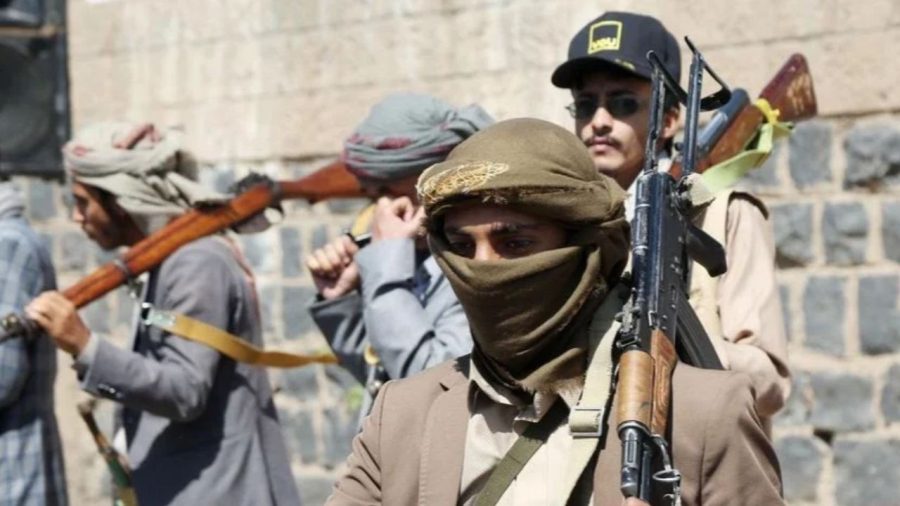



A Houthi missile attack on the presidential palace in the southern Yemeni port city of Aden has killed five people and injured 16 others, officials said.
Al-Maashiq Palace serves as the seat of Yemen’s internationally recognised government, reports BBC.
Information Minister Moammar al-Eryani told the media that Prime Minister Shaya Zindani and other ministers were unharmed when five ballistic missiles struck the complex.
Yahya Sarea, the Houthis’ military spokesman, said the group had targeted what he described as “the Saudi enemy’s military operations headquarters in Aden”.
The Saudi-led coalition backs Yemen’s internationally recognised government and is providing air support to pro-government forces fighting the Iran-backed Houthis.

Yemen’s Health Minister Qasim Buhaibeh said those killed and injured included security personnel guarding the site and civilian employees.
Prime Minister Zindani condemned the attack, describing it as “cowardly” and part of what he called the Houthis’ continuing criminal behaviour. He said the government would continue performing its duties and that the strike would not weaken the determination of government forces to pursue military operations against the Houthis along Yemen’s southwestern Red Sea coast and other front lines.
Tensions spread across Saudi Arabia and Yemen
The attack came amid escalating hostilities between the Houthis and Saudi Arabia. Earlier, the Houthis denied launching an attack on Saudi territory on Thursday after the Saudi-led coalition reported intercepting a cruise missile in the Medina region, home to one of Islam’s holiest sites.
The Houthis have repeatedly launched missiles and drones at Saudi airports, oil and gas facilities, and military installations in retaliation for strikes on areas under their control in western Yemen, including the capital, Sanaa.

On Saturday, a Houthi missile strike killed 13 people at Riyadh’s international airport, marking the deadliest attack in Saudi Arabia in more than a decade.
Saudi Arabia’s Deputy Foreign Minister Rayed Krimly accused Iran of encouraging the Houthis to intensify their campaign against the kingdom.
“Iran continues to arm, train and support the Houthi militia in violation of UN Security Council resolutions,” Krimly told reporters, according to AFP.
He added that Riyadh believed Iran was encouraging the Houthis to escalate the conflict at its latest stage.
Iran’s government did not immediately respond to the allegations. Tehran has previously denied supplying weapons to the Houthis, maintaining that its support for the group is political.
Iran’s foreign minister has also expressed readiness to provide “any assistance necessary to facilitate the start of talks” between Saudi Arabia and the Houthis.
Yemen’s long-running conflict intensifies
Yemen has been devastated by civil war since 2014, when the Houthis drove the internationally recognised government out of Sanaa. The conflict intensified in 2015 after a Saudi-led coalition of Arab states intervened in an effort to restore the government’s authority.
An informal ceasefire that had lasted four years began to unravel in July, when the Houthis announced a “maritime embargo” against Saudi Arabia and launched missile and drone attacks on Saudi airports, oil installations and tankers in the Red Sea.
The group said its actions were retaliation for what it described as a Saudi blockade of territory under its control, as well as an air strike on Sanaa airport that it blamed on Riyadh.
The fighting escalated further in September after the Houthis captured part of Yemen’s southwestern Red Sea coastline near the Bab al-Mandab Strait, a strategically important passage for international shipping. Their advance contributed to rising oil prices following six months of war involving the United States, Israel and Iran.
Last week, pro-government forces said they had recaptured territory overlooking the Bab al-Mandab Strait after launching a major counter-offensive backed by Saudi air strikes.
According to Yemen’s Health Ministry, at least 1,282 people have been killed and 5,890 injured in the fighting since 6 August.
The United Nations has also reported that approximately 201,000 people have been displaced by the conflict, alongside an alarming increase in suspected cholera cases.