In our political culture, praise has long been political currency – exchanged for access, protection, preferment and, at times, even survival. At party rallies, official functions, television talk shows and across social media, leaders are routinely portrayed as visionaries, saviours or indispensable guardians of the nation’s future.
Sycophancy distorts information, weakens institutional checks, suppresses inconvenient evidence and rewards loyalty over competence. Decision-makers hear what pleases them rather than what they need to know. The result is a state increasingly vulnerable to policy failure, institutional decay and declining public trust.
Within political parties, competition to display devotion can be intense. Activists and mid-level leaders vie to deliver extravagant speeches, commission large portraits and stage elaborate displays of loyalty. Government achievements are personalised as the accomplishments of the top leader, while failures are blamed on conspiracies, external pressures or previous administrations.
The culture extends beyond party structures. Sections of the media, business community and civil society have joined the chorus at different times – sometimes out of admiration, but often to secure contracts, licences, appointments, postings, access or protection from those in power.
Its roots lie in a personalised political system in which institutions have repeatedly been subordinated to individuals. Social media has amplified the phenomenon, turning praise into a continuous performance and shrinking the space for dissent.
Advisers become reluctant to deliver unwelcome assessments. Officials learn to present data selectively. Policy alternatives that challenge the prevailing narrative are filtered out before they reach decision-makers.
The consequences can be severe. In the banking sector, politically influenced lending turned banks into instruments of patronage.
Non-performing and distressed loans rose from roughly Tk22,000 crore when the previous long-ruling government took office to more than Tk6 lakh crore by 2024 – equivalent, according to official white-paper estimates, to the cost of 13–14 Dhaka Metro systems or 22–24 Padma Bridges.
High-profile scandals illustrate the pattern: the Hallmark Group’s embezzlement of around Tk3,500–4,000 crore from Sonali Bank through forged documents; BASIC Bank irregularities involving some Tk4,500 crore between 2009 and 2013 under a politically appointed chairman; and successive scandals involving institutions including Farmers Bank.
Wilful defaulters with political connections faced little consequence for years. Illicit financial outflows averaged an estimated $16 billion annually between 2009 and 2023, with cumulative losses put at roughly $234 billion. Regulatory capture and reluctance to confront powerful borrowers allowed the crisis to deepen.
Mega-infrastructure projects reflected a similar pattern. Eight major projects that began with an estimated cost of $11.2 billion ultimately reached $18.64 billion – an excess of $7.44 billion, or 68 percent. The Padma Bridge also underwent successive cost revisions that pushed the final bill far beyond early estimates.
Unviable or poorly designed projects could continue because abandoning them would puncture a cultivated image of transformative success. Acknowledging design flaws, corruption, or waste carried a political cost that sycophantic circles were unwilling to impose.
In education, the gap between rhetoric and reality is equally stark. Despite repeated curriculum changes and claims of progress, foundational learning remains weak. Teacher shortages, particularly of subject specialists outside major cities, persist. Students and parents remain heavily dependent on coaching because classroom teaching often fails to deliver.
Recent board examination results, following the removal of ‘sympathetic marking’, exposed multi-year lows in pass rates, pointing to accumulated learning deficits rather than a sudden collapse. Educated youth unemployment has hovered around 25 percent in some estimates, reflecting a persistent skills mismatch. Education spending has also remained among the lowest in the region as a share of GDP.

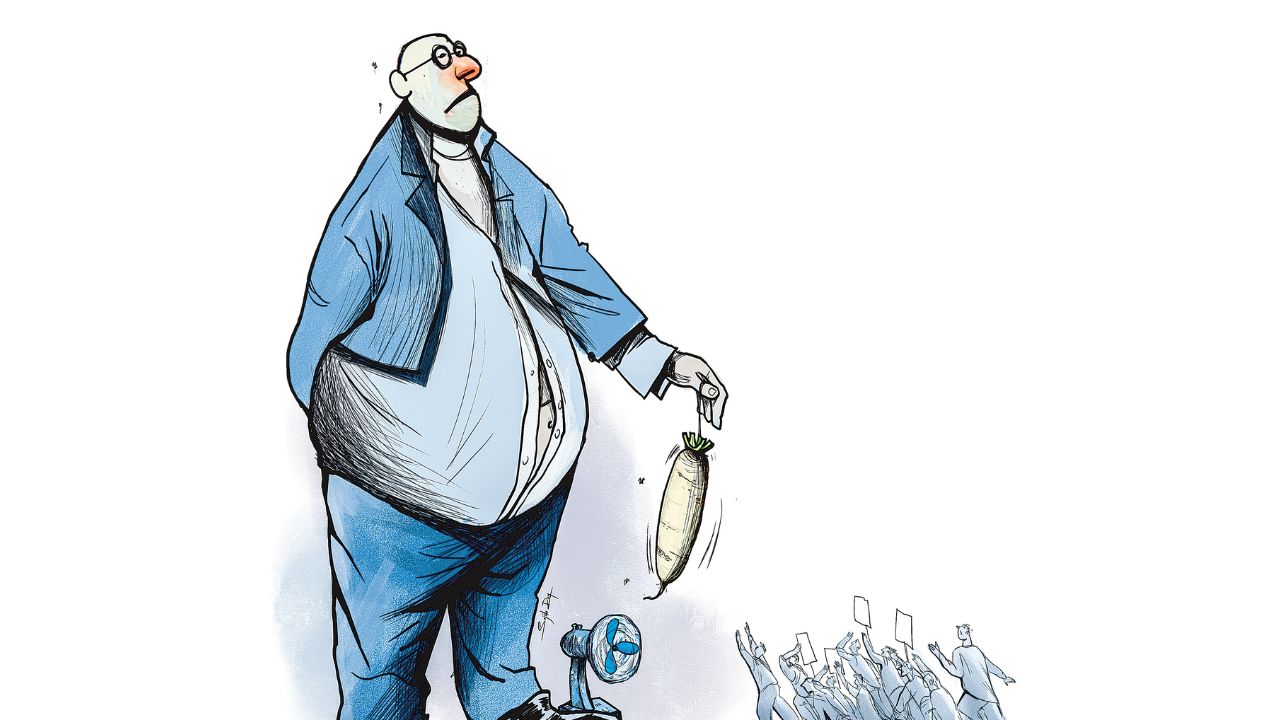


Across these sectors, complex problems have too often been reduced to slogans, ceremonies and publicity campaigns. Evidence contradicting the success narrative was filtered, softened or delayed. Policies and projects continued not because they worked, but because correcting them would damage the image of infallible leadership.
Sycophancy does not merely distort individual judgement. It corrodes institutions. Parliament, the bureaucracy, regulatory bodies and other state institutions can become more concerned with protecting political narratives than enforcing accountability.
Oversight weakens. Questions become gentler. Reports are softened. Bad news is filtered. Institutions designed to scrutinise power begin instead to shield it.
When every success is attributed to one leader and every failure is explained away, official narratives lose credibility. Citizens grow sceptical. Younger generations may come to believe that loyalty, connections and proximity to power matter more than competence, integrity or performance. Once that perception takes root, institutional trust becomes difficult to rebuild.
By documenting scams, cost overruns, learning failures and urban mismanagement, rigorous journalism can force uncomfortable facts into public view and onto the desks of decision-makers who might otherwise remain insulated from them.
Yet this role has been systematically constrained. During the long previous regime, media ownership became heavily concentrated among business groups with close political ties. Broadcast licences, government advertising and regulatory favours created strong incentives for alignment. Some outlets joined the culture of flattery, personalising achievements while softening or ignoring failures.
Those that attempted greater faced legal harassment under the Digital Security Act and its successor, economic pressure, physical threats and widespread self-censorship. Thousands of cases under the DSA targeted critics, including hundreds of journalists.
The July–August 2024 uprising briefly demonstrated the media’s residual power as independent outlets and digital platforms documented repression and challenged official narratives.
But structural vulnerabilities remained. In the post-uprising period, a fragile opening appeared alongside new pressures. Ownership and editorial alignments shifted towards the new authorities, while non-state actors introduced fresh forms of intimidation.
The December 2025 mob attacks on the offices of Prothom Alo and The Daily Star, in which buildings were vandalised and set on fire while staff were trapped inside, demonstrated the continuing risks. Both newspapers were forced to suspend print editions temporarily.
When the media is weakened – by state pressure, economic capture or street-level intimidation – organised praise faces fewer restraints. Leaders hear less of what they need to know. Policy failures remain unexamined for longer. Public distrust deepens.
Leaders are glorified while opponents are demonised. Politics becomes a contest between personalities rather than policies, ideas and records of performance.
Criticism is easily recast as disloyalty or betrayal. Journalists, academics, professionals and officials who question decisions risk marginalisation. The result is a narrower democratic space and poorer public debate.
A political system that punishes criticism eventually deprives itself of one of governance’s most valuable resources: honest information. Bangladesh has made significant economic and social gains despite persistent institutional weaknesses.
But long-term stability cannot rest on personalities. It depends on institutions capable of identifying errors, challenging bad decisions and adapting when policies fail. A political system built around admiration rather than accountability is poorly equipped for crisis.
Economic shocks, climate disasters, financial instability and global uncertainty demand accurate information, open debate and leaders willing to hear criticism.
Praise may protect political egos. It cannot protect an economy, strengthen institutions or solve public problems. Ending the culture of sycophancy requires stronger institutions, transparent appointments, postings, independent oversight and political incentives that reward competence rather than personal loyalty.
Independent media, when allowed to function without fear or favour, remains one of the few institutions capable of delivering the uncomfortable truths that sycophantic circles withhold.
Above all, leaders need institutions, advisers and a press strong enough to tell them when they are wrong – not people competing to praise them.
Until that changes, the language of flattery will continue to exact a heavy price: weaker institutions, poorer decisions and a widening gulf between political leadership and public trust.
The author is the Chief News Editor, TIMES of Bangladesh.