


Victims of enforced disappearance, their families, and leaders of the 11-party alliance have strongly criticised the government over allegations of weakening the proposed enforced disappearance prevention law.
They alleged that the draft law, by allowing those involved in disappearances to investigate the crimes and introducing punitive measures for complainants who fail to prove their cases, would make the path to justice much harder for victims.
To mark the International Day of the Victims of Enforced Disappearances, the National Committee to Observe International Disappearance Prevention Day organised a march from Banglamotor to Jatiya Sangsad on Sunday.
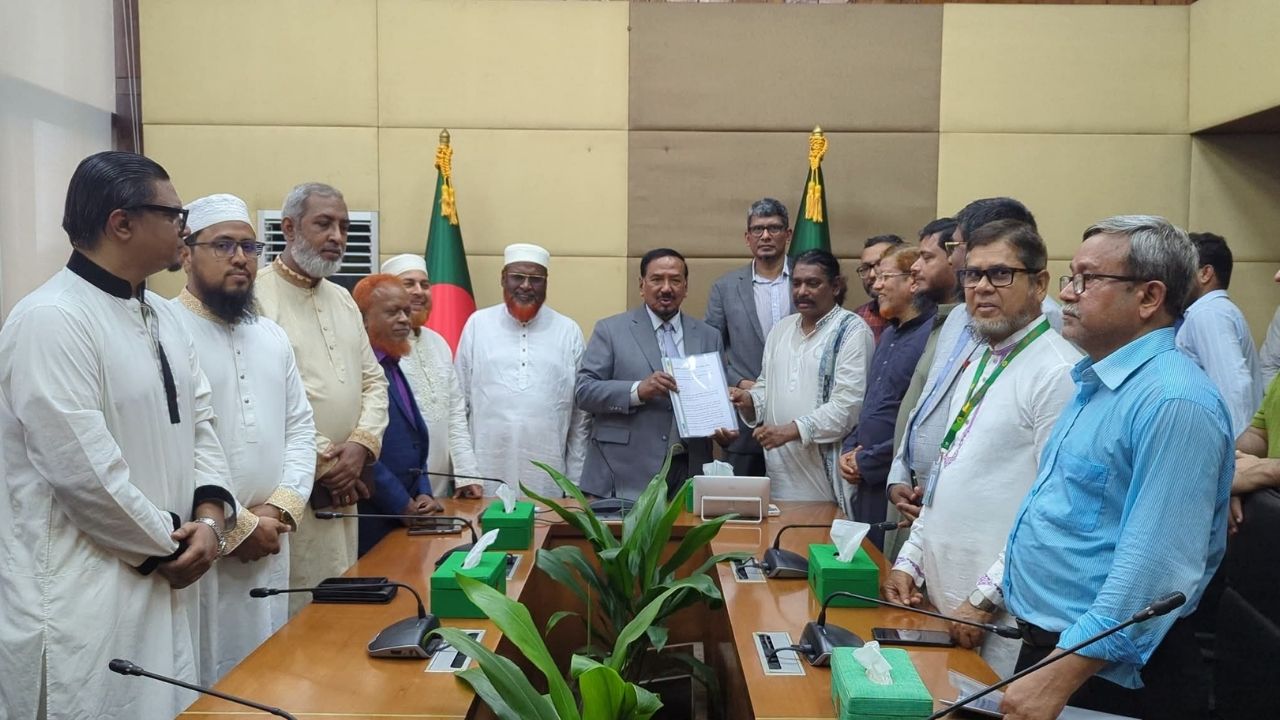
Activists from the Jamaat-e-Islami-led 11-party alliance participated in the programme. Following the march, a brief rally was held in front of the parliament building, after which a delegation submitted a memorandum to the Speaker.
Speakers at the rally demanded that the Enforced Disappearance Prevention Ordinance formulated during the interim government must be enacted into law without any cuts or modifications.

They also called for the formation of an independent and neutral commission of inquiry – rather than assigning investigation duties to any forces involved in the disappearances – as well as locating missing persons and prosecuting those responsible for disappearances and killings.
Prior to the march, a brief rally took place in front of the Rupayan Trade Centre in Banglamotor, presided over by former army officer Hasinur Rahman, himself a victim of enforced disappearance during the Awami League regime.
He criticised Home Minister Salahuddin Ahmed and demanded that the disappearance prevention ordinance be turned into law.
Speaking at the rally, former army officer Akhtaruzzaman said that the law proposed by the Ministry of Home Affairs includes a provision of five years’ imprisonment for the complainant if they fail to prove the incident.



He questioned the capacity of a victim or their family to gather evidence for a crime like enforced disappearance.
Akhtaruzzaman mentioned that the burden of proof must not lie entirely on the victims.
He demanded that the proposed law by the Enforced Disappearance Commission of the interim government, led by Muhammad Yunus, be implemented exactly as proposed, and that families of the victims receive state compensation and rehabilitation.
Rezaul Karim, secretary of Jamaat-e-Islami Dhaka Metropolitan North, raised similar allegations, stating that the proposed law tasks the police with investigating disappearances and prescribes punishment for complainants who fail to provide proof.
He described these provisions as unacceptable.
Abdul Wahab Minar, vice chairman of the AB Party, said that a strong law is necessary to stop the opportunity of suppressing opposition voices through enforced disappearances. He demanded that the loopholes in the draft law of the Home Ministry be corrected to form an effective prevention law.
Several victims of enforced disappearance and torture also shared their experiences at the rally.
Former diplomat Sakib Ali, who is a member of the National Committee to Prevent Enforced Disappearances, demanded that the remains of those disappeared and killed be returned to their families.
He warned that if the instigators and executors of these crimes are not prosecuted, such incidents could recur in the future.
The march proceeded from Banglamotor through Karwan Bazar and Farmgate before reaching the National Parliament building. There, a delegation led by the National Committee’s convenor Hasinur Rahman and Shahriar Kabir submitted a memorandum to the Speaker.
In a closing briefing, Hasinur Rahman said the Speaker listened to their demands carefully and assured them of positive steps. He announced that their next major programme, a “long march,” would take place on the 5th.
During the march, protesters chanted various slogans, including “Justice for enforced disappearance must be served,” “My brother is in the grave, why is the killer in India?” and “The Parliament building will be besieged.”