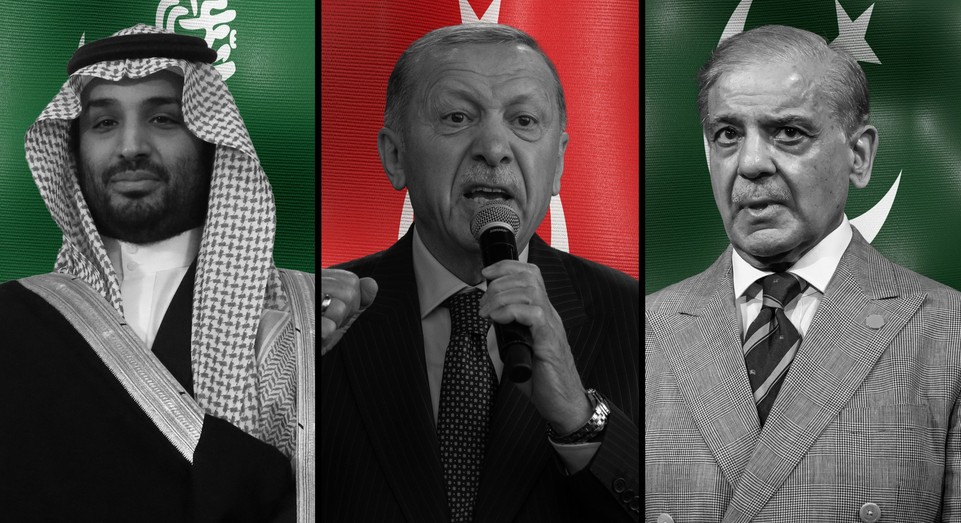



The Middle East has shown its ability to form alliances and partnerships with other security networks that rival them and with outside powers. The Saudi Arabia, Türkiye, and Pakistan defence deal signed in Mecca can be a turning point in the region’s defence relations. It is not just another political accord or diplomatic agreement among thousands of others in the region. But its true message is more fundamental: one that has been changing in the minds of the Gulf states and their allies, one that concerns their security, and their strategic autonomy and the reliability of traditional alliances.
For a long time, the U.S. has been at the forefront of the Gulf security system. Saudi Arabia and other nations of the Persian Gulf had a strong American appetite for arms, allowed American troops to stay in their country and had close ties with Washington. But recent geopolitical developments have led the capitals of the Gulf countries to consider the sustainability of depending on one external guarantor. This is not the strength of America’s workforce. However, it is the foreseeability and the time that should be taken into consideration. The Mecca Pact should thus be viewed as part of a broader Gulf strategy of strategic diversification. Regional powers are not about to abandon the United States, but are seeking various security alliances. This type of setup provides greater maneuvering space, diversity in military strength and maneuverability diplomatically. Saudi Arabia’s more comprehensive foreign policy is evident in its active relationship with other countries, such as Türkiye, Pakistan, China and Russia.
One of the strengths of the Mecca Pact is the contribution of the three parties involved. Saudi Arabia provides significant economic strength, geographic significance, political influence and one of the biggest defence markets in the world. Any security alliance with Riyadh carries great importance, as it is situated at the heart of the Arabian Peninsula. On the other hand, Türkiye has built up its own well-established defence industry. Turkish military technology such as drones, missiles, naval platforms, electronic warfare systems, armoured vehicles and others has garnered interest in the international community. The growing defence industrial capabilities of Ankara offer a technological aspect to this partnership. Türkiye also has a rich diplomatic history across the Middle East and engagement with a wide variety of actors in the region.

Another unique set of capabilities comes from Pakistan. It has one of the most powerful and well-trained military forces in the region, with a wealth of military experience and strategic capabilities. Especially, no other member country is nuclear other than Pakistan. It has a long history of defence cooperation with Saudi Arabia, and the two have long military interactions to build upon for enhanced security coordination. The pairing is thus potentially important. It is possible that Saudi financial and geopolitical influence, Turkish technologies and Pakistani military expertise can lead to a partnership that is greater than mere defence-related cooperation. But effectiveness in terms of a strategy relies not just on ability. In the past, treaties have failed when political interests are conflicting.
The Arab coalition to intervene in Yemen was indeed formed in 2015. Even with significant military power, the conflict ended up in a division within the coalition on political and military goals, strategy and what to expect from the political setup in Yemen after the conflict. The different interests of the states involved showed that the threats experienced did not motivate common strategic priorities. Similarly, the Islamic Military Counter Terrorism Coalition, established in 2015, included numerous countries controlled by Muslims. In arranging members around a common declaration, however, the combination of command structures, common strategy and operations was more difficult. Numbers could not replace political unity.




The lessons learned from these experiences are very important to the Mecca Pact. There have been defence pacts, declarations and coalitions in Middle Eastern countries for years. It has often lacked a strong common political foundation for building viable security institutions. The core issue then is whether the Mecca Pact can solve this historical issue. Its success will hinge on the extent of shared threat perception between Saudi Arabia and Türkiye and on the identification of common pathways for consultation and collective action between Saudi Arabia/Türkiye and Pakistan. Security is more than a military exercise and arms. It requires political confidence, institutional harmonisation, sharing of intelligence, interoperability, monetary investment and, most importantly, risk-taking in respect of each other.
The agreement could also impact security in the wider Gulf region. If it is successful in developing, other regional states may be interested in creating more cooperation in security matters in addition to the U.S.-led entities. But it is not a death-knell to U.S. influence. Instead, it could result in a more diversified security landscape where the Gulf countries have links with Washington and boost ties with other Gulf countries. It would be a part of the global political shift from unipolar dependency to a variety of partnerships. It is one of the aspects of Saudi foreign policy that the kingdom has been doing in recent times. Riyadh has thus been seeking to establish new economic and diplomatic partnerships with China, additional ones with Iran, a continued relationship with the U.S., and more with emerging powers like Türkiye. This more comprehensive concept of strategic diversification is in line with the Mecca Pact.
Saudi-Iranian relations will always play a major factor in any new security setup in the Gulf. The Mecca Pact can be offered as a tool for regional balance and deterrence, which may lead to a more balanced security environment. But if it is viewed as an explicitly anti-Iranian bloc, it can exacerbate polarisation in the region. There will also be a close connection between the U.S. and the relationship. Washington’s military power remains unmatched, as are its bases, intelligence networks and defence ties in the Gulf. For the time being, however, a new Saudi-Turkey-Pak security axis is not likely to force the Americans out of the equation. It could rather spur Washington to rethink its approach to its relationships with regional partners.
The point here in the Mecca Pact is how it will be effective in creating greater regional responsibility regarding regional security. The Middle East is caught up in a political dilemma. For now, the region will need to seek external security guarantees and start building a fairer security system by establishing regional security partnerships, strategic diversification, and shared responsibility. The second is the possibility brought about by the Mecca Pact. Whether it will alter the security situation in the long term should depend on the signatories’ determination to take action when the next crisis comes and whether they have signed any deals in Mecca.
The views expressed in this article are solely those of the author
The writer is a Professor, Department of International Relations, University of Chittagong, Bangladesh. Director, Hong Kong Research Centre for Asian Studies-Bangladesh Centre (RCASBC). Email: [email protected]