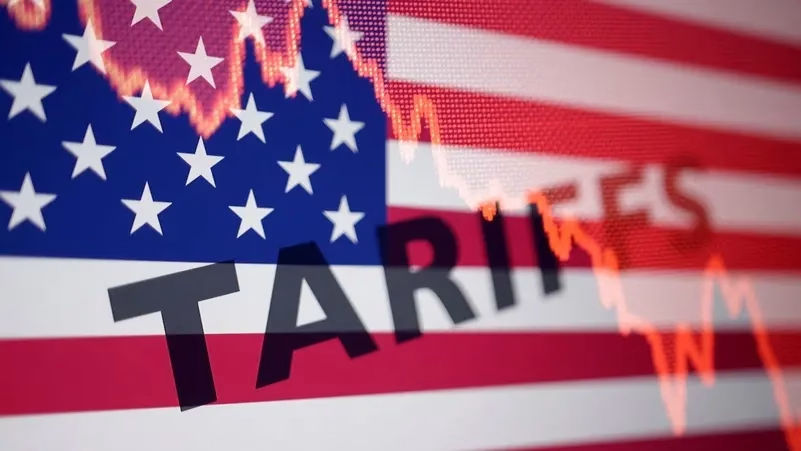



The United States from Tuesday began levying a new 10 percent tariff on all goods not covered by exemptions, US Customs and Border Protection said, applying the rate President Donald Trump first announced on Friday instead of the 15 percent he indicated a day later, reports Reuters.
The move followed a US Supreme Court decision that struck down earlier tariffs on the grounds that they had been illegally justified as an emergency measure.
In response to the ruling, Trump unveiled a temporary global tariff of 10 percent and said on Saturday that he would raise it to 15 percent.
However, in a notice described as intended to “provide guidance regarding the 20 February Presidential Proclamation”, Customs and Border Protection stated that, except for exempted products, imports would “be subject to an additional ad valorem rate of 10 percent”.
The notice did not explain why the lower rate was implemented, adding to uncertainty around US trade policy.

The Financial Times cited a White House official as saying the increase to 15 percent would come later, although Reuters could not immediately verify the claim.
“Remember that Trump is delivering the State of the Union address tonight, so it is possible we might get a better sense of the next steps on tariffs,” Deutsche Bank said in a note.
“Net-net we still think the effective tariff rate will fall this year and that the world post-SCOTUS will see lower tariffs than the pre-SCOTUS world,” its analysts said, referring to the Supreme Court of the United States.



Although a 10 percent tariff is less severe than previously expected, traders pointed to continued trade uncertainty as European shares opened lower on Tuesday, even as the pan-European STOXX 600 index later traded flat.
The new duties came into force at midnight, while the collection of tariffs invalidated by the Supreme Court was suspended. Those earlier levies had ranged from 10 percent to as high as 50 percent.
It is still unclear whether companies will receive refunds for payments made under the annulled tariff regime.
Under Section 122, the president may impose such duties for up to 150 days to address “large and serious” balance-of-payments deficits and “fundamental international payments problems”.
Trump’s order argued that such a deficit existed, citing a $1.2 trillion annual US goods trade deficit, a current account deficit equal to 4 percent of gross domestic product and a reversal of the US primary income surplus.
On Monday, Trump cautioned countries against retreating from previously negotiated trade agreements with the United States, saying he could impose substantially higher duties under other laws.
Japan said it had requested assurances from Washington that its treatment under the new tariff framework would be as favourable as under its existing agreement.
The European Union, Britain and Taiwan also signalled their preference to maintain current trade arrangements.
Carsten Brzeski, global head of macro at ING, said trade uncertainty was unlikely to ease soon, even with the 150-day cap on the measures.
“Because the next thing that he could do is always, with the interruption of one day, theoretically endlessly extend by 150 days,” he said.
China urged Washington to drop what it called “unilateral tariffs” and signalled readiness for another round of trade talks with the United States, the commerce ministry said in a statement on Tuesday.